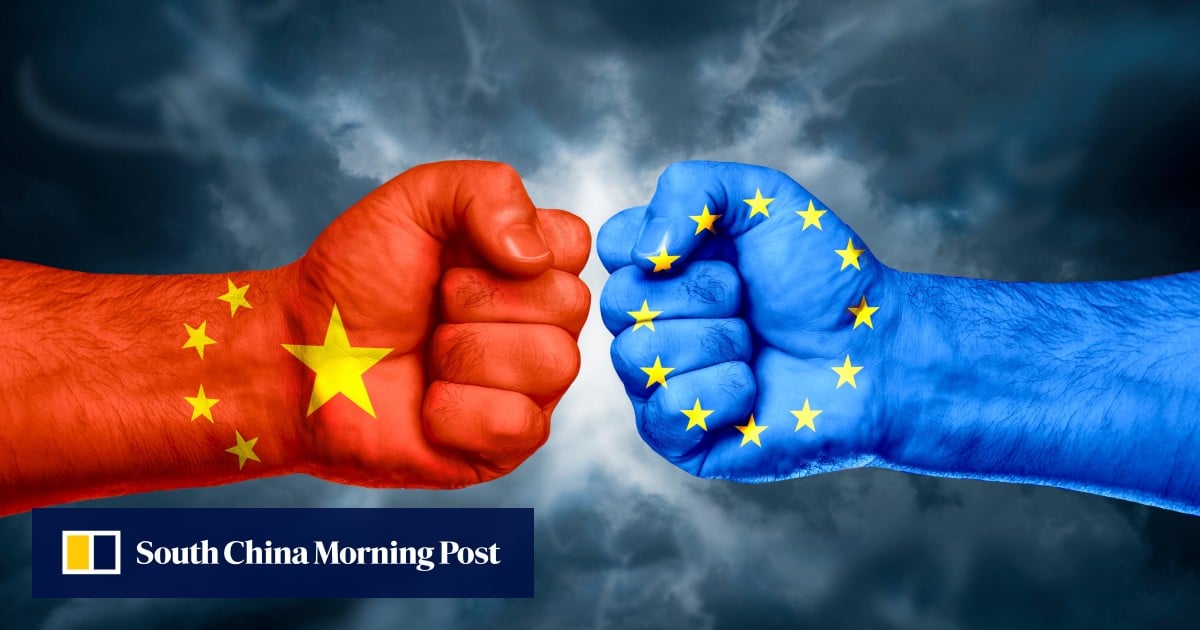
Can Europe win a trade war with China? It may depend on how victory is defined
As trade tensions with China reach boiling point, EU officials are ramping up engagement with Beijing in search of an off-ramp. Europe is preparing for a trade war, with a steely determination to ensure the bloc's manufacturing heartlands are not deindustrialised by the '…
Intelligence analysis by Llama
The EU is preparing for a trade war with China, with a focus on ensuring the bloc's manufacturing heartlands are not deindustrialised. EU officials are ramping up engagement with Beijing in search of an off-ramp, but some analysts say the sides are already in a trade war.
Imagine you're playing a game of chess with China. The EU is preparing for a trade war, which means they're getting ready to make some moves to protect their manufacturing sector. But China is a strong player, and the EU needs to be careful not to get caught in a trap. The EU is trying to find a way to win the game without losing too much, but it's not easy.
Analysis
A Steely Determination in Brussels
As trade tensions with China reach boiling point, EU officials are ramping up engagement with Beijing in search of an off-ramp. Quietly behind the scenes, though, Europe is preparing for a trade war. In Brussels, a steely determination has set in to ensure the bloc's manufacturing heartlands are not deindustrialised by the 'China Shock 2.0'.
With some industries already haemorrhaging jobs, the EU's resilience-building and de-risking plans are now laced with deterrents as Brussels looks to acquire leverage and credible retaliatory tools that would allow it to respond if China uses trade coercively. Some analysts say the sides are already in a trade war, others think the two sides are still preparing for the inevitable storm – and some say that a trade war should be avoided at all costs.
But a question that is increasingly being asked is: could Europe actually win? Few in Brussels share the hubris of US President Donald Trump, who in March 2018 said 'trade wars are good, and easy to win'. During a parliamentary hearing last week, the EU's top trade enforcer, Denis Redonnet, said the purpose of engaging with Beijing was 'to avoid sleepwalking at two levels'.
The China Shock 2.0
The 'China Shock 2.0' refers to the potential economic impact of a trade war on the EU's manufacturing sector. The EU's manufacturing heartlands are heavily reliant on trade with China, and a trade war could lead to a significant decline in exports and a loss of jobs. The EU's resilience-building and de-risking plans are designed to mitigate this impact and ensure that the bloc's manufacturing sector remains competitive.
The EU's Leverage
The EU's leverage in a trade war with China is limited, but Brussels is working to acquire more credible retaliatory tools. The EU's top trade enforcer, Denis Redonnet, has said that the purpose of engaging with Beijing is 'to avoid sleepwalking at two levels'. This suggests that the EU is taking a cautious approach to the trade war, but is also preparing for the possibility of a more confrontational approach.
The Road Ahead
The road ahead for the EU in a trade war with China is uncertain. The EU's resilience-building and de-risking plans are designed to mitigate the impact of a trade war, but the outcome is still far from certain. The EU will need to balance its desire to protect its manufacturing sector with the need to avoid a full-blown trade war. The stakes are high, and the outcome will have far-reaching consequences for businesses and workers in both regions.
Key points
- The EU is preparing for a trade war with China, with a focus on ensuring the bloc's manufacturing heartlands are not deindustrialised.
- EU officials are ramping up engagement with Beijing in search of an off-ramp, but some analysts say the sides are already in a trade war.
- The EU's resilience-building and de-risking plans are designed to mitigate the impact of a trade war, but the outcome is still far from certain.
If the EU can find a way to balance its desire to protect its manufacturing sector with the need to avoid a full-blown trade war, it may be possible to find a mutually beneficial solution. This could involve the EU and China working together to find common ground and avoid a trade war.
If the EU and China are unable to find a way to resolve their differences, a full-blown trade war could have devastating consequences for the global economy. This could lead to a significant decline in trade and a loss of jobs, particularly in the manufacturing sector.