Canada to Retaliate for US Tariffs, Worsening Ties after Talks Fail
Canada will impose tariffs on some US goods in retaliation for 50% levies ordered by President Donald Trump on Canadian products, Prime Minister Mark Carney said on Saturday, after trade talks collapsed between the two neighbors.
Intelligence analysis by Llama
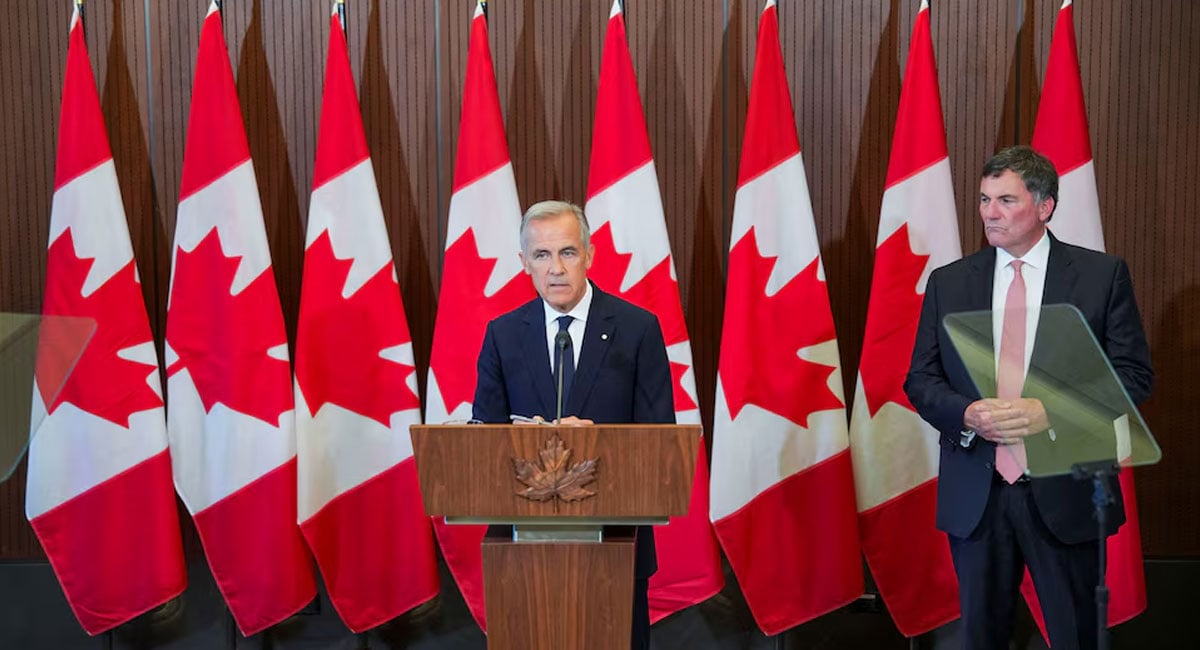
Canada will match Washington's new tariffs dollar for dollar in order to protect Canadian workers, farmers, families, and businesses, Prime Minister Mark Carney said on Saturday, after trade talks collapsed between the two neighbors.
Imagine you're playing a game with your friend, and your friend starts to cheat. You would want to make sure you're not getting cheated again, right? That's what Canada is doing by imposing tariffs on some US goods. They're trying to protect their own workers, farmers, families, and businesses from being unfairly treated.
Analysis
Canada's Retaliation Strategy
Canada's decision to retaliate against the US tariffs is a significant development in the ongoing trade tensions between the two countries. Prime Minister Mark Carney has stated that Canada will match Washington's new tariffs dollar for dollar in order to protect Canadian workers, farmers, families, and businesses. This move is seen as a response to the US's 50% levies on Canadian products, which are expected to have a significant impact on the Canadian economy.
Impact on the Canadian Economy
The new US tariffs are expected to have a significant impact on the Canadian economy, particularly on industries such as softwood lumber and wine. Trade experts have warned that these tariffs could lead to job losses and business closures, and that Canada will need to mobilize its network of businesses to brace for impact. The Canadian government has announced that it will provide support measures for industries hit by the new US duties, which could last for years.
Sticking Points in Trade Talks
One of the main sticking points in the trade talks was the treatment of larger vehicles. Canada wanted favorable tariff terms proposed for light-duty vehicles to extend to medium- and heavy-duty trucks, but the US resisted. This move would have excluded Canadian-made models, including Ford's F-350, F-450, and F-550 trucks and General Motors' Silverado, making Canadian production less competitive. There were also US proposals that affected Canadian culture, language, and sovereignty, which Carney did not elaborate on.
Key points
- Canada will impose tariffs on some US goods in retaliation for 50% levies ordered by President Donald Trump on Canadian products.
- The breakdown complicates the future of a US-Mexico-Canada free-trade pact.
- Canada will match Washington's new tariffs dollar for dollar in order to protect Canadian workers, farmers, families, and businesses.
- The new US tariffs are expected to have a significant impact on the Canadian economy, particularly on industries such as softwood lumber and wine.
If this development plays out positively, it could lead to a more balanced trade relationship between Canada and the US. Canada may be able to negotiate better terms and protect its industries from unfair competition.
The realistic downside risks or failure modes of this development include job losses and business closures in industries such as softwood lumber and wine. The Canadian economy may also be negatively impacted by the new US tariffs, leading to a decline in economic growth.