Ceuta migration crisis: did social media lure migrants to their deaths?
At least 72 migrants drowned trying to reach Spain's Ceuta enclave from Morocco in a surge of tens of thousands. The episode has reopened bitter EU divisions over migration policy and raised questions about viral social media posts that promised 'Spain's route is open.'
Intelligence analysis by Llama
BBC Persian examines the unprecedented Ceuta migration surge that killed at least 72 people, and whether coordinated social media messaging — not traditional smugglers — drove the wave. The political fallout has pitted Spanish PM Pedro Sánchez against Italy's Giorgia Meloni and drawn commentary from Trump and Moscow, exposing fresh rifts inside the EU over border policy.
Imagine a giant pool where the shallow end is in Morocco and the deep end is in Spain. One day, videos on phones told thousands of people, 'Just swim across, it's easy!' Lots of them tried, and sadly 72 didn't make it. The governments of Europe are now arguing about whose fault it was, while some politicians are using the scary pictures to win votes.
Analysis
A Border Designed for Wading, Not Swarms
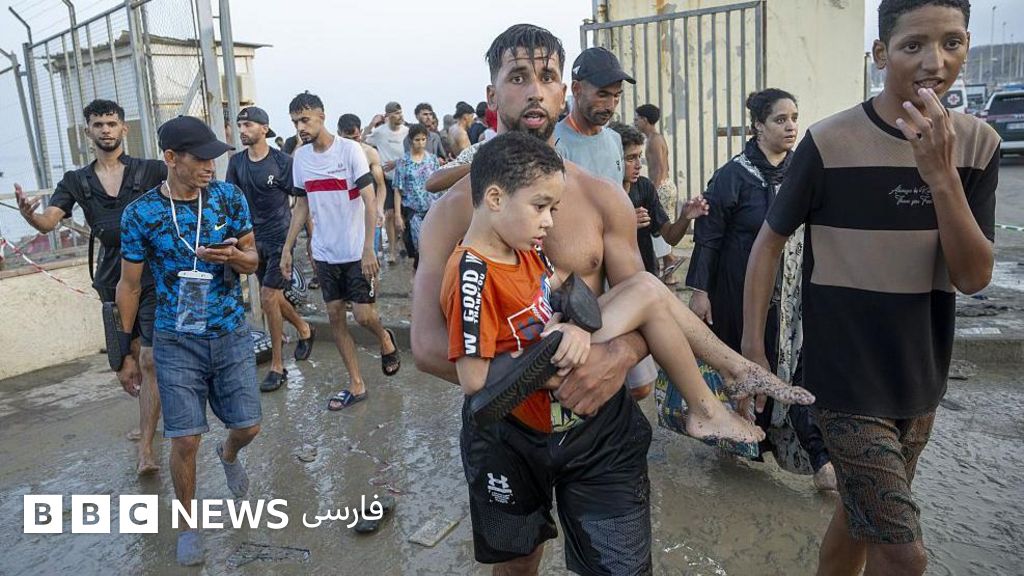
On a single Thursday, tens of thousands of people — most of them Moroccan — waded or swam into the Spanish enclave of Ceuta on the North African coast, an unprecedented volume that overwhelmed Spanish and Moroccan security forces. At least 72 bodies were recovered from the water, many tangled in inflatable rings and discarded swim fins. Spanish police and military eventually escorted the bulk of the arrivals back across the frontier to Morocco. The sheer scale forced Spain to extend its border fence further into the sea and deploy a line of orange patrol vessels, measures that speak to how badly existing infrastructure was outmatched. Ceuta is not part of the Schengen free-movement zone, so even those who made it across the border had no legal path to continental Europe — a fact that, according to the article, did little to deter those who came.
The Social Media Catalyst
The article's central investigative question is what actually mobilized the crowd. Migrants showed BBC journalists viral posts depicting young men in wetsuits and fins leaping into the surf with captions like 'the road to Spain is open.' Several of the accounts pushing this content were only weeks old, yet some racked up tens of thousands of likes. Crucially, most of the arrivals were Moroccan nationals who already knew the short route to Ceuta, and unlike the Mediterranean crossings from sub-Saharan Africa, they did not need to pay smuggling networks — the internet did the coordination. Spanish PM Pedro Sánchez has argued that smugglers twisted a recent Spanish Supreme Court ruling (which bars automatic return of sea arrivals) to advertise an 'easy' entry point. The piece notes that the ruling's actual protections were narrow and that the online promises were, in the words of the article, 'all lies' — those who reached Ceuta found no food, no shelter, and no onward route to Europe.
A Europe Wide Open to Exploitation
The political aftershock has been as dramatic as the human toll. Italy's far-right prime minister Giorgia Meloni quickly posted images of the chaos with a sarcastic caption targeting Sánchez, and announced she was suspending the Schengen agreement with Spain on security grounds. Sánchez, a Socialist, fired back, accusing unnamed EU governments of attacking Spain for domestic political gain. Meloni faces elections next year and is losing ground to a harder-line anti-immigration party, making the crisis a useful rallying point. About 24 EU leaders signed Meloni's call for an emergency interior ministers' meeting and the removal of any policies seen as 'pull factors' — code for Spain's regularization program for hundreds of thousands of undocumented migrants, framed by Madrid as a labor-shortage fix. President Trump labeled the event a 'catastrophe' and an 'invasion'; the article notes his hostility is sharpened by Spain's refusal to back his 'war against Iran.' Russia, per the piece, also welcomed the spectacle of European disunity. For now, Spain is hardening its border rather than reopening the policy debate, leaving the deeper question — whether weaponized viral content can now substitute for smuggling networks — unresolved.
Key points
- At least 72 migrants drowned as tens of thousands tried to swim or wade into Spain's Ceuta enclave from Morocco in a single day.
- BBC reporting indicates viral social media posts — not smuggling networks — coordinated the surge, with most arrivals being Moroccan nationals who already knew the short route.
- Italian PM Giorgia Meloni suspended the Schengen agreement with Spain over the crisis, accusing Madrid of being too soft on migration ahead of Italian elections.
- Spanish PM Pedro Sánchez pushed back, accusing unnamed EU governments of attacking Spain for domestic political gain and pointing to a recent Supreme Court ruling that smugglers distorted online.
- President Trump called the episode a 'catastrophe' and 'invasion,' with the article noting his hostility is compounded by Spain's refusal to back his 'war against Iran.'
- Russia was reported to welcome European disunity, and Spain is extending its Ceuta border fence into the sea to prevent a recurrence.
If European interior ministers use the Ceuta crisis as a catalyst for a credible joint response — combining faster processing, anti-smuggling coordination, and targeted legal pathways — the episode could push the EU toward a more coherent migration framework rather than a race to the bottom on border theatrics. Spain's regularization track, which the article links to genuine labor demand from an aging population, could also be refined rather than abandoned if framed as a managed channel rather than a pull factor.
The more likely trajectory, as the article suggests, is that the images of chaos become fuel for far-right parties across Europe heading into a series of elections. Italy's suspension of Schengen with Spain — even if legally questionable given Ceuta's special status — signals that unilateral border nationalism is back in vogue. If viral content can mobilize tens of thousands of people without any smuggling infrastructure, future surges could be triggered on a politician's whim, with drownings as the price.