China makes mandatory L3/L4 autonomous-driving standard public
China has released its first mandatory national safety standard, GB 44721-2026, for L3 and L4 autonomous-driving systems, covering passenger and freight vehicles. It takes effect on July 1, 2027, replacing a previous recommended standard.
Intelligence analysis by Gemini 2.5 Flash
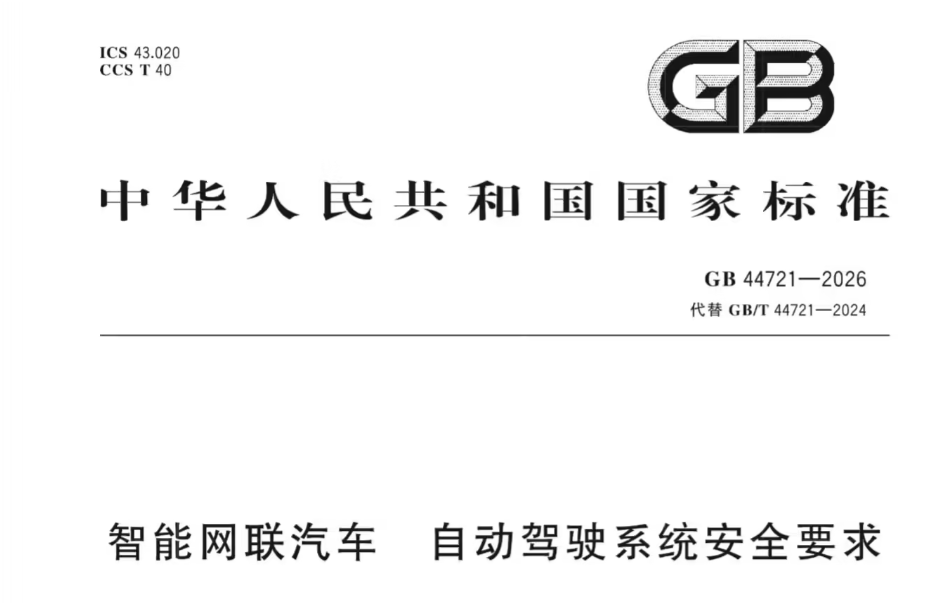
The new GB 44721-2026 standard in China mandates safety requirements for L3 and L4 autonomous driving, encompassing dynamic tasks, human-machine interaction, and remote assistance. This move provides a unified regulatory framework for automakers and suppliers, aiming to enhance safety and accelerate the deployment of advanced self-driving technology.
Imagine a smart car that can drive itself most of the time, like a super-smart robot chauffeur. China has made new rules, like a special instruction book, to make sure these super-smart cars are very safe before they start driving on roads with people and goods. These rules will start working in a few years, so car makers have time to make their robot cars follow all the safety steps.
Analysis
The recent public release of China's GB 44721-2026 standard marks a pivotal moment for the nation's autonomous driving sector. This is China's first mandatory national safety standard specifically designed for Level 3 (L3) and Level 4 (L4) automated-driving systems, signifying a clear regulatory push towards safer and more standardized deployment of advanced vehicle autonomy. The standard comprehensively addresses critical operational aspects, including the execution of dynamic driving tasks, the design of human-machine interaction interfaces, the provision of clear user notices, robust safety assurance protocols, and the implementation of remote assistance capabilities. This holistic approach aims to ensure that vehicles operating at these higher levels of automation meet stringent safety benchmarks before widespread adoption.
GB 44721-2026
The introduction of the GB 44721-2026 standard represents a significant upgrade from previous regulatory frameworks. It replaces a recommended standard issued in 2024, transitioning from voluntary guidelines to compulsory requirements for manufacturers and suppliers. This shift underscores China's commitment to establishing a robust regulatory environment that fosters innovation while prioritizing public safety in the rapidly evolving autonomous vehicle landscape. By making these requirements mandatory, the government aims to eliminate ambiguity and ensure a consistent level of safety and performance across all L3 and L4 systems deployed within the country.
The standard's detailed scope, encompassing elements like dynamic driving tasks and human-machine interaction, reflects a deep understanding of the complexities involved in autonomous operations. It mandates specific criteria for how vehicles should perform driving functions autonomously, how human drivers should be engaged or disengaged, and how users are informed about the system's status and limitations. Furthermore, the inclusion of safety assurance and remote assistance provisions highlights a proactive stance on managing potential risks and providing fallback mechanisms, which are crucial for building public trust and ensuring operational reliability in autonomous vehicles.
July 1, 2027
The effective date of July 1, 2027, provides automakers and their suppliers with a defined timeline to adapt their current and future autonomous driving technologies to meet the new mandatory requirements. This lead time is crucial for the industry to conduct necessary research and development, re-engineer systems, and undergo rigorous testing to ensure full compliance. The transition period allows for a structured implementation, minimizing disruption while ensuring that all stakeholders are adequately prepared for the new regulatory landscape.
This specific date also signals the government's long-term vision for the autonomous vehicle industry, indicating a phased but firm approach to integrating advanced driving systems into the national transportation infrastructure. Companies operating in or planning to enter the Chinese market must now align their product development cycles and certification processes with this deadline. The clarity of the effective date helps in strategic planning and resource allocation for companies aiming to deploy L3 and L4 vehicles in China.
L3 and L4 systems
The focus on L3 and L4 autonomous driving systems is particularly noteworthy, as these levels represent a significant leap in vehicle autonomy where the vehicle can perform most driving tasks under specific conditions, but human intervention may still be required (L3) or the vehicle can handle all driving tasks within its operational design domain (L4). The standard's application to both passenger and freight vehicles indicates a broad regulatory scope, acknowledging the diverse applications and potential impacts of autonomous technology across different segments of the automotive industry.
For passenger vehicles, these standards will directly influence the safety and user experience of future consumer cars equipped with advanced self-driving features. For freight vehicles, the implications are equally profound, potentially transforming logistics and supply chains by enabling autonomous long-haul trucking and last-mile delivery. By setting clear, mandatory safety benchmarks for these advanced systems, China is positioning itself as a leader in regulating the safe deployment of highly automated vehicles, aiming to accelerate their adoption while mitigating inherent risks.
Key points
- China has published its first mandatory national safety standard for L3 and L4 autonomous driving systems.
- The GB 44721-2026 standard covers dynamic driving tasks, human-machine interaction, user notices, safety assurance, and remote assistance.
- It applies to both passenger and freight vehicles equipped with L3 or L4 systems.
- The standard is scheduled to take effect on July 1, 2027, replacing a previous recommended standard from 2024.
- This provides a common set of requirements for automakers and suppliers in China.
The mandatory standard provides a clear regulatory framework, fostering innovation and accelerating the safe deployment of L3 and L4 autonomous vehicles across China. This clarity could boost consumer confidence and lead to more efficient and safer transportation systems.
While beneficial, the strict mandatory standard could pose significant compliance challenges for some automakers and suppliers, potentially slowing down the pace of innovation or increasing development costs. Non-compliance could lead to market exclusion for some players.