China’s navy has missiles and drones. Why is it bringing back the ‘big guns’?
China is testing a new 155mm naval gun, which could become the world’s largest of its kind and add fire support for future operations.
Intelligence analysis by GPT-5.4 Mini
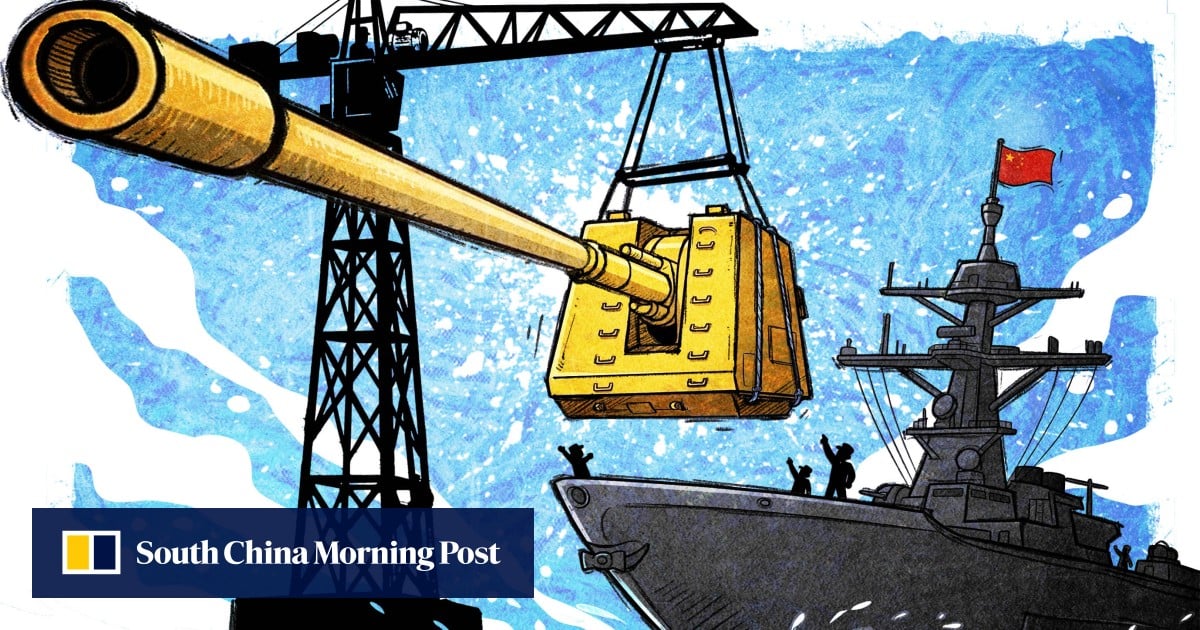
China’s navy is experimenting with a huge 155mm naval gun even as modern warfare leans on missiles and drones. Sea trials on an experimental warship suggest the system is getting closer to deployment, and it may be aimed at giving the PLA Navy extra firepower for a future Taiwan operation.
China is putting a giant cannon back on a ship, even though ships also have missiles and drones now. It is like adding a huge water hose to a robot: the newer tools are smart, but the old giant tool can still blast a lot of force.
Analysis
What is being tested
China is reportedly developing a new naval gun that fires 155mm shells, a caliber more commonly associated with heavy artillery than modern ship weapons. According to the article, that would make it the largest naval gun of its kind in the world today.
Why it stands out
The timing is notable because naval combat is now usually described in terms of missiles, air power, drones, and precision strikes. Even so, the article says China’s navy appears to be reviving the idea of large-caliber gunfire, likely because a gun can still be useful for sustained fire support at sea or near shore.
Evidence of progress
The piece says the gun was recently seen undergoing sea-based performance testing from an experimental warship named the Wu Yunduo. It was photographed earlier with the large gun mounted on its bow at a shipyard in Dalian, in northeastern China. The vessel later sailed into nearby waters for about two weeks before returning, suggesting the system is moving through live testing.
What the tests mean
Sea trials for a main gun typically check how stable the ship is, how accurate the fire-control system is, and whether the weapon can keep firing reliably under different conditions. The article does not say the gun is already in service, only that the testing suggests it may be getting closer to deployment by the PLA Navy.
Strategic angle
The article says the weapon could provide firepower support for a future attack on Taiwan. That gives the development a clear military and political context, even though the final operational role is not yet confirmed.
Key points
- China is testing a new 155mm naval gun on an experimental warship.
- The article says it could be the largest naval gun of its kind in the world.
- The Wu Yunduo was seen sailing for sea trials near Dalian.
- Sea tests usually check stability, fire-control accuracy, and firing reliability.
- The gun may be intended to support future operations involving Taiwan.
If the testing succeeds, the PLA Navy could gain another way to support operations from the sea, especially with heavy fire near shore. A reliable large gun could add flexibility alongside missiles and drones.
The weapon may prove hard to operate reliably at sea, especially if the tests expose stability or firing problems. If it is meant for Taiwan-related scenarios, its development could also reinforce fears that China is preparing more forceful military options.