Chinese custom sees women throw embroidered balls from balconies to choose husbands
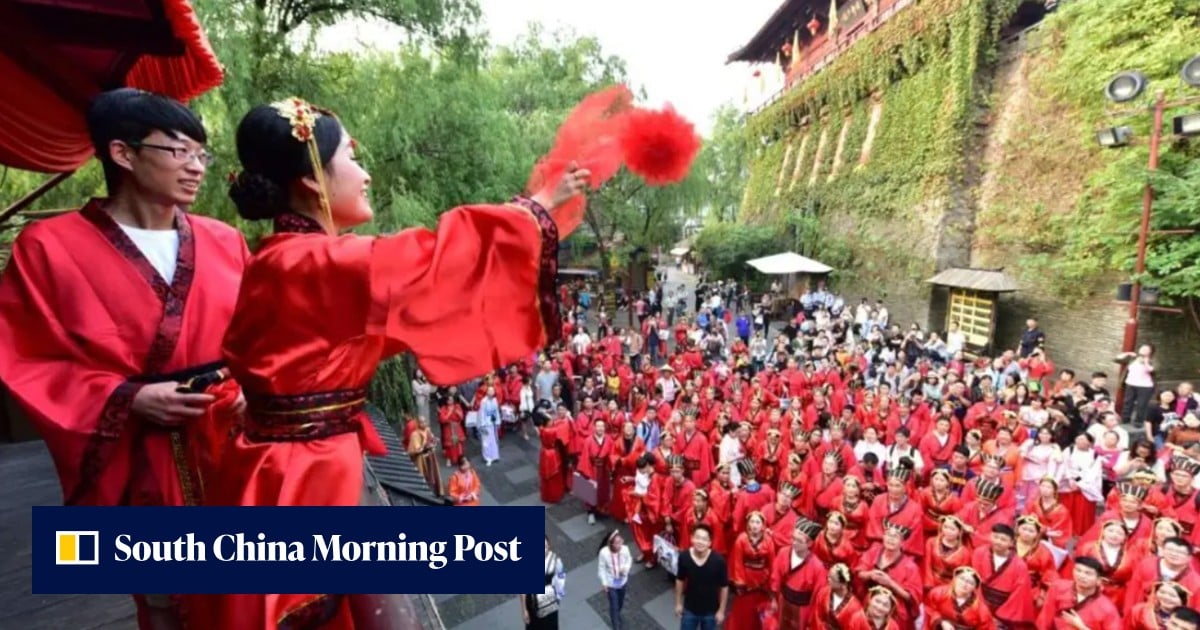
A popular Chinese custom, often depicted in literature and dramas, involves women throwing embroidered balls from balconies to choose husbands. However, studies reveal this is a literary adaptation of a structured 2,000-year-old courtship ritual of the Zhuang ethnic group…
Intelligence analysis by Gemini 2.5 Flash
The article explores the widely believed Chinese tradition of women selecting husbands by throwing an embroidered ball to a crowd. It debunks the common misconception that this was a random act, clarifying that it's a literary embellishment of a much older, structured courtship practice specific to the Zhuang ethnic group in China's Guangxi region.
Imagine a long, long time ago in China, some stories say girls would throw a special embroidered ball from a balcony, and whoever caught it became their husband! But it turns out that was mostly just in books, like a fairy tale. In real life, a group called the Zhuang people had a similar game, but it was more like a fun, organized way for young people to meet and choose partners, not just a random catch.
Analysis
Zhuang
The Zhuang ethnic group, primarily residing in China's Guangxi region, is central to understanding the true origins of the embroidered ball custom. Far from a random game of chance, the practice among the Zhuang people is a "beautifully structured courtship ritual" with a history spanning 2,000 years. This tradition highlights a nuanced approach to partner selection, emphasizing community involvement and established protocols rather than pure serendipity.
This structured nature contrasts sharply with the popular fictional portrayals, which often simplify the custom into a whimsical, fate-driven event. For the Zhuang, the embroidered ball serves as a cultural artifact within a broader framework of social interaction and courtship, reflecting their unique cultural values and social organization. It underscores the importance of understanding specific ethnic practices within China's diverse cultural landscape.
Guangxi
The geographical context of Guangxi Zhuang autonomous region is crucial for situating this ancient tradition. It is within this southern Chinese region that the practice of throwing embroidered balls remains a popular and living custom among young Zhuang people. This regional specificity demonstrates that what is often generalized as a "Chinese custom" is, in fact, deeply rooted in the particular heritage of a distinct ethnic minority.
The continued practice in Guangxi serves as a testament to the resilience of local traditions in the face of broader cultural narratives. It also illustrates the rich tapestry of customs that exist across China, where different ethnic groups maintain their unique social rituals. Understanding the custom's origins in Guangxi helps to correct widespread misconceptions and appreciate the diversity of Chinese cultural practices.
Journey to the West
Classic Chinese literature, such as the 16th-century novel Journey to the West, played a significant role in popularizing and, in some ways, misrepresenting the embroidered ball custom. The novel famously depicts the father of the Buddhist monk Xuanzang being chosen by his mother through the throwing of an embroidered ball, presenting it as a random act of destiny. This literary device captured the public imagination, embedding the idea of a purely chance-based marriage selection into popular culture.
Such literary adaptations, including the 1998 drama My Fair Princess, have profoundly shaped public perception, leading many to believe that the custom was a widespread and entirely random ancient tradition across China. This highlights the powerful influence of storytelling in shaping historical understanding, often prioritizing dramatic narrative over anthropological accuracy. The article's clarification serves to distinguish between cultural myth and historical fact, offering a more precise view of this intriguing tradition.
Key points
- The custom of women throwing embroidered balls to choose husbands is widely depicted in Chinese literature and dramas.
- Popular belief suggests this was a random marriage tradition in feudal China.
- Studies reveal it is a literary adaptation of a 2,000-year-old structured courtship ritual of the Zhuang ethnic group.
- The tradition is a popular practice among young Zhuang people in southern China's Guangxi Zhuang autonomous region.
- Examples of its depiction include the 16th-century novel Journey to the West and the 1998 drama My Fair Princess.
The clarification of this custom highlights the richness and specificity of China's diverse ethnic traditions, moving beyond generalized historical narratives. This deeper understanding can foster greater appreciation for the cultural heritage of groups like the Zhuang people and encourage more accurate portrayals in media.
The persistent popular misconception, fueled by classic literature, demonstrates how fictional narratives can overshadow historical accuracy, potentially diluting the true cultural significance of traditions for future generations. This could lead to a superficial understanding of complex ethnic customs.