Chinese translation of Nizami’s “Khamsa” unveiled at 32nd Beijing International Book Fair
The Chinese translation of Nizami Ganjavi's 'Khamsa' was unveiled at the 32nd Beijing International Book Fair. The collection is a masterpiece of Persian literature and marks a significant cultural exchange between Iran and China.
Intelligence analysis by Llama 3.3 70B
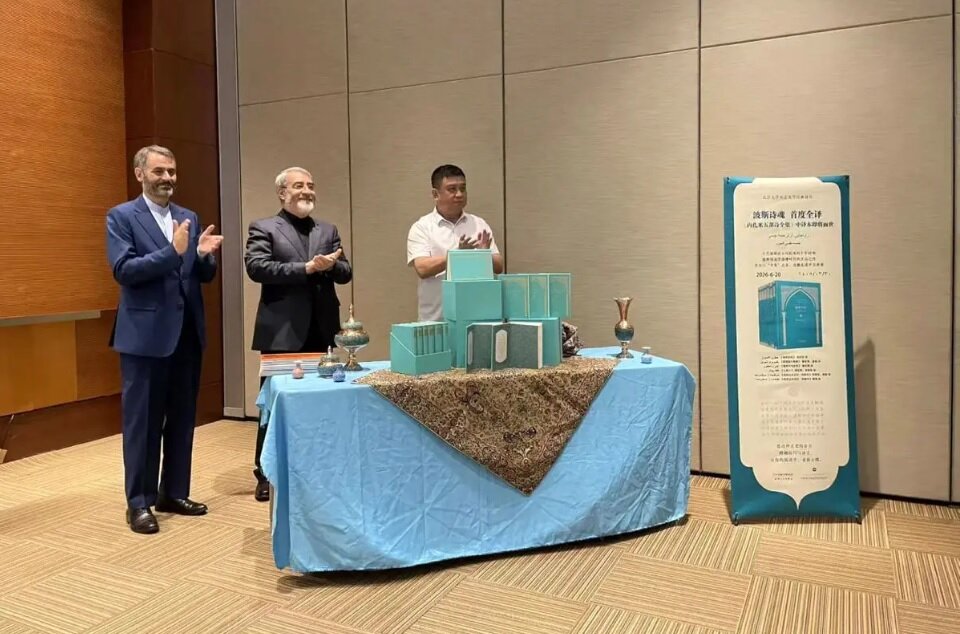
The unveiling of the Chinese translation of 'Khamsa' highlights the deep cultural connections between Iran and China, with references to Chinese culture and history throughout the collection.
A famous book of poems from Iran called 'Khamsa' has been translated into Chinese. This is a big deal because it will help people in China learn more about Iranian culture and literature.
Analysis
Cultural Significance of Khamsa
The 'Khamsa' is a collection of five long narrative poems that is considered the greatest work of Nizami Ganjavi, a renowned Persian poet. The collection is a masterpiece of Persian literature and has been widely appreciated in Iran, Afghanistan, the Republic of Azerbaijan, the Kurdistan region, and Tajikistan. The Chinese translation of 'Khamsa' is a significant development in the cultural exchange between Iran and China, and is expected to introduce the work to a new audience.
The 'Khamsa' is a collection of stories that explore themes of love, beauty, and spirituality. The collection includes stories such as 'Layla and Majnun' and 'Haft Peykar', which are considered some of the greatest works of Persian literature. The collection is known for its beautiful language and its exploration of the human condition.
Historical Context of the Translation
The translation of 'Khamsa' into Chinese is a significant development in the cultural exchange between Iran and China. The two countries have a long history of cultural exchange, with many Iranian scholars and poets having been influenced by Chinese culture and literature. The translation of 'Khamsa' is expected to deepen scholarly and literary relations between the two countries, and to introduce Iranian literature to a new audience.
The translation of 'Khamsa' was unveiled at the 32nd Beijing International Book Fair, which is one of the largest book fairs in Asia. The fair is an important platform for publishers and authors to showcase their work, and the unveiling of the 'Khamsa' translation is a significant development in the cultural exchange between Iran and China.
Future Implications of the Translation
The translation of 'Khamsa' into Chinese is expected to have a significant impact on the cultural exchange between Iran and China. The translation is expected to introduce Iranian literature to a new audience, and to deepen scholarly and literary relations between the two countries. The translation is also expected to promote cultural understanding and exchange between Iran and China, and to contribute to the development of a more nuanced understanding of Iranian culture and literature.
The translation of 'Khamsa' is also expected to have a significant impact on the study of Persian literature in China. The translation is expected to provide Chinese scholars with a new perspective on Persian literature, and to contribute to the development of a more nuanced understanding of Iranian culture and literature. The translation is also expected to promote the study of Persian language and literature in China, and to contribute to the development of a more diverse and inclusive literary landscape.
Key points
- The Chinese translation of 'Khamsa' was unveiled at the 32nd Beijing International Book Fair
- The 'Khamsa' is a collection of five long narrative poems that is considered the greatest work of Nizami Ganjavi
- The translation is expected to introduce Iranian literature to a new audience and to deepen scholarly and literary relations between Iran and China
The translation of 'Khamsa' into Chinese is expected to promote cultural understanding and exchange between Iran and China, and to contribute to the development of a more nuanced understanding of Iranian culture and literature. It is also expected to introduce Iranian literature to a new audience and to deepen scholarly and literary relations between the two countries.
The translation of 'Khamsa' into Chinese may face challenges in terms of promoting cultural understanding and exchange between Iran and China. There may be difficulties in translating the complex language and cultural references of the 'Khamsa' into Chinese, and the translation may not be widely read or appreciated in China.