Climate Change Is Destabilizing the Ground Beneath Our Feet
Warming-driven glacier retreat, permafrost thaw, and extreme rainfall are destabilizing mountains and land across the planet, with US sites from Alaska to North Carolina already affected.
Intelligence analysis by Llama
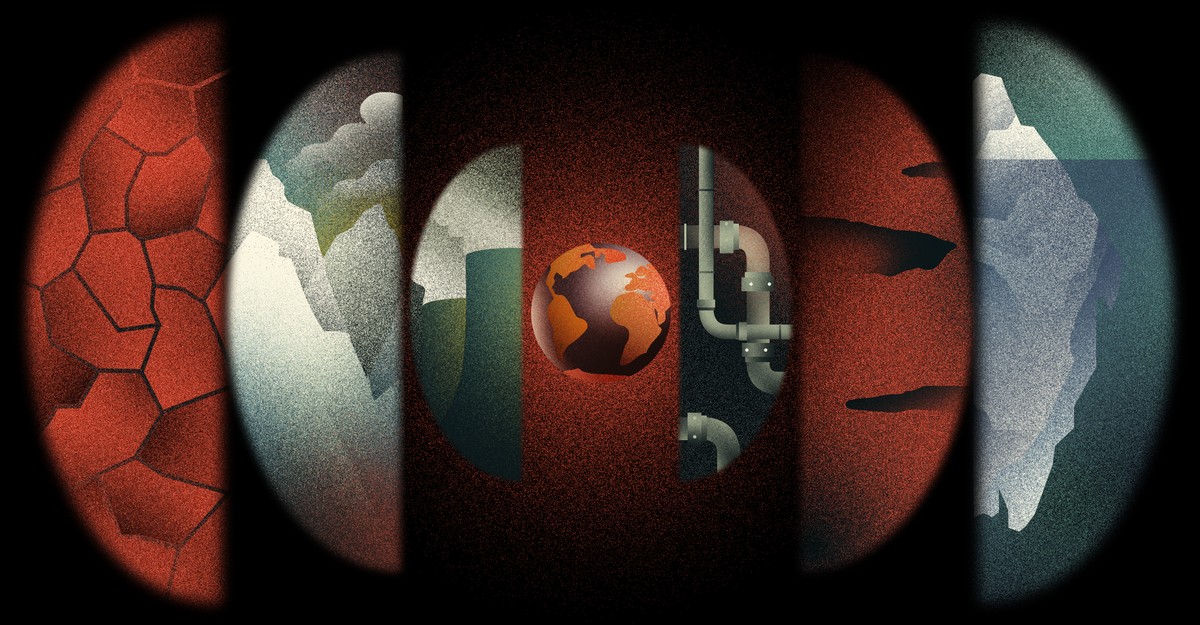
Climate change is no longer just an atmospheric story. As glaciers melt, permafrost thaws, and storms intensify, the solid ground itself is giving way — in Alaska, Greenland, Switzerland, California, and beyond. The pattern is global, accelerating, and the worst may be yet to come.
The ground we stand on used to be very steady, but the ice and frozen dirt that held mountains together is melting because the planet is getting warmer. When that happens, hills and cliffs can suddenly fall, sometimes causing giant waves or burying villages — like a snow cone that collapses when it gets too soft.
Analysis
Mountains Without Their Ice
The most dramatic evidence of climate-driven ground instability is unfolding in high-altitude and high-latitude ranges. In Greenland, a collapsing cliff sent a 660-foot wave rippling through Earth's monitoring stations for nine days in 2023. In Alaska, a fjord landslide-tsunami struck waters used by cruise ships the following year. In Switzerland, part of a glacier detached and buried the village of Blatten in 2025. According to geologist Kristian Svennevig of the Geological Survey of Denmark and Greenland, the landslide magnitudes now possible in the Arctic could exceed anything in the geologic record. The reason is structural: today's glaciers have persisted long enough to carve steep, unstable cliffs, meaning the upper bound of what could collapse has not yet been reached. The pattern is no longer a string of isolated incidents but a documented link between ice loss and slope failure.
The Permafrost Meltdown
Glaciers are only one half of the equation. Permafrost acts as geological glue holding together high-latitude mountains, and it is thawing across the entire Arctic. In Alaska's Brooks Range — home of the Trans-Alaska Pipeline — long-frozen peaks have begun spontaneously deforming and collapsing. Independent geologist Bretwood Higman told the article that humanity is pushing these mountains into a state of disequilibrium, their slopes too steep for the warmer climate now imposed on them. The infrastructure response is already expensive and unusual: Denali National Park is close to finishing a $100 million bridge spanning a moving permafrost landslide, and engineers in the Brooks Range are pumping refrigerant underground to refreeze ground beneath pipelines. Arctic-climate scientist Sue Natali of the Woodwell Climate Research Center framed the thaw as a pan-Arctic phenomenon, not a local one, and one whose pace is accelerating rather than slowing.
Storms, Slides, and the Next Geological Frontier
The instability does not stop at ice. A warmer atmosphere holds more moisture, generating the harder, more intense, longer-duration rainfall events that landslide scientist Jonathan Godt of the US Geological Survey links directly to debris flows. Hurricane Helene triggered more than 2,000 landslides in a week in North Carolina, while California's drought-and-fire-then-rain cycle produced the deadly 2018 Montecito mudslide. With global landslide damages already at $20 billion annually, the trajectory is steepening. Less understood, but emerging on the research horizon, is the possibility that shifting precipitation and ice loads could reactivate volcanic and tectonic systems — a hypothesis University College London volcanologist Bill McGuire advanced more than a decade ago in Waking the Giant. The crust, weighted down by ice for millennia, is now unloading, and the response from below the surface may only be beginning.
Key points
- Glacier retreat is triggering unprecedented landslides in Greenland, Alaska, Switzerland, and the European Alps, with magnitudes potentially exceeding anything in the geologic record.
- Thawing permafrost is destabilizing mountains in Alaska's Brooks Range, prompting a $100 million bridge in Denali and underground refrigerant systems to protect the Trans-Alaska Pipeline.
- Extreme rainfall linked to climate change is driving landslides in the lower latitudes, including more than 2,000 in North Carolina after Hurricane Helene and the 2018 Montecito mudslide that killed 23 people.
- Global landslide damages already total $20 billion annually and are projected to rise as warming continues.
- Scientists are beginning to investigate whether shifting ice and water loads could also increase volcanic and seismic activity, a hypothesis first laid out by Bill McGuire in Waking the Giant.
Scientists are increasingly able to model and predict where landslides will strike, giving communities time to evacuate or reinforce infrastructure. Projects like the Denali bridge and the Brooks Range refrigerant systems show that engineering responses, while expensive, are technically feasible and can protect critical assets such as the Trans-Alaska Pipeline.
Researchers warn that the largest possible landslides have not yet occurred, and that Arctic events could exceed anything in the geologic record. With permafrost thaw accelerating across the entire pan-Arctic and landslide damages already at $20 billion globally, the cumulative cost to infrastructure, communities, and potentially volcanic and tectonic systems is likely to grow sharply.