‘Defanging’ Aung San: Myanmar’s generals wage war on memory
Myanmar's military-backed authorities are removing statues of Aung San, the country's founding father, citing 'incorrect proportions and shapes'. Analysts see a deliberate attempt to erase Aung San's presence and strip democratic legitimacy from his daughter, Aung San Suu…
Intelligence analysis by Llama
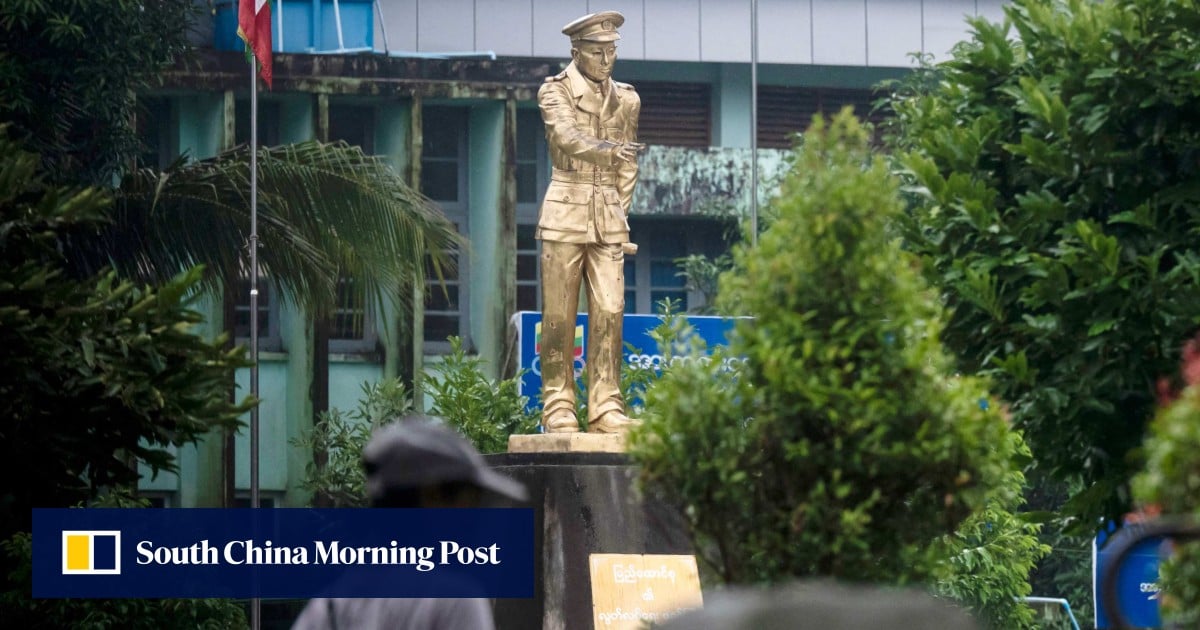
Myanmar's generals are removing statues of Aung San, the country's founding father, in an attempt to erase his presence and strip democratic legitimacy from his daughter, Aung San Suu Kyi.
Myanmar's military-backed authorities are removing statues of Aung San, the country's founding father, because they want to erase his presence and make it seem like his daughter, Aung San Suu Kyi, is not a legitimate leader. This is like trying to erase someone's history and make them seem like they never existed.
Analysis
Aung San's Legacy Under Threat
The removal of Aung San's statues is a deliberate attempt by Myanmar's military-backed authorities to erase his presence and strip democratic legitimacy from his daughter, Aung San Suu Kyi. Aung San founded Myanmar's military, united its diverse ethnic groups, and spearheaded the nationalist movement that ultimately wrested independence from British colonial rule. His statues have watched over the nation he never got to lead for over eight decades, many being erected during the brief democratic interlude when his daughter governed through her National League for Democracy.
The statues' removal now is an attempt to 'diminish' Aung San's legacy, according to James Char, an assistant professor specialising in Asian history and international relations at Singapore's S. Rajaratnam School of International Studies. He said it was a project that would take years to complete, 'if it can succeed at all', adding that 'any tangible benefits' for Min Aung Hlaing – the general turned president now courting regional recognition after an election widely discredited as a sham – would be slow to arrive.
Myanmar's President Min Aung Hlaing's ongoing outreach efforts, mending fences with Thailand and Laos and deepening ties with China and India, rely on a version of history analysts say the statues contradict. The removal of Aung San's statues is a significant move by Myanmar's military-backed authorities, as it aims to undermine the democratic government and diminish the legacy of the country's founding father.
Min Aung Hlaing's Outreach Efforts
Myanmar's President Min Aung Hlaing is engaged in ongoing outreach efforts, mending fences with Thailand and Laos and deepening ties with China and India. However, analysts say that these efforts rely on a version of history that the statues contradict. Min Aung Hlaing's government has been widely discredited for its human rights abuses and suppression of democracy, and its efforts to mend fences with regional neighbours are seen as an attempt to legitimize its rule.
The Road Ahead
The removal of Aung San's statues is a significant move by Myanmar's military-backed authorities, as it aims to undermine the democratic government and diminish the legacy of the country's founding father. However, analysts say that the project will take years to complete, and any tangible benefits for Min Aung Hlaing will be slow to arrive. The future of Myanmar's democracy remains uncertain, as the military-backed authorities continue to suppress democratic institutions and undermine the rule of law.
Key points
- Myanmar's military-backed authorities are removing statues of Aung San, the country's founding father, citing 'incorrect proportions and shapes'.
- Analysts see a deliberate attempt to erase Aung San's presence and strip democratic legitimacy from his daughter, Aung San Suu Kyi.
- The removal of Aung San's statues is a significant move by Myanmar's military-backed authorities, as it aims to undermine the democratic government and diminish the legacy of the country's founding father.
If the removal of Aung San's statues is successful, it could lead to a more stable and peaceful Myanmar, as the military-backed authorities would have successfully undermined the democratic government and diminished the legacy of the country's founding father. However, this is a highly uncertain outcome, and the future of Myanmar's democracy remains uncertain.
The removal of Aung San's statues could lead to a further erosion of democracy in Myanmar, as the military-backed authorities continue to suppress democratic institutions and undermine the rule of law. This could lead to a more authoritarian and repressive government, which would be detrimental to the country's development and stability.