Devastating European wildfires in maps - and how they're being tackled
Wildfires have forced more than 300,000 people to evacuate in France and Spain, with France seeing its worst fires in two decades and Madrid calling the blazes the worst in its history.
Intelligence analysis by Llama
Wildfires are tearing through France and Spain, forcing over 300,000 evacuations. France battles its worst blazes in 20 years near Bordeaux, while Madrid calls its fires the worst in regional history. Dry, hot conditions are set to worsen.
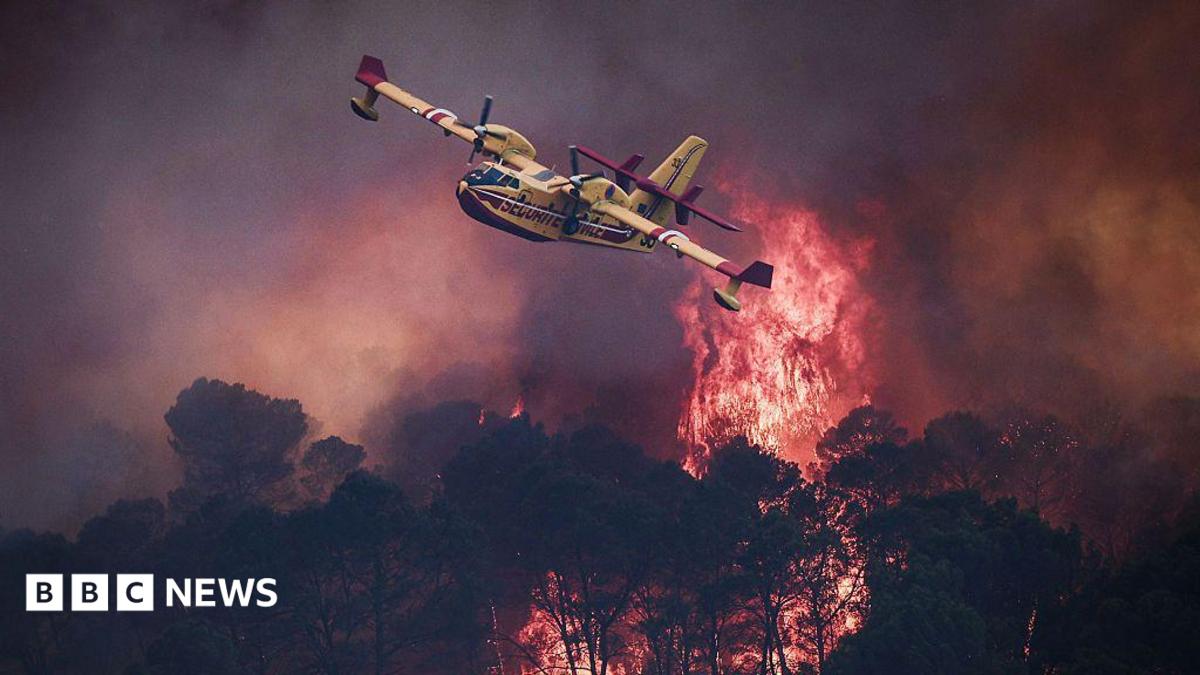
Huge fires are burning in France and Spain, so bad that 300,000 people have had to leave their homes. Firefighters are using planes that scoop water from lakes and drop it on the flames, and they're even digging big empty strips of land so the fire can't spread. The fires are so hot they're making their own thunderstorms, which can actually start more fires — a scary loop.
Analysis
A Continent Ablaze: France and Spain's Historic Infernos
The 2025 fire season has crossed a threshold in southwestern Europe. In Gironde, around Bordeaux, more than 200,000 people have been forced from their homes as flames have consumed over 420 square kilometres in less than four days — an area roughly four times the size of Paris. The blaze now sits just 15 kilometres from the southern edge of Bordeaux, putting France's prized wine country and several sensitive military and industrial sites — including facilities tied to ballistic missiles, rocket motors and hazardous chemical processing — in the line of fire. France's interior authorities have called it the country's worst wildfire season in two decades.
Across the border, the picture is similarly grim. Fires in the regions outside Madrid have burned about 660 square kilometres since 1 July — an area larger than the city itself. Government delegate Francisco Martin described one of the blazes as "undoubtedly the largest fire in the history of the Madrid region." On current trajectory, the Spanish national total is on course to become the worst the country has seen in 20 years, according to officials cited in the piece. The combined toll of more than 300,000 evacuations across two countries is a measure of how fast "fire season" is becoming a misnomer in Europe.
When Wildfires Spawn Their Own Weather
Perhaps the most striking element of the coverage is the rise of pyrocumulonimbus — fire-driven thunderstorms. These form when heat from an intense wildfire forces air to rise rapidly, carrying smoke, ash and water vapour high into the atmosphere. If the fire is powerful enough and the atmosphere unstable, the resulting cloud can grow into a cumulonimbus and produce its own lightning, which can in turn spark new fires. It is a vicious self-reinforcing loop, and one that makes fire behaviour "extreme and unpredictable", according to the BBC's reporting.
Responding to such volatility requires a layered approach. French authorities have deployed roughly 2,500 firefighters, 1,500 military personnel and 1,200 police and gendarmes in Gironde alone. Air support ranges from Air Tractor AT-802F Fire Boss water bombers — capable of scooping 6,000 litres in 12 seconds — to A400M military transports dropping retardant. Ground crews have carved firebreaks up to 100 metres wide near Lacanau, while loaded aircraft patrol high-risk zones on dangerous days so they can drop water within minutes of a sighting. It is, in effect, a war footing for what is increasingly a year-round threat.
An Under-Resourced Front Line in a Warming Europe
Even with that arsenal, the system is straining. Gironde official Jean Luc Gleyze told the BBC that authorities simply do not have enough personnel or trucks, adding that he believed "France don't have enough" to fight the blazes. That admission from a regional official of one of Europe's wealthiest countries is a quiet but telling indictment of how thinly emergency services are stretched. It also lands awkwardly in Brussels, where EU member states have spent years debating the merits of a joint civil protection mechanism capable of rapidly mobilising aircraft and crews across borders.
The longer arc is climate-driven. The BBC notes that hotter, drier conditions linked to climate change are allowing fires to spread faster and burn more fiercely, with high pressure forecast to bring dry, settled and increasingly hot temperatures in the week ahead. For a continent where summers are no longer reliably cool, the policy questions are no longer about whether such seasons will recur, but how often, how big, and how well-prepared European institutions and national governments will be when the next one arrives.
Key points
- More than 300,000 people have been evacuated as wildfires burn through France and Spain, with France calling it its worst fire season in two decades and Madrid labelling its blazes the worst in the region's history.
- The Gironde blaze near Bordeaux has consumed over 420 square kilometres in under four days and now sits 15 kilometres from the city, threatening sensitive military and chemical sites.
- Pyrocumulonimbus — fire-driven thunderstorms formed when intense heat and smoke generate their own lightning — is making the fires more unpredictable and harder to contain.
- Fire crews in Gironde include roughly 2,500 firefighters, 1,500 military personnel and 1,200 police, supported by water-bombing aircraft and 100-metre-wide firebreaks near Lacanau.
- Gironde official Jean Luc Gleyze told the BBC authorities do not have enough people or trucks, even in one of Europe's wealthiest countries, highlighting a structural resource gap as climate-driven fires intensify.
If high pressure does not bring the forecast heatwave, fire crews could gain ground in both Gironde and around Madrid, allowing the more than 300,000 evacuees to return home and limiting further damage to Bordeaux's wine country. The deployment of military aircraft and cross-agency coordination offers a template for a faster, more unified EU-level wildfire response in future seasons.
Forecasters expect dry, settled and increasingly hot conditions in the coming week, which could swell both the Gironde and Madrid blazes and force further mass evacuations. Pyrocumulonimbus events, by generating lightning and erratic fire behaviour, make containment far harder, and a regional official's admission that France lacks enough personnel and trucks points to a structural gap that will worsen as hotter summers become routine.