Engine parts smashed Ryanair window that man's head was sucked out of, report says
US investigators say broken engine fan blade fragments smashed a Ryanair cabin window mid-flight, partially sucking a Serbian passenger's head and shoulder out of the hole.
Intelligence analysis by Llama
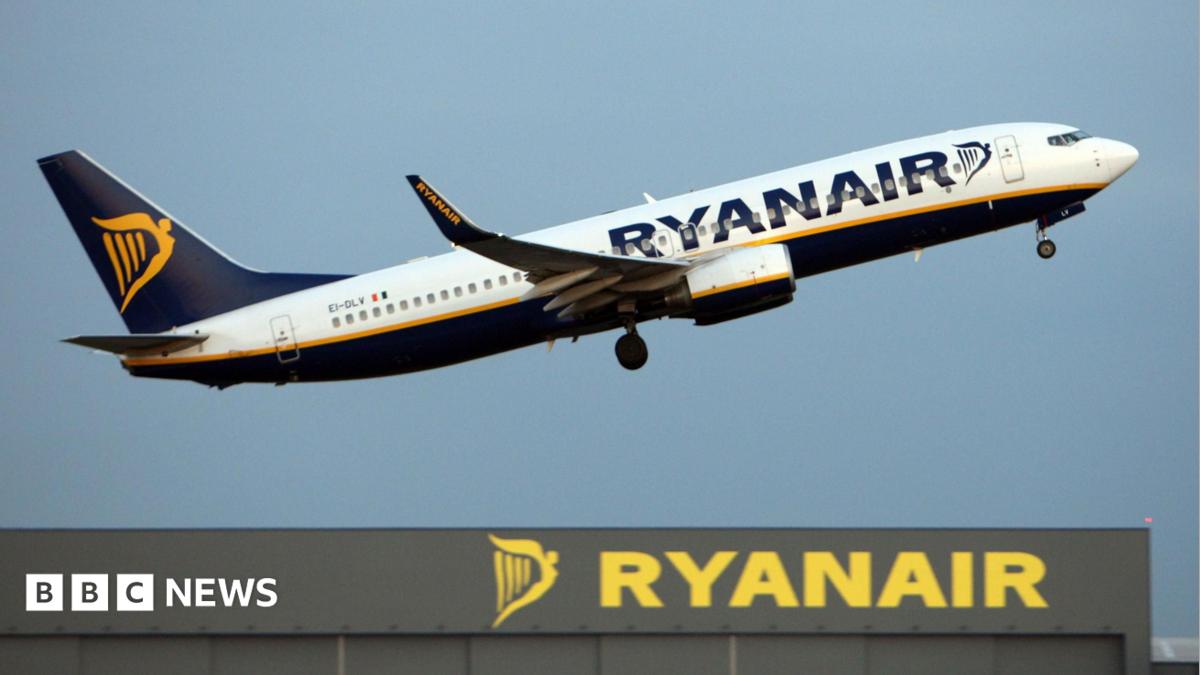
A preliminary NTSB report on the 10 July Ryanair incident links a cabin window failure to a No. 2 engine fan-blade-out event shortly after takeoff from Thessaloniki, leaving one passenger seriously injured. The engine had passed ultrasonic inspection in May.
Imagine sitting in a plane when a piece of the engine breaks off and punches a hole through the window next to you. The rushing air tries to pull a man's head outside! His wife and two friends grabbed his legs and held on for several minutes until the pilots landed safely. The man was badly hurt but survived, and investigators are now figuring out why the engine broke.
Analysis
The No. 2 (right) engine
The NTSB's preliminary account pins the entire sequence on a single mechanical event: a fan-blade-out failure in the No. 2 (right) engine, which sits on the right side of the aircraft, shortly after the climb-out from Thessaloniki. A fan blade fractured, the engine shed fragments, and at least one of those pieces struck the cabin with enough force to destroy a window outright. The crew received a "high vibration" alert during the climb, throttled back, ran through their checklists, and resumed the climb on autopilot when the shaking stopped. Only when the vibrations returned with a loud bang did they declare an emergency and turn back. The NTSB is now reconstructing whether the autopilot climb continued for too long after the first warning, a question that goes to pilot procedure as much as to the engine itself.
Malta Air as the operator of record
Although the flight carried Ryanair's livery and brand, the aircraft was operated by Malta Air, one of the Irish carrier's three main subsidiaries. The NTSB was "delegated the investigation in full" by Greek authorities, a procedural detail that matters because Malta-based operators fall under different European oversight pathways than Ryanair's Irish-registered fleet. The fact that a public NTSB report, rather than a European Union Aviation Safety Agency bulletin, is the lead document on this incident is itself a signal of how cross-border low-cost carrier operations are investigated when something goes wrong in a third country. Any maintenance, crew-training, or scheduling finding that emerges is likely to cascade into Ryanair's other AOC structures.
The May ultrasonic inspection
Perhaps the most uncomfortable detail in the NTSB filing is what the inspection record does and does not show. The engine had undergone ultrasonic inspection in May with no findings of fault, meaning the defect that fractured the fan blade either grew rapidly in the roughly two months between check and failure, or sat below the detection threshold of the May procedure. Ryanair boss Michael O'Leary publicly suggested "foreign object damage" to the engine, an explanation that would point to debris ingested at Thessaloniki rather than a metallurgical flaw. The NTSB has not endorsed that theory. The tension between the clean May inspection, O'Leary's foreign-object framing, and a fracture pattern that investigators have not yet characterised will define the final report and any enforcement action that follows.
Key points
- NTSB preliminary report attributes the cabin window failure to a No. 2 engine fan-blade-out shortly after takeoff from Thessaloniki on 10 July
- Serbian passenger Ljubisa Karović was partially ejected through the missing window; his wife and two other passengers held his legs for several minutes
- The affected engine had passed an ultrasonic inspection in May with no faults identified
- The flight was operated by Ryanair subsidiary Malta Air, not by Ryanair's main Irish-registered entity
- Ryanair CEO Michael O'Leary publicly suggested foreign object damage, a theory the NTSB has not endorsed
The crew's handling, including the rapid return to SKG and an "uneventful landing," shows that the existing training and checklists functioned as designed once the failure was recognised. A thorough NTSB final report could also give regulators and operators a clear, shareable lesson that tightens fan-blade inspection intervals across the European short-haul fleet.
The fact that the engine cleared an ultrasonic inspection in May yet failed catastrophically in July raises the possibility that inspection intervals or techniques missed a propagating defect, a worry that may spread beyond Malta Air. Public and regulatory confidence in budget-carrier maintenance practices, and in Ryanair's multi-AOC structure, could take a hit even before the final report is published.