Farooq Sattar urges govt to revisit economic policies after Karachi family tragedy
MQM-P leader Farooq Sattar urged the government to seriously review its economic policies following the tragic deaths of five family members in Karachi, reportedly due to financial hardship.
Intelligence analysis by Gemini 2.5 Flash
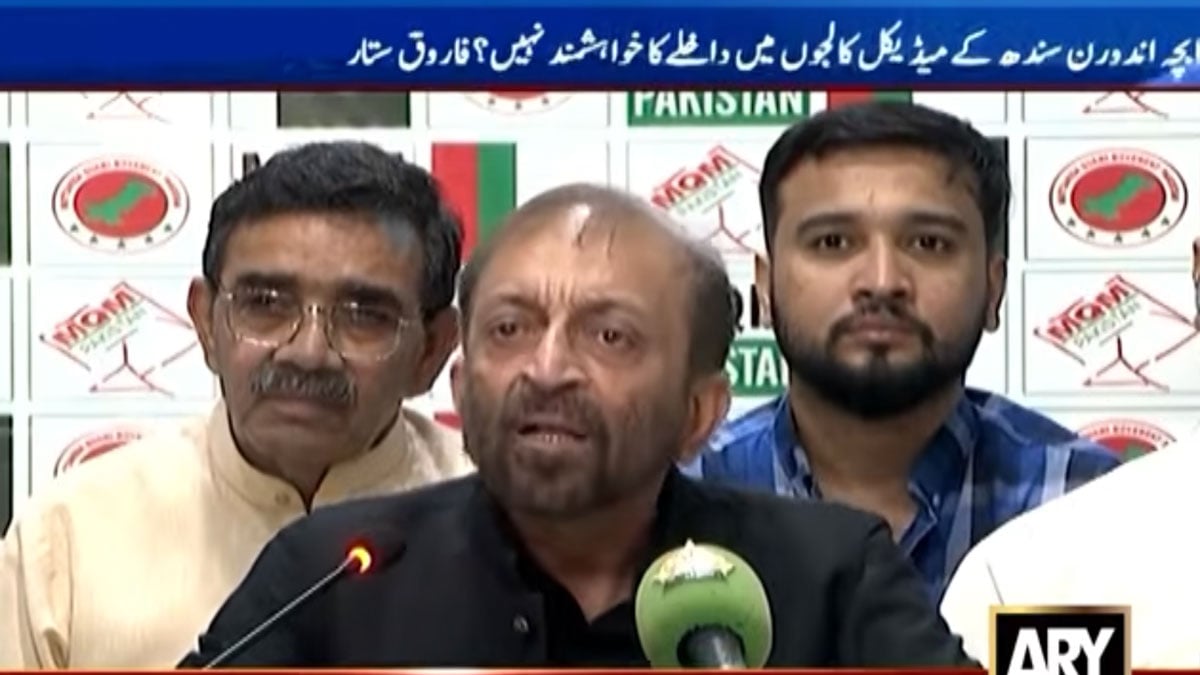
Dr. Farooq Sattar, a Member of the National Assembly from MQM-P, expressed profound grief over a Karachi family tragedy linked to economic distress, calling for immediate and practical steps from the government to formulate people-friendly policies, reduce inflation, and create employment opportunities.
Imagine a family in Karachi was so sad and worried because they didn't have enough money for food and couldn't find jobs, that something very terrible happened. A kind politician named Farooq Sattar, who is part of the government, heard about this and said, 'This is a big problem! We need to change our country's money rules right away so that no other family has to feel so hopeless. We must make sure everyone can get food and jobs easily.'
Analysis
The recent tragedy in Karachi, where five members of a family were found dead with a suicide note citing financial difficulties, has brought Pakistan's economic challenges into sharp focus. Dr. Farooq Sattar, a prominent leader of the Muttahida Qaumi Movement-Pakistan (MQM-P) and a Member of the National Assembly, has leveraged this heartbreaking incident to issue a strong appeal to the government, of which his party is a part, for a fundamental reassessment of its economic strategies. His statement underscores a critical moment of introspection, acknowledging shared responsibility within the government to address the plight of ordinary citizens grappling with poverty and hunger.
Farooq Sattar
Dr. Farooq Sattar's intervention is particularly significant given his position within the ruling coalition. As an MNA and a leader of MQM-P, his call for a serious review of economic policies is not merely an opposition critique but an internal demand for accountability and action. He emphasized that the incident should serve as a moment for the government to recognize its own responsibilities and move beyond mere expressions of sorrow to implement practical, effective measures.
Sattar's statement highlights the growing pressure on the government from within its own ranks to address the escalating economic distress. His insistence on 'people-friendly policies' suggests a desire for a more inclusive economic approach that prioritizes the welfare of low-income and middle-class households. This public stance from a government ally could potentially galvanize efforts towards more responsive governance, or it could expose deeper rifts within the ruling structure regarding economic direction.
Karachi Family Tragedy
The catalyst for Sattar's urgent appeal was the discovery of five deceased family members in Karachi's Bin Qasim area, identified as Shahzaib, his wife Saba, his sister Shumaila, and their young daughters Aizal and Arya. Police investigations recovered a bloodstained handwritten note from the scene, which explicitly detailed the family's severe financial difficulties and their unsuccessful attempts to secure assistance from relatives. This tragic event serves as a stark and grim reminder of the extreme consequences that prolonged economic hardship can inflict upon vulnerable households.
The details of the tragedy, including the ages of the young children involved, have resonated deeply across the nation, drawing widespread attention to the pervasive issue of poverty and unemployment. The incident has become a symbol of the despair that can arise when basic needs, such as providing two meals a day for children, become insurmountable challenges. It underscores the urgent need for social safety nets and economic policies that prevent citizens from reaching such desperate circumstances.
Economic Policies
Dr. Sattar's primary demand is for the government to seriously reconsider its current economic policies, which he argues are failing to provide relief to the common person. He specifically called for the formulation of policies aimed at reducing inflation, creating sustainable employment opportunities, and offering meaningful assistance to low-income and middle-class families. This critique suggests that existing measures are perceived as insufficient or misdirected in addressing the core economic grievances of the populace.
The emphasis on 'people-friendly policies' implies a shift away from potentially austerity-driven or growth-focused strategies that may not trickle down effectively to the most vulnerable segments of society. Sattar's plea for immediate assistance to deserving families and ensuring no citizen is driven to despair by hunger or helplessness reflects a humanitarian concern that he believes should be at the forefront of governmental action. The tragedy serves as a potent argument for re-evaluating the efficacy and human impact of Pakistan's broader economic framework.
Key points
- MQM-P leader Farooq Sattar urged the government to revisit economic policies after a Karachi family tragedy.
- Five family members, including two young daughters, were found dead in Karachi, with a suicide note citing financial difficulties.
- Sattar, whose party is part of the government, called for introspection and practical steps to address poverty and hunger.
- He advocated for people-friendly policies to reduce inflation, create jobs, and provide relief to low- and middle-class households.
- Police recovered a bloodstained note detailing the family's financial struggles and failed attempts to seek help.
If the government heeds Farooq Sattar's urgent call, it could lead to a serious re-evaluation and reform of economic policies, potentially resulting in measures that genuinely alleviate poverty, reduce inflation, and create much-needed employment opportunities for the low- and middle-income segments of society. Such proactive steps could prevent similar tragedies and restore public confidence in the government's commitment to its citizens' welfare.
Should the government fail to respond effectively to these warnings and continue with existing economic policies, the current hardships faced by ordinary citizens could intensify. This inaction risks further social distress, potential increases in poverty and unemployment, and a deepening sense of despair among vulnerable populations, potentially leading to more tragic incidents and eroding public trust.