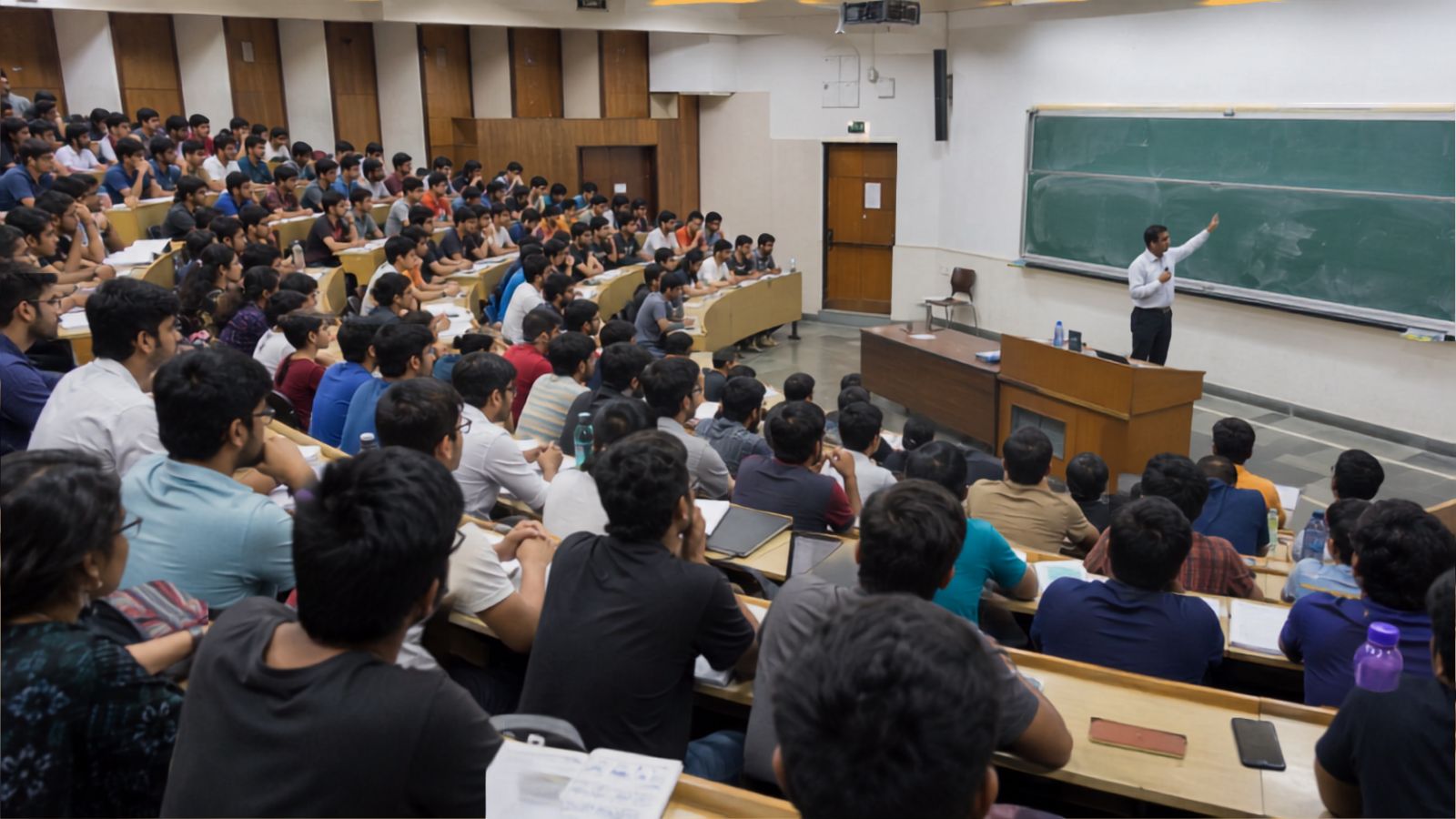
Fewer Indian students going abroad, while Indian institutes take their campuses overseas
Indians going abroad to study fell for a second straight year in 2025, while IITs and IIMs expanded campuses overseas.
Intelligence analysis by GPT-5.4 Mini

BoI data shows outbound student travel rose sharply after Covid, then declined for two years from its 2023 peak. At the same time, Indian institutions are starting to build a small but visible overseas footprint.
More Indian students are not leaving to study overseas as much as they used to, like a river that was rushing fast and then slowed down. At the same time, some Indian colleges are opening little branches in other countries, so the classroom is starting to travel too.
Analysis
6.19 lakh in 2025
The headline number matters less as a standalone count than as a sign of momentum changing direction. After the post-pandemic rebound pushed outbound study travel to 8,94,758 in 2023, the fall to 6,19,264 in 2025 suggests the surge has clearly cooled.
That does not mean the overseas education market has shrunk back to its old baseline. The 2025 figure is still above 2021 levels, which means demand has not disappeared. What has changed is the pace, and in a sector shaped by timing, visas and financing, pace is often the first thing to break.
The article also notes that the government has not pinned the decline on one cause. That is important because it points to a layered slowdown: affordability, access to finance, and stricter immigration rules can all bite at once.
Canada, the United States and the United Kingdom
The concentration of Indian students in three destinations is one of the clearest signals in the data. Canada alone accounts for 4,27,085 university and tertiary students, with the United States at 2,55,247 and the United Kingdom at 1,73,190.
That concentration creates vulnerability. When a few countries dominate the flow, changes in policy or cost in any one of them can quickly alter the overall picture for Indian students.
It also explains why a decline in departures does not require a collapse in demand to matter. Even modest friction in those destination markets can have an outsized effect on Indian mobility because so many students are routed through the same narrow set of choices.
IIT Madras, IIT Delhi and IIM Ahmedabad
The overseas campuses are still small, but they signal a different kind of internationalisation. Instead of only sending students out, some Indian institutions are beginning to plant their own flags abroad, with campuses in Zanzibar, Abu Dhabi and Dubai.
The numbers are not comparable to the scale of outbound student travel, and the article is careful about that. Yet the campuses matter because they show Indian higher education trying to meet global demand where it is, rather than relying only on student migration.
That could become strategically useful if overseas education gets harder or more expensive for Indian students. It could also help Indian brands build prestige abroad, though the article’s figures show this is still an early-stage experiment rather than a mass shift.
The broader takeaway is that Indian higher education is becoming more two-way. Students are still crossing borders in large numbers, but institutions are now crossing them too, which hints at a future where international education is less about leaving India entirely and more about extending India’s campus network beyond it.
Key points
- Indian student departures for study abroad fell for the second consecutive year in 2025.
- The annual count peaked in 2023 and then declined in 2024 and 2025.
- Canada, the United States and the United Kingdom remain the main university destinations for Indian students.
- Indian institutes such as IIT Madras, IIT Delhi and IIM Ahmedabad have started opening campuses overseas.
- The article frames the trend as an early sign of changing internationalisation in higher education.
If the slowdown reflects better options at home, students may face less pressure to leave India for a good education. The overseas campuses could also give Indian institutions a bigger global reach while keeping their brand and teaching model visible abroad.
If the decline is driven by tighter visas or higher costs, fewer students may be able to access the destinations they have long relied on. The overseas campuses are still small, so they are unlikely to absorb the demand if outbound education becomes harder to access.