First Trump, then Putin go to China. Does great-power diplomacy now hinge on Beijing?
Trump and Putin’s trips to Beijing did not produce a breakthrough, but they highlighted China’s rising role in managing ties with both powers.
Intelligence analysis by GPT-5.4 Mini
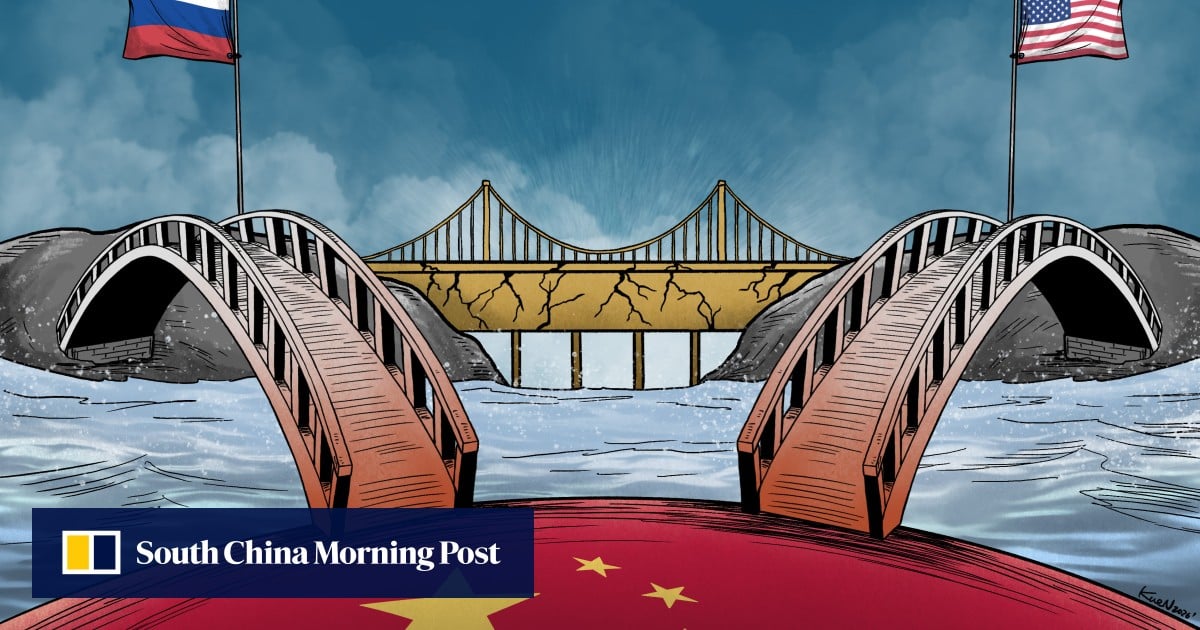
The article argues that China is handling the US and Russia on separate tracks: a strategic partnership with Moscow and a more transactional, stability-first approach to Washington. That gives Beijing the look of a diplomatic pivot, but observers say the real impact is still open to debate.
It is like two quarrelling classmates both asking one friend for help. China looks like the friend in the middle, but the story says that does not mean the fights are fixed or that the friend controls everything.
Analysis
China as a separate track manager
The article says the recent visits to Beijing by Donald Trump and Vladimir Putin did not produce a new trilateral framework or any major diplomatic breakthrough. Instead, observers see a pattern in which Beijing manages its two key relationships separately: a deep strategic partnership with Moscow, and a more transactional, stability-focused relationship with Washington.
That approach makes China look more central to global diplomacy, but the piece is careful not to overstate the shift. Yun Sun of the Stimson Centre says the visits create the impression that the United States and Russia, in different ways, need China. At the same time, she argues that whether this truly raises China’s standing remains debatable.
Why the pattern is unstable
Other analysts quoted in the article say the result is an increasingly asymmetrical and unpredictable triangle. The story links that uncertainty to several ongoing pressures: the war in Ukraine, conflict in the Middle East, turbulence in energy markets, and a changing nuclear order with more than two major powers in play.
The core point is that Beijing may be able to keep both relationships moving, but it is doing so without resolving the wider tensions around them. That makes China look influential, yet also places it in the middle of problems it cannot easily control.
Key points
- Trump and Putin’s visits to Beijing did not deliver a new trilateral framework or a major diplomatic breakthrough.
- The article says China is trying to manage its ties with Russia and the United States on separate tracks.
- Analysts say this can make China look like a pivot point in world diplomacy, but the effect is still debated.
- The broader backdrop includes Ukraine, the Middle East, energy turbulence and a changing nuclear order.
If China can keep its ties with Washington and Moscow on separate tracks, it may preserve stable channels with both capitals. That could give Beijing more room to manage crises without being forced into one side’s camp.
The same setup could make the US-China-Russia triangle more uneven and harder to predict. Conflicts in Ukraine and the Middle East, plus energy-market swings and nuclear tensions, could keep pulling China into disputes it cannot settle.