Forehead tattoos and alcohol dares: Inside the dark underbelly of crypto's memecoin craze
A Pump.fun bounty typo became a $600,000 token after a user tattooed it on his forehead. The story shows how memecoin incentives can push stunts into real-world harm.
Intelligence analysis by GPT-5.4 Mini
Pump.fun GO is turning dares into tradable tokens, and one misspelled tattoo bounty showed how fast that can spiral. A forehead typo became BOUTYWORK, a token with millions in volume, while the person who did the stunt says he received a far smaller payout.
It was like a dare game where one tiny spelling mistake turned into a trading card people rushed to buy. One person put a bad word on his forehead, and then a crypto token made from that mistake became worth a lot.
Analysis
What happened
CoinDesk reports that a Pump.fun GO bounty asked someone to tattoo the misspelled ticker $boutywork on their forehead and submit video proof. A user posting as Arivu said he completed the task exactly as written, then complained that the misspelling was not his mistake.
The typo did not stay a joke. A Solana token using the ticker BOUTYWORK began trading on PumpSwap and quickly climbed to more than a $600,000 market cap. CoinDesk says it also saw over $3.5 million in 24-hour volume, 2,630 holders, and about $43,000 in liquidity.
Why the story got attention
Pump.fun GO is designed as a bounty system for almost any task, which the company framed as a way to let users “pay anyone to do anything.” In practice, the article says the incentives can move from harmless internet dares into permanent body changes or other harmful behavior.
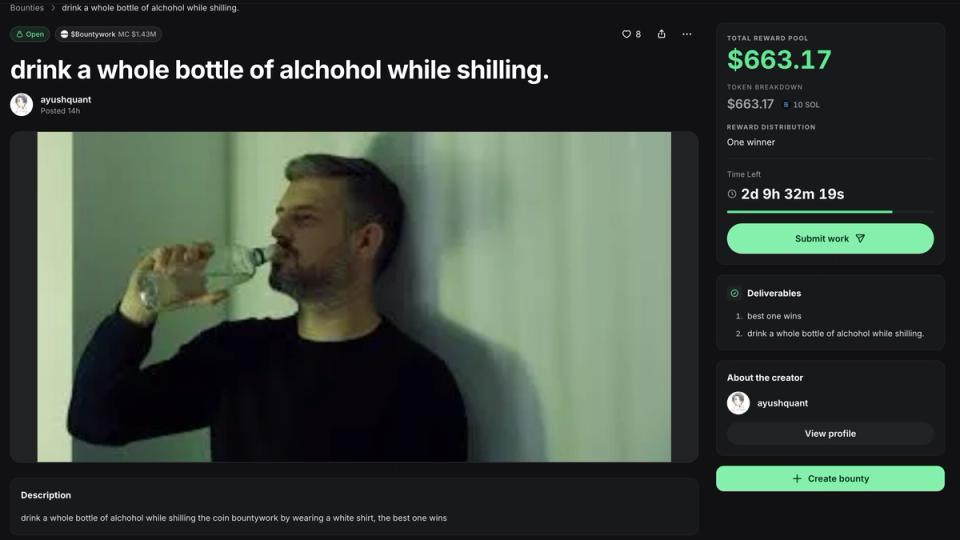
CoinDesk points to other open bounties that ranged from a watermelon-eating challenge to interviews with unhoused people in Los Angeles’ Skid Row. It also notes more dangerous tasks, including one that asked people to drink a whole bottle of alcohol while promoting a token and another that offered payment for shaving a head while yelling “Jobcoin.”
The bigger concern
The article’s central argument is that Pump.fun GO converts attention into bounties, bounties into content, and content into token trading. That structure can leave the person doing the stunt with only a small payment while token creators and traders may capture much more if the market moves.
Pump.fun says it is not responsible for the content users create and has moderation in place, but the story places this episode in the context of earlier controversial live-streaming behavior on the platform. The result is an uncomfortable example of how memecoin culture can turn online jokes into irreversible real-world acts.
Key points
- A Pump.fun GO bounty typo led a user to tattoo "$boutywork" on his forehead.
- The misspelling became a Solana token, BOUTYWORK, that quickly exceeded a $600,000 market cap.
- CoinDesk says the token saw more than $3.5 million in 24-hour volume, 2,630 holders, and about $43,000 in liquidity.
- The story argues that memecoin bounties can reward attention in ways that encourage exploitation and dangerous behavior.
- Pump.fun says it moderates content, but the episode revived concerns about the platform's social experiments.
If Pump.fun GO is moderated well, it could channel playful internet challenges into harmless rewards instead of dangerous stunts. The bounty format could still support creative community-driven experiments without rewarding abuse or self-harm.
If the incentives stay the same, users may keep pushing further into risky or humiliating acts just to chase attention and token value. The article shows that the people performing the stunt can end up with far less upside than the traders who profit from the resulting token.