Germany at a Critical Juncture as It Tries to Rein in the Far-Right Alternative for Germany
AfD is polling ahead of Germany's conservatives, intensifying talk of banning the party and weakening Chancellor Friedrich Merz.
Intelligence analysis by GPT-5.4 Mini
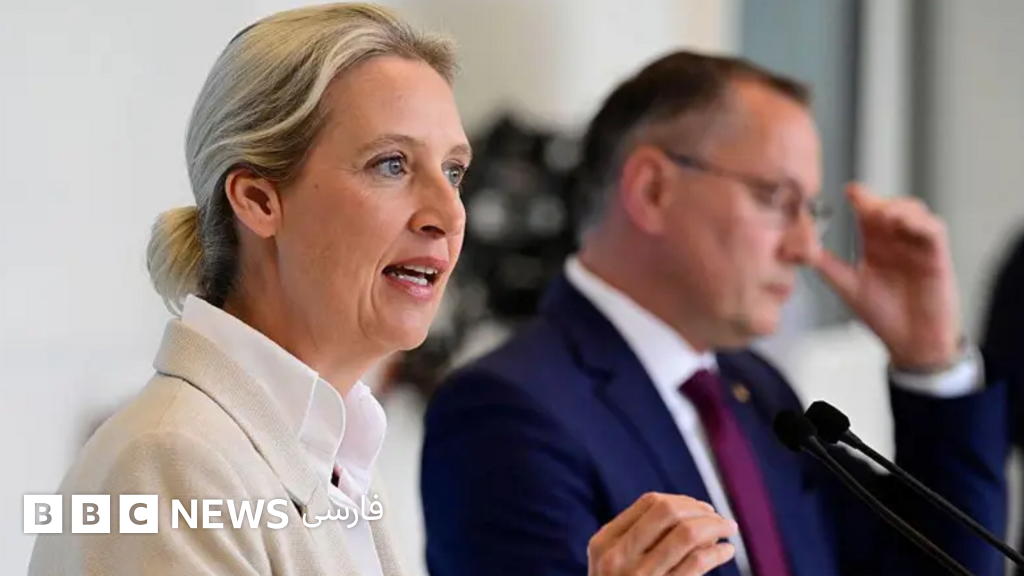
New polls put the far-right AfD at 29%, above the conservatives that govern Germany, while Merz's approval falls sharply. The article says the party could become the first to win a state outright, turning Saxony-Anhalt into a dangerous test for German democracy.
Germany's politics looks like a race where one team, the AfD, is suddenly running much faster than expected. If smaller teams trip up, the AfD could end up with enough points to run a state by itself, which worries the people who want to keep the game fair.
Analysis
Poll surge
BBC Persian reports that the far-right Alternative for Germany (AfD) is gaining momentum in national polling and has opened a wider debate about whether the party should be banned. In the latest INSA poll published on 6 June, the AfD reached 29%, ahead of the conservative bloc led by Chancellor Friedrich Merz. The same survey put the Christian Democratic/Christian Social Union bloc at 21%, while dissatisfaction with Merz reached 77%.
Pressure on Merz
The article says the polling has rattled Germany's governing parties, especially the CDU. Reports in recent weeks suggested Merz had lost support inside his own party, and rumors even circulated that Hendrik Wüst might replace him as chancellor. Wüst rejected those claims and said he still supported Merz. Merz's allies described the rumors as claims that only help the AfD and weaken the chancellor inside his party.
Merz had promised to reduce support for the AfD when he took office. According to the article, he has called the party the "biggest threat" because it challenges pluralist democracy and said he would respond with reforms aimed at reviving the economy and moving Germany forward. The report says he has not yet been able to deliver those reforms because of economic problems tied to the war between the U.S. and Israel and Iran, as well as unresolved disputes with his coalition partner, the Social Democrats.
The Saxony-Anhalt test
The article focuses on the state election in Saxony-Anhalt on 6 September, where the AfD is polling at 42%. In neighboring Mecklenburg-Vorpommern, it is at 34%. BBC Persian says experts view a scenario in which the AfD can govern alone in Saxony-Anhalt as a dangerous threshold for the country.
Germany's domestic intelligence service in Saxony-Anhalt classifies the AfD as a "far-right extremist" group and says it promotes racist views and tries to discredit Germany's democratic system, its representatives and its institutions. Other parties have already said they will not enter a coalition with it. The remaining question, the article suggests, is whether weak results for smaller parties such as the Greens, FDP and Sahra Wagenknecht's alliance could leave the AfD with enough seats to govern on its own.
Key points
- The AfD has risen to 29% in the latest INSA poll, ahead of Merz's conservative bloc at 21%.
- Merz's approval is falling, and the article says 77% of respondents are unhappy with his performance as chancellor.
- Reports of internal CDU unrest and speculation about a replacement for Merz were denied by Hendrik Wüst.
- The article warns that the AfD could become the first party to govern a German state alone, especially in Saxony-Anhalt.
- Germany's domestic intelligence service in Saxony-Anhalt classifies the AfD as a far-right extremist group and says it promotes racist views.
If Merz's promised reforms start working, the government could regain trust and slow the AfD's rise. The article also suggests that other parties remain united in refusing coalitions with the AfD, which could still keep it out of power even if its vote share stays high.
If polling trends hold, the AfD could become strong enough to govern alone in Saxony-Anhalt, which the article calls a dangerous threshold. Continued coalition tensions and Merz's weak popularity could deepen Germany's political paralysis and make the far right even harder to contain.