Hong Kong-built greenhouse gas tracker device ‘functioning well’ on space station
A greenhouse gas monitoring instrument developed in Hong Kong is successfully operating aboard China's Tiangong space station, capturing clear images and data.
Intelligence analysis by Gemini 2.5 Flash
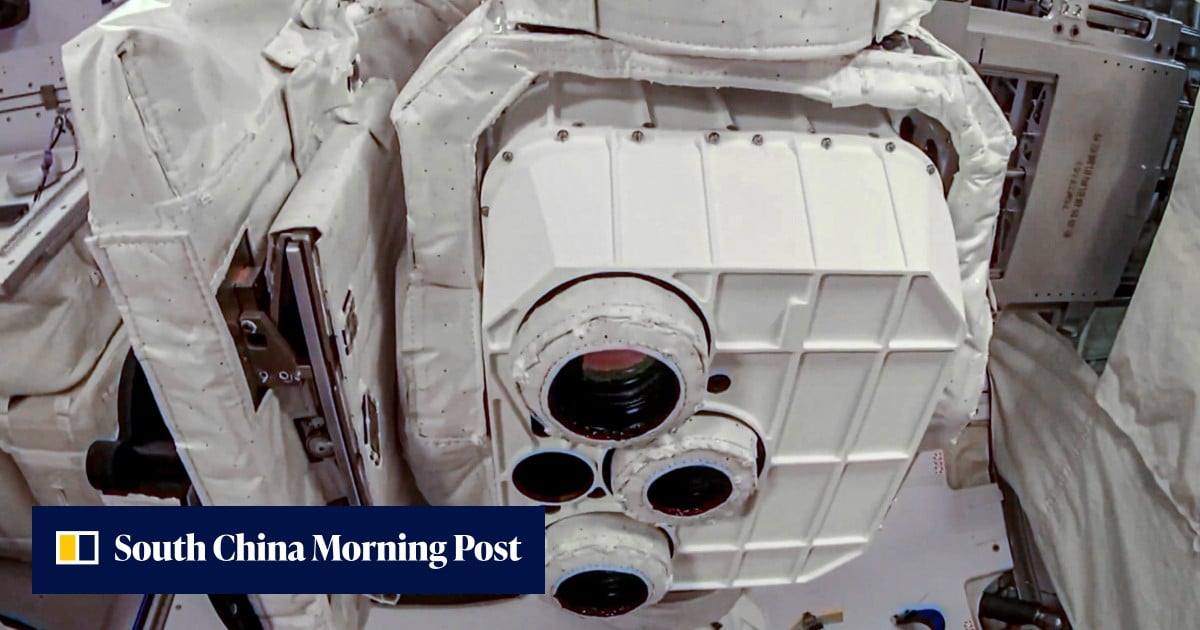
Hong Kong's Secretary for Innovation, Technology and Industries, Sun Dong, announced that the Multi-Spectral Imaging Carbon Observatory (MUSICO), developed by HKUST, is functioning well on the Tiangong space station. This device is designed to provide highly accurate monitoring data for carbon dioxide and methane, contributing to global climate change efforts.
Imagine a super-smart camera in space, built by scientists in Hong Kong, that can see invisible gases like the ones that make our planet warmer. This camera is now on China's big space station, Tiangong, and it's working perfectly, taking clear pictures of these gases. It's like having a special detective in the sky helping us understand how to keep our Earth healthy.
Analysis
The successful deployment and operation of the Multi-Spectral Imaging Carbon Observatory (MUSICO) on the Tiangong space station marks a significant milestone for Hong Kong's scientific and technological ambitions. Developed by the Hong Kong University of Science and Technology (HKUST) with government funding, this instrument represents a tangible contribution to global environmental monitoring efforts. Its ability to capture clear images and data from orbit underscores the city's capacity for high-precision engineering and scientific research, positioning Hong Kong as a key player in China's burgeoning space program.
MUSICO
The Multi-Spectral Imaging Carbon Observatory (MUSICO) is touted as the world's first lightweight, high-resolution, and high-precision synergistic observatory specifically designed to track carbon dioxide and methane. Its four sensors are crucial for detecting these key greenhouse gases, along with oxygen and aerosols, providing a comprehensive atmospheric snapshot. The device's successful functioning, as confirmed by Secretary Sun Dong, means it is already delivering on its promise to collect vital environmental data. This data is expected to be instrumental in understanding global emission patterns and informing strategies to combat climate change over its projected operational lifespan of at least two years.
Tiangong space station
The deployment of MUSICO aboard China's Tiangong space station is a testament to the collaborative spirit within China's scientific community, integrating Hong Kong's expertise into national space infrastructure. The Tiangong station serves as a critical platform for various scientific experiments and observations, and MUSICO's inclusion enhances its utility for Earth observation and environmental science. This collaboration not only elevates Hong Kong's profile in space technology but also strengthens the overall capabilities of the Tiangong station in addressing pressing global challenges like climate change through advanced orbital monitoring.
Sun Dong
Secretary for Innovation, Technology and Industries Sun Dong's announcement provides official confirmation of MUSICO's success and offers insights into the broader context of Hong Kong's involvement in space. His web blog post detailed the device's performance and its potential impact on sustainable development, emphasizing the city's commitment to innovation. Sun Dong also briefly touched upon the activities of Hong Kong's first astronaut, Lai Ka-ying, highlighting the city's expanding engagement with human spaceflight and its ambition to foster a vibrant ecosystem for space science and technology, aligning with national strategic goals.
Key points
- A Hong Kong-developed greenhouse gas monitoring device, MUSICO, is successfully operating on China's Tiangong space station.
- The Multi-Spectral Imaging Carbon Observatory (MUSICO) was developed by the Hong Kong University of Science and Technology (HKUST) with government funding.
- MUSICO's four sensors are detecting carbon dioxide, methane, oxygen, and aerosols, capturing images with good clarity.
- The device is expected to provide automatic, controllable, and highly accurate greenhouse gas emission data for at least two years.
- This instrument is considered the world's first lightweight, high-resolution, high-precision synergistic observatory for carbon dioxide and methane.
The successful operation of MUSICO promises to provide highly accurate and controllable data on greenhouse gas emissions, which could significantly enhance global efforts to monitor and respond to climate change. This technological achievement also elevates Hong Kong's standing in advanced scientific research and space technology.