How PPP Dismantled Karachi: Census Rigging, Gerrymandering, and Financial Starvation
A Raftaar documentary lays out how PPP stripped Karachi of fair representation and withheld billions in owed transfers while two flagship infrastructure projects sat unfinished for decades.
Intelligence analysis by Claude Sonnet 4.6
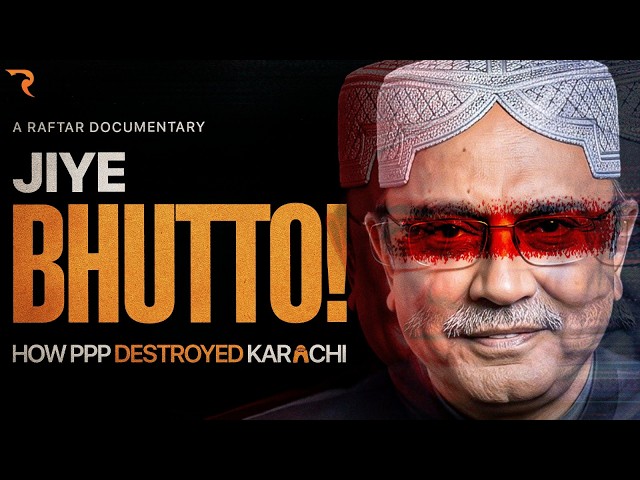
Eighteen years of PPP rule in Sindh left Karachi's population undercounted in back-to-back censuses, its union councils drawn to favor rural constituencies, its municipal budget frozen while provincial revenues grew 8.5 times over, and its two biggest infrastructure projects still incomplete.
Imagine a school where one table pays the most into the lunch fund but gets almost nothing back, while other tables eat well. Karachi is that table. The province's rulers collect the city's money but win their elections elsewhere, so fixing Karachi's roads, water, or buses was never something they needed to do.
Analysis
Census manipulation as political strategy
The 18th Constitutional Amendment of 2010 handed broad powers from Islamabad to provincial governments. PPP pushed it through under President Asif Ali Zardari. If Karachi's seat count could be kept low relative to interior Sindh, the party could hold the chief ministership without winning a single urban constituency.
The census was the instrument. JICA, the Japanese agency behind Karachi's mass transit plan, estimated the city's population at 18 million in 2010. Independent demographers projected 22.5 million by 2017. The official census recorded 16 million. The 2023 digital census, meant to be more accurate, came in at 20 million, still below what electricity meter data alone suggests: 3.7 million meters, six people per household on average, gives 22 million before the 30-40% of residents in informal settlements with no meters at all.
Pakistan counts people at their registered address, not where they live. In a city of migrants, those two figures diverge considerably.
Redrawn boundaries
Fewer counted residents means fewer seats. PPP then worked with the seats that existed. Sindh added 53 union councils to Karachi's total, but the distribution tracked partisan interest. Orangi, reliably against PPP, got 8 UCs for 700,000 residents. Manora, reliably for it, got 11 for 580,000. In 2020, District West was cut into two districts, letting 65 union councils be concentrated in PPP strongholds without the number standing out against the provincial average of 35-40.
The municipal budget in freefall
KMC's budget in 2005 was Rs 43 billion. Sindh's was Rs 120 billion. Today Sindh's budget is over Rs 3,500 billion. KMC's is Rs 55 billion. In dollar terms, that is a drop from $800 million to $200 million. The octroi-linked transfer that once grew with GST revenue was frozen. The infrastructure cess owed to Karachi for port-related road damage has not been paid in a decade, leaving over Rs 1,000 billion outstanding. Researcher Yunus Dhaka's figures put Karachi's owed development allocation over ten years at Rs 3,360 billion; it received Rs 472 billion.
Projects that never arrived
The K-IV water project was conceived in 2002 and approved at Rs 25 billion in 2011. It was 20% complete in 2018 when a design flaw shut construction down. WAPDA took over in 2020; the revised cost is Rs 243 billion and the projected finish is 2027, at best. The Karachi Transportation Improvement Project, a 175-km rapid transit plan from JICA, has produced 9 km of completed track in 14 years. The documentary puts the time needed for the remaining 150 km, at the current pace, at 535 years.
Key points
- Pakistan's 2017 census put Karachi at 16 million people. JICA had estimated 18 million in 2010; independent demographers projected 22.5 million by 2017. Pakistan counts people at their registered address, not where they live, which reliably undercounts a city built on migration.
- PPP drew Karachi's union councils to its advantage. Orangi got 8 UCs for 700,000 residents; Manora, a PPP-friendly area, got 11 for 580,000. District West was split in 2020 to pack 65 union councils into PPP strongholds.
- KMC's budget went from Rs 43 billion in 2005 to Rs 55 billion today. Sindh's went from Rs 120 billion to over Rs 3,500 billion in the same period. In dollar terms, KMC fell from $800 million to $200 million.
- The K-IV water project started in 2002, was approved at Rs 25 billion in 2011, and now costs Rs 243 billion with completion pushed to 2027 at the earliest. The planned 175-km transit network has produced 9 km of track in 14 years.
- Researcher Yunus Dhaka's figures show Karachi was owed Rs 3,360 billion in development funds over ten years and received Rs 472 billion. The infrastructure cess for port-related road damage, over Rs 1,000 billion, remains unpaid.
Mexico City is a real precedent. After 1997, when residents got to elect their own mayor and city government took over policing, water, and transport, the city turned around within a decade. Karachi has the economic base to do the same if local government is given real authority and a predictable revenue share.
PPP has held Sindh for 15 consecutive years without giving Karachi's local government anything meaningful, and the 18th Amendment makes federal intervention constitutionally awkward. The corruption the documentary describes, contractors returning 40-60% of contract value through advance fees and per-check commissions, is not a run of bad decisions. It is a functioning system that works well for the people running it.