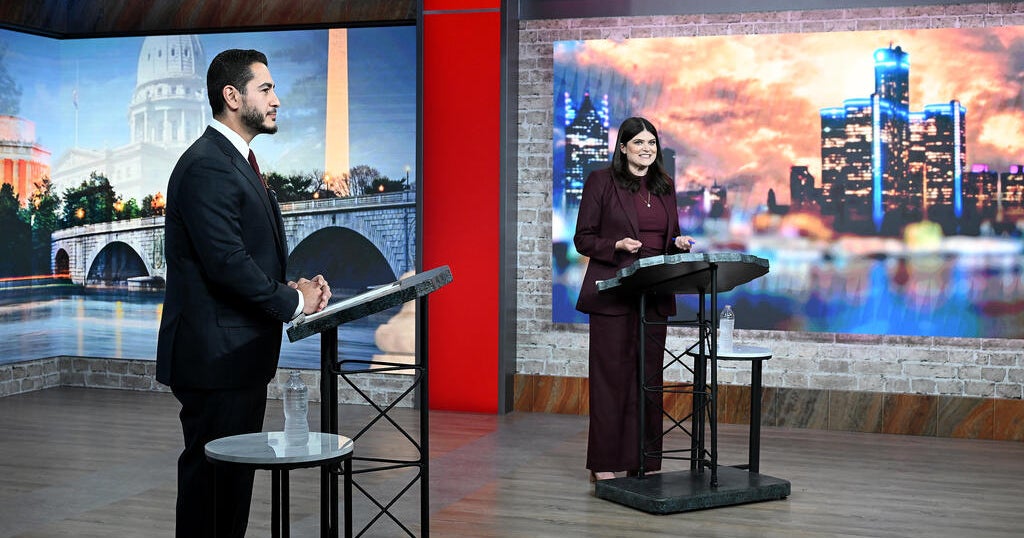
In final Michigan Senate Democratic debate, Stevens and El-Sayed spar over outside spending and personal attacks
Michigan Democratic Senate candidates Abdul El-Sayed and Rep. Haley Stevens clashed on issues of spending by outside groups, the tone of the race, and electability in the last televised debate before a pivotal primary election next Tuesday.
Intelligence analysis by Llama
In the final Michigan Senate Democratic debate, candidates Abdul El-Sayed and Haley Stevens sparred over outside spending, the tone of the race, and electability. El-Sayed accused Stevens of being influenced by outside funding, while Stevens denied the claim and pointed to El-Sayed's own super PAC.
Imagine you're in a big election, and two candidates are arguing about who's the best choice. One candidate says the other is being influenced by outside money, while the other says that's not true. They're also arguing about who's the best fit for the job and who can win the election.
Analysis
A Proxy for a Larger Debate
The Democratic primary contest to fill the open seat of outgoing Democratic Sen. Gary Peters has turned into a proxy for a larger intra-party debate over whether candidates with progressive policy stances on Medicare for All and abolishing Immigration and Customs Enforcement — as well as aggressive criticism of U.S. financial support for Israel — are the best options to run in competitive races this November.
Outside Spending and Personal Attacks
On outside funding, El-Sayed has hammered Stevens for the wave of outside funding that has backed her campaign, especially the tens of millions of dollars from groups affiliated with the American Israel Public Affairs Committee, or AIPAC. On Monday, El-Sayed cited her July vote against an amendment that would cut $3.3 billion in annual military aid to Israel. El-Sayed called military assistance to Israel the "worst use of our tax dollars." Stevens denied that the influx of outside spending would influence her views on Israel as a senator. She said she supports a two-state solution to the conflict between Israelis and Palestinians, and highlighted her recent criticism of Israeli Prime Minister Benjamin Netanyahu, drawing pushback from Netanyahu in a CNN interview .
Electability
The winner of the Aug. 4 Democratic primary will likely face Republican former Rep. Mike Rogers in November, who spent Monday at President Trump's side during his remarks at a General Motors plant in Milford, Michigan. "The president is doing his part. You look around the country. They're scoring some big wins in manufacturing … We got to send President Trump some help," Rogers said on stage with the president, who won Michigan in 2024 by 1.4 points. A Republican hasn't represented Michigan in the Senate for 25 years. But as the national Democratic Party debates whether the success of insurgent progressive and democratic socialist candidates in New York City and elsewhere represents a winning strategy for the whole country, Stevens and her allies argue that El-Sayed poses a political risk. El-Sayed does not identify himself as a socialist. "I'm just a capitalist who understands how capitalism works," El-Sayed said Monday night. "The biggest threat to capitalism was never the idea of government regulation. It was always monopol[ies]."
A Celebrity Candidate?
Stevens argued one of the things progressive politicians who support El-Sayed are "missing" is "an understanding of what makes our state tick." "We don't need a celebrity candidate. We don't need a celebrity senator. We need somebody who is committed to six years of hard, unglamorous work that's going to stand up to this junk that is wreaking havoc and causing chaos right before our very eyes," Stevens said. Rogers told CBS News on Monday he has no preference on which candidate he'd prefer to face in November. "They talk the same way, and they vote the same way," he said. "The crazy train has arrived. It's going to be either crazy, or common sense."
Key points
- El-Sayed and Stevens clashed on issues of outside spending and personal attacks in the final Michigan Senate Democratic debate.
- El-Sayed accused Stevens of being influenced by outside funding, while Stevens denied the claim and pointed to El-Sayed's own super PAC.
- The debate highlights the ongoing intra-party debate over whether progressive candidates with policy stances on Medicare for All and abolishing Immigration and Customs Enforcement are the best options to run in competitive races this November.
- Stevens argued that El-Sayed poses a political risk and that he lacks an understanding of what makes Michigan tick.
- Rogers told CBS News that he has no preference on which candidate he'd prefer to face in November.
If El-Sayed wins the primary, he could bring a progressive perspective to the Senate and potentially influence the national Democratic Party's strategy. Additionally, his campaign has highlighted the need for campaign finance reform and the importance of understanding what makes Michigan tick.
If El-Sayed's campaign continues to focus on personal attacks and outside spending, it could alienate moderate voters and make it harder for him to win the general election. Additionally, his progressive policies may not resonate with all voters in Michigan.