In Israel vote, ex-army chief emerges main rival to Netanyahu
Former Israeli army chief Gadi Eisenkot has emerged as the main challenger to Prime Minister Benjamin Netanyahu in the upcoming elections. Eisenkot's rise comes at a pivotal moment in Israeli politics, with the election widely viewed as a referendum on the long-serving pr…
Intelligence analysis by Llama
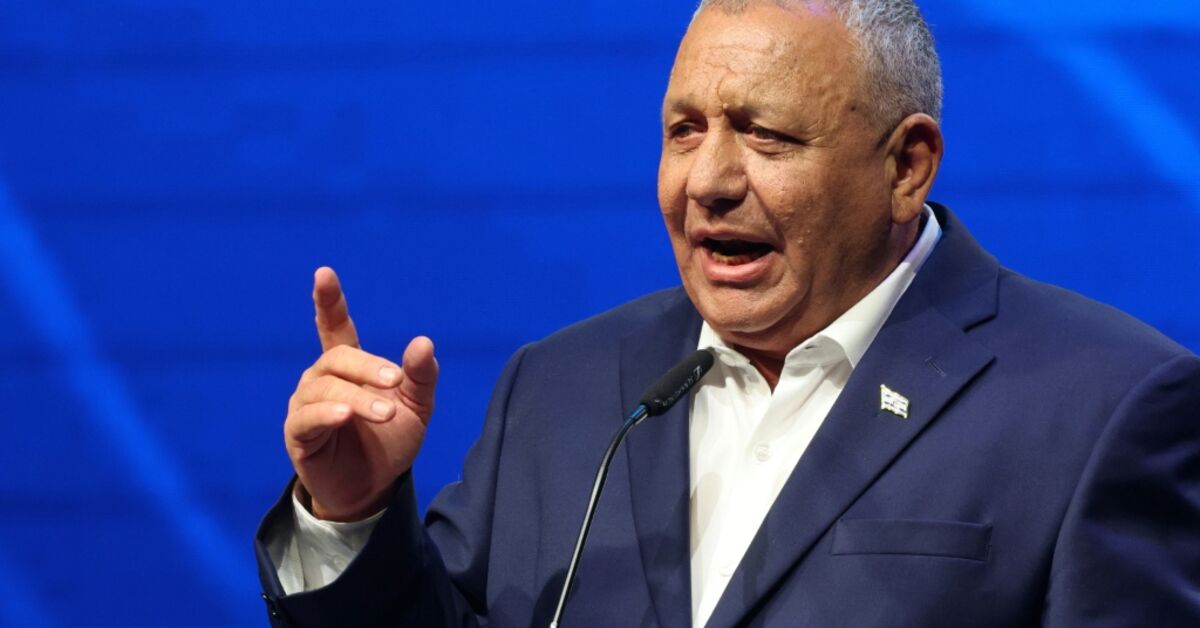
Gadi Eisenkot, the former Israeli army chief, has emerged as the main challenger to Prime Minister Benjamin Netanyahu in the upcoming elections. Eisenkot's campaign focuses on restoring Israel's security, unity, and democratic institutions, and he has built a 10-point platform to achieve this goal.
Imagine Israel is like a big family, and the family is in trouble. The family's leader, Benjamin Netanyahu, has been in charge for a long time, but many people think he's not doing a good job. A new leader, Gadi Eisenkot, has emerged who promises to make the family stronger and safer. Eisenkot wants to make sure everyone in the family contributes to the safety of the family, including people who don't usually serve in the military. He also wants to make sure the family's laws and institutions are fair and just for everyone.
Analysis
A $60B Vote of Confidence
Gadi Eisenkot, the former Israeli army chief, has emerged as the main challenger to Prime Minister Benjamin Netanyahu in the upcoming elections. Eisenkot's rise comes at a pivotal moment in Israeli politics, with the election widely viewed as a referendum on the long-serving premier's leadership in the violent aftermath of Hamas's October 7, 2023, attack on Israel. A recent Channel 12 poll put Eisenkot's new party, Yashar, ahead of Netanyahu's Likud, projecting 23 seats to Likud's 22 in the 120-member Knesset. The same survey found that 43 percent of respondents considered Eisenkot, 66, the most suitable candidate for prime minister, compared with 34 percent for Netanyahu. Eisenkot's campaign focuses on restoring Israel's security, unity, and democratic institutions, and he has built a 10-point platform to achieve this goal. At the top of his civilian manifesto is a pledge to establish a state commission of inquiry into Hamas's bloody 2023 cross-border attack, which triggered the Gaza war and quickly expanded into a broader regional conflict, and which led to Netanyahu's government being accused of overseeing an intelligence failure. Tens of thousands of Israelis have repeatedly demonstrated in support of such an inquiry, but Netanyahu's coalition has instead proposed a commission whose members would be chosen by politicians. Eisenkot also promises a 'new long-term national security doctrine' aimed at strengthening the military and reinforcing Israel's borders. A central plank of this is a 'universal national service law' that would extend compulsory service to ultra-Orthodox Jews and Arab citizens. He has also pledged to 'protect judicial independence, the rule of law, minority rights and a free press.' 'Through these steps, we will ensure that Israel is a Jewish, democratic, powerful, advanced and secure state,' Eisenkot's campaign says. His overall position on the Israeli-Palestinian conflict, however, remains less clearly defined. 'The only signal that he sent was that Israel should be a state of law,' said Tal Elovits, a researcher at Israeli think tank Molad. 'Therefore, illegal settlements and settlers' violence will be dealt with.' Relatively new to politics, Eisenkot has attracted widespread public sympathy after his son, Gal, and two nephews were killed fighting in Gaza. Eisenkot's call for universal military service has become a defining issue of his campaign, putting him at the forefront of opposition to Netanyahu's alliance with ultra-Orthodox parties. Eisenkot has repeatedly attacked Netanyahu's agreement with his coalition partners to advance legislation exempting many Haredi men from military service. 'This is a government that chooses to weaken the army in the midst of a brutal war, while the finest sons and daughters of this nation are deployed across all fronts,' he wrote, in a social media post. - 'Different generation' - Unlike Netanyahu, who comes from one of Israel's elite families, Eisenkot is the son of Moroccan immigrants and grew up on the country's geographic periphery. 'In a political universe full of Netanyahu wannabes ... Eisenkot reads as a man of a different generation, far more connected to the traditional security narratives of Zionism,' columnist Nadav Eyal wrote in a recent blog. Eisenkot's understated style could prove to be one of his strongest political assets, said Elovits. 'The middle class and upper middle class... look for someone that will look responsible, boring, and I think that Eisenkot has that appeal,' he said. Although opposition leaders Yair Lapid and Naftali Bennett remain in contention, current polling suggests neither is as well positioned as Eisenkot to defeat Netanyahu. Lapid and Bennett governed together between 2021 and 2022 in a coalition that included an Arab party. - Strategic option - According to Elovits, many disillusioned right-wing voters still see that alliance as a 'betrayal', making them unlikely to return to Bennett. 'Many voters of the right wing who do not like what Netanyahu is doing... are looking for a home. And a reasonable house for them today is Gadi Eisenkot,' said Gayil Talshir, a political science professor at the Hebrew University in Jerusalem. For liberal centrist voters, Eisenkot increasingly represents the opposition candidate with the strongest chance of unseating Netanyahu. 'Once Eisenkot began to rise above Bennett in the polls, the strategic voters of the liberal camp went with Eisenkot,' Talshir said.
Key points
- Gadi Eisenkot, the former Israeli army chief, has emerged as the main challenger to Prime Minister Benjamin Netanyahu in the upcoming elections.
- Eisenkot's campaign focuses on restoring Israel's security, unity, and democratic institutions.
- He has built a 10-point platform to achieve this goal, including a pledge to establish a state commission of inquiry into Hamas's 2023 cross-border attack.
- Eisenkot promises a 'new long-term national security doctrine' aimed at strengthening the military and reinforcing Israel's borders.
- He has also pledged to 'protect judicial independence, the rule of law, minority rights and a free press.'
If Gadi Eisenkot becomes the new leader of Israel, he may be able to bring the country together and make it stronger and safer. His promise to make universal military service a reality could help to create a sense of shared responsibility among all citizens, and his commitment to protecting judicial independence and minority rights could help to ensure that the country's institutions are fair and just for everyone.
However, Eisenkot's rise to power may also be met with resistance from those who are loyal to Netanyahu and his policies. The ultra-Orthodox parties that have allied themselves with Netanyahu may try to undermine Eisenkot's efforts to implement universal military service, and the country's deep-seated divisions may make it difficult for Eisenkot to bring about the changes he promises. Additionally, the Israeli-Palestinian conflict remains a major challenge for any leader, and Eisenkot's position on this issue is still unclear.