InfiMaker Seeks to Bring Industrial Manufacturing to Every Desktop with AI
InfiMaker is developing a desktop 5-axis CNC platform, the K1, that uses AI and software automation to make industrial-grade precision machining more accessible to individual users.
Intelligence analysis by Gemini 2.5 Flash Lite
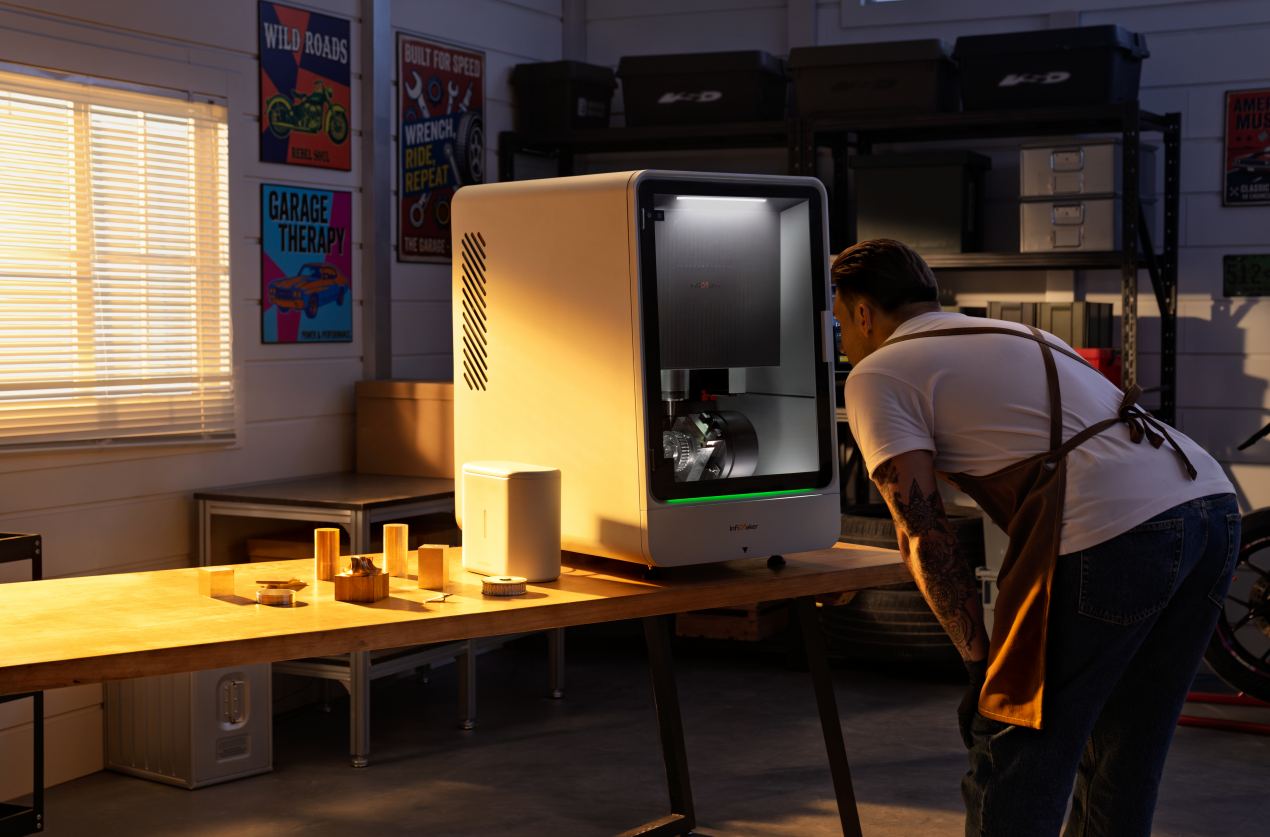
InfiMaker aims to democratize advanced manufacturing by integrating AI into its K1 desktop 5-axis CNC machine. The company's approach focuses on simplifying complex software workflows and reducing the expertise needed for precision machining, making it accessible to engineers, designers, and makers.
Imagine a super-smart robot helper that turns your computer designs into real objects, like a tiny factory on your desk. This helper uses AI, like a clever brain, to figure out the best way to cut and shape materials, making it easy for anyone to create things without needing years of training.
Analysis
AI-Powered Accessibility in Precision Machining
InfiMaker is challenging the traditional perception of advanced manufacturing as solely the domain of large, expensive industrial machines. By focusing on a compact, desktop 5-axis CNC platform called the K1, the company is targeting engineers, designers, entrepreneurs, and makers. Their core innovation lies not just in the hardware, but in leveraging AI to overcome the significant software complexity and steep learning curves that have historically confined 5-axis machining to industrial settings. This strategic focus on software automation and AI-assisted workflows is designed to bridge the gap between a digital design and a physical part, making sophisticated manufacturing capabilities available to a much broader audience.
Simplifying the 5-Axis Workflow
The K1's workflow is built around InfiStudio, InfiMaker's proprietary CAM software. This platform integrates AI to automate critical aspects of the manufacturing process, including parameter generation, machining strategy recommendations, and toolpath creation. For artistic projects, users can even upload a reference image, and the AI can generate a 3D model and prepare the machining process. For precision parts, importing CAD models initiates a guided workflow where the AI suggests settings and generates toolpaths, significantly reducing manual setup. Furthermore, the K1 features automatic material recognition via an onboard camera, which loads appropriate machining profiles and cutting parameters, further streamlining the design-to-production pipeline.
Redefining the Future of Manufacturing
InfiMaker's vision extends beyond just selling a machine; they aim to foster a future where hands-on building is possible for individuals, effectively turning desks into micro-factories. The company believes that future manufacturing competition will be defined by accessibility and workflow design, not solely by machine performance. While AI is not expected to replace manufacturing engineers, it is seen as a tool to lower knowledge barriers and democratize advanced capabilities. Initially targeting North America and Europe due to mature maker communities, InfiMaker plans global expansion, emphasizing user feedback and community building to drive future product development, signaling a broader trend towards AI-driven simplification in desktop manufacturing.
Key points
- InfiMaker is developing the K1, a desktop 5-axis CNC platform designed for broader accessibility.
- The company uses AI and software automation to simplify complex CAM workflows and reduce the expertise required for precision machining.
- Features like AI-assisted parameter generation, automated toolpath creation, and automatic material recognition streamline the design-to-production process.
- InfiMaker aims to make industrial-grade manufacturing capabilities available to engineers, designers, and makers.
- The company believes future manufacturing competition will focus on accessibility and workflow design, driven by AI integration.
If InfiMaker's vision succeeds, it could empower a new generation of creators and entrepreneurs by democratizing access to industrial-grade manufacturing tools. This could lead to accelerated innovation, faster prototyping, and the emergence of new businesses and artistic endeavors previously limited by the cost and complexity of traditional manufacturing.
The success of InfiMaker's K1 platform hinges on the AI's ability to reliably handle the complexities of 5-axis machining across diverse materials and designs. If the AI proves insufficient or the software workflow remains too challenging for some users, the product might fail to gain widespread adoption, and the dream of desktop industrial manufacturing could remain out of reach.