Iran's president denies threatening to resign during talks over strait of Hormuz
Iran's President Masoud Pezeshkian has denied claims he repeatedly threatened to resign, pushing back against hardline critics opposed to a US deal to reopen the strait of Hormuz.
Intelligence analysis by Llama
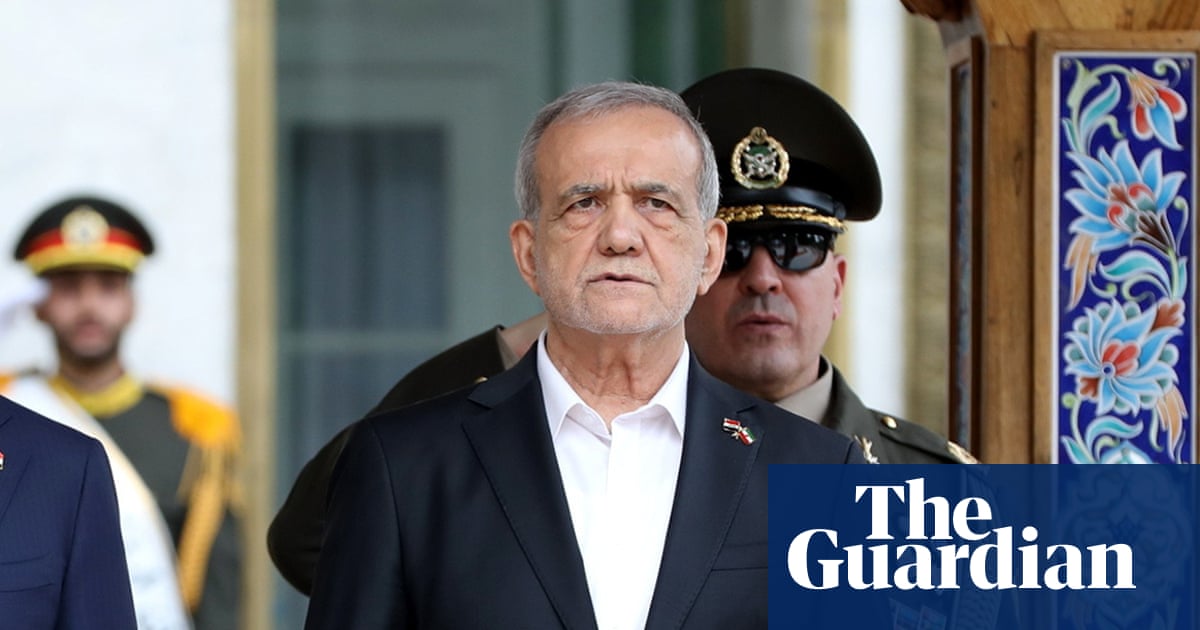
On a televised interview marking two years in office, Pezeshkian rejected resignation claims linked to the new supreme leader's family as he battles hardliners who call US negotiations 'futile.' The row exposes deep divisions over a Hormuz deal already in the works.
Analysis
A Denial Made on State Television
Iran's President Masoud Pezeshkian used a televised interview marking his second anniversary in office to push back against claims, splashed across Iranian front pages, that he had repeatedly threatened to resign. The allegations, attributed to Mohammad Bagher Kharazi — brother-in-law of the new supreme leader Mojtaba Khamenei — suggested Pezeshkian had grown frustrated at being frozen out of decision-making, especially as the supreme leader hides his whereabouts for fear of foreign intelligence. Pezeshkian's response was blunt: "If I want to resign, I will officially announce that I have resigned. I will not resign, I will stand." The denial matters because the accusation came from inside the ruling family, not from a fringe opponent, and because it surfaced at precisely the moment Iran is negotiating the reopening of one of the world's most important shipping lanes.
The timing is not coincidental. Pezeshkian's presidency was sold as a consensus-builder, and his defenders argue that pragmatism toward Washington is part of that mandate. But the interview appears designed to dispel a different impression: that the president's commitment to dialogue had become a liability, and that hardliners running the war effort were already marginalizing him. By preempting the resignation narrative on state television, Pezeshkian is signaling that he intends to remain in the chair through whatever comes next — and that the claim itself, not his conduct, is the scandal.
The Hormuz Concession and Its Domestic Critics
The diplomatic backdrop is a proposed arrangement under which ships would enter the Strait of Hormuz close to the Iranian coast but exit through a route passing through Iranian and Omani waters. US and European officials are pressing Oman to accept what Muscat privately fears is a formula that entrenches Iranian dominance of the chokepoint. Pezeshkian has framed the June memorandum of understanding as a "cornerstone" of future foreign relations, arguing Tehran must "compel the enemy to remain committed to what it has signed."
Hardliners reject that framing outright. The Assembly of Experts, dominated by conservatives, issued a statement on Monday calling hopes for a US agreement "futile" and describing "whispers of capitulation in the name of defending peace" as an "unforgivable betrayal." That institutional pushback suggests Pezeshkian faces not just rhetorical attacks but an organized campaign to delegitimize the diplomacy before it is concluded, even as Washington and Brussels reportedly believe a deal is imminent. Mehdi Tabatabaei, a senior member of the president's office, accused a "sinister coalition of lying, deceitful and reckless extremism" of acting as "puppets of Iran's enemies." Reformist journalist Ahmad Zeidabadi called the claims inflammatory. The exchange shows Pezeshkian's position is not merely under rhetorical attack — it is being tested by factions who may calculate that a weakened, distracted presidency serves their interest in the post-war order.
The Khamenei Succession Shadow
Underlying the row is the unresolved question of who actually runs Iran. The previous supreme leader was killed in the opening Israeli strike of the war, and his son Mojtaba was elevated to the post in March, according to the Guardian's reporting. He has not been seen in public since being badly injured in the same attack, and his office took the unusual step of publicly calling Kharazi's claim about the resignation warnings "fundamentally false and untrue." That an official denial was needed at all is itself a signal: even within the new inner circle, the rules of who can speak for the supreme leader are unsettled.
Critics note that Kharazi has a record of making unsubstantiated allegations and that it is unclear whether he has actually seen Mojtaba Khamenei since the latter's elevation. Regardless of the truth of the specific resignation claim, the episode reveals a regime in which the post-war power map is still being drawn, and where the elected president is fighting to keep his footing against rivals with closer ties to the new supreme leader and to wartime security institutions.
Key points
- President Pezeshkian publicly denied on state TV that he had repeatedly threatened to resign, accusing critics of seeking to 'create a rift' inside Iran.
- The resignation claims came from Mohammad Bagher Kharazi, brother-in-law of the new supreme leader Mojtaba Khamenei; Khamenei's office called the claim 'fundamentally false and untrue.'
- A deal to reopen the Strait of Hormuz is reportedly imminent, but ships would be routed close to Iran and through Iranian-Omani waters — a structure Omani officials privately fear entrenches Iranian dominance.
- The conservative Assembly of Experts called hopes for a US agreement 'futile' and labeled diplomacy an 'unforgivable betrayal,' exposing a sharp internal split.
- Mojtaba Khamenei has not been seen publicly since being injured in the Israeli strike that killed his father, leaving succession politics fluid and contested.
If Pezeshkian holds his ground and the June memorandum is implemented, the Strait of Hormuz could reopen on terms that restore confidence in global oil shipments. A successfully negotiated settlement would also vindicate his consensus-based approach and weaken hardliners who currently treat any deal as betrayal.
The Assembly of Experts' public condemnation of US talks and the proximity of the resignation claims to the supreme leader's family suggest an organized campaign to sink the Hormuz deal before it is signed. If hardliners prevail, negotiations could collapse, leaving the strait partially closed and oil supply routes exposed to renewed military escalation.
Market signals
- OIL A reported imminent US-Iran deal to reopen the Strait of Hormuz would ease the supply-route risk premium on crude, though hardline resistance and denial of an internal rift could derail the agreement.
AI-generated analysis of potential market relevance. Not financial advice.