Israel’s response to Trump’s Gaza peace plan: Silence from Netanyahu and a weekend of deadly strikes
Israeli Prime Minister Benjamin Netanyahu has not publicly commented on US President Donald Trump's Gaza peace plan, which calls for Hamas to disarm. Instead, Israel has increased airstrikes in Gaza, killing 28 people over the weekend.
Intelligence analysis by Llama
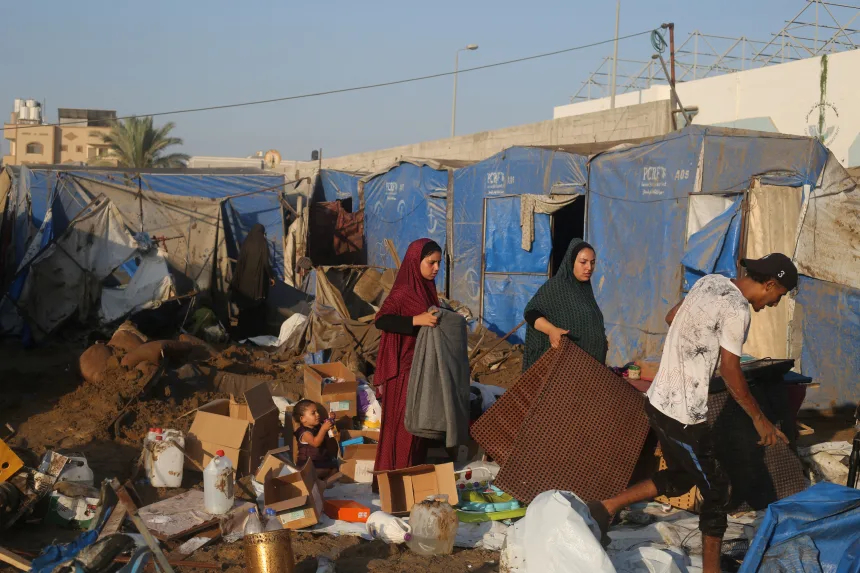
Israeli Prime Minister Benjamin Netanyahu has not commented on US President Donald Trump's Gaza peace plan, which calls for Hamas to disarm. Israel has increased airstrikes in Gaza, killing 28 people over the weekend, despite the plan's call for a halt to attacks.
Imagine you're trying to get two friends to agree on something. One friend, Israel, is not saying yes or no to a plan that the other friend, the US, thinks is a good idea. Meanwhile, Israel is doing something that makes the other friend, the US, unhappy. This is kind of like what's happening between Israel and the US right now. Israel is not saying yes or no to a plan that the US thinks is a good idea, and instead, Israel is doing something that makes the US unhappy.
Analysis
A $60B Vote of Confidence
The US President Donald Trump's Gaza peace plan has been met with a mix of reactions from the international community. While some have hailed it as a significant breakthrough, others have expressed concerns about its feasibility. The plan, which calls for Hamas to disarm, has been met with silence from Israeli Prime Minister Benjamin Netanyahu. Instead, Israel has increased airstrikes in Gaza, killing 28 people over the weekend. The escalation has drawn a sharp rebuke from Nickolay Mladenov, the chief envoy for Trump's Board of Peace. Mladenov wrote on X that the weekend's violence had 'killed civilians and destroyed medical supplies,' warning it was undermining 'intense efforts' to advance the disarmament framework. Behind the scenes, two sources familiar with the matter said the rebuke reflected 'anger' among the US and the international mediators who demanded Israel halt its strikes in Gaza. Hours after the tweet, Mladenov arrived in Israel on Monday to meet Netanyahu, alongside Aryeh Lightstone, a senior US adviser to the Board of Peace. The meeting was 'constructive and detailed,' according to a Board of Peace readout on X. It said that while the goal of full decommissioning of weapons and a transition to civilian government in Gaza was 'not in question' by Israel or the Board, the process for getting there was 'still being worked out.' A source familiar with the meeting said the two envoys had also pressed Netanyahu to stop Israeli attacks. Any hope that the meeting might prompt a public softening appeared unfounded when an Israeli official issued a statement after the meeting stressing that 'Israel will not withdraw from the current line in the Gaza Strip and will continue to thwart any threat to our civilians and soldiers.' The statement reiterated Israel's refusal to pull troops back to the original demarcation line defined by the October 2025 ceasefire agreement, which the Israeli military has since pushed farther into Gaza. Hamas has said it will only follow through with its promise of disarmament if Israel withdraws from the additional territory. While Netanyahu remains quiet, his political allies are not – underscoring the political sensitivity of Trump's Gaza plan fewer than three months before Israel's October elections. The stakes escalated Monday with a formal letter to Netanyahu from far-right Finance Minister Bezalel Smotrich and Settlements Minister Orit Strouk, urging the prime minister to immediately convene the security cabinet and block the entry of the international stabilization force (ISF) into Gaza – a deployment approved by the same Cabinet just last week, and meant to oversee security in a pilot zone in the territory A lawmaker from Netanyahu's own Likud party was particularly blunt. 'You can wrap tomorrow's fish with this agreement; it has no meaning. Not a single soldier will move from Beit Hanoun or Khan Younis,' Amit Halevi said in an interview, making reference to two towns inside Gaza. The timing of Israel's general election is significant and Israeli sources assess Netanyahu will not withdraw from any territory before the vote. One source said Netanyahu is highly skeptical that Hamas intends to disarm and believes instead that group is using the framework to buy time and avert another Israeli military campaign. 'He is wary of confronting Trump directly and is instead hoping Hamas fails to comply – a scenario which he hopes will grant Israel legitimacy for renewed military action.' Thousands of shoes are placed on Scheveningen Beach during a public memorial to symbolize children killed in Gaza, in The Hague, Netherlands, on August 1. Mouneb Taim/Anadolu/Getty Images Netanyahu, who has traditionally seen Trump as a valuable campaign asset, is walking a fine line. A senior US administration official said Thursday that Trump would be 'very, very disappointed' if Israel didn't comply with the new agreement. A diplomatic source said the plan's future depends largely on how much pressure Trump is willing to put on Netanyahu, arguing that 'the only party that can move him (Netanyahu), or stop him, is the United States.' Michael Milstein, a senior researcher at Tel Aviv University's Dayan Center and a former senior official in Israeli military intelligence, said the weekend's toll was no accident and was likely sending one of two signals 'It is an Israeli attempt to say that we are moving forward despite the restrictions … or it reflects a fear that the gate is about to close soon, so let's clean out the bank,' he said. Milstein also agreed the key factor now is Trump. 'If he presses Netanyahu to accept withdrawal terms before the election, that would amount to a political blow.' Milstein said he expects Netanyahu to choose delaying tactics rather than outright rejection.
Key points
- Israeli Prime Minister Benjamin Netanyahu has not commented on US President Donald Trump's Gaza peace plan.
- Israel has increased airstrikes in Gaza, killing 28 people over the weekend.
- The escalation has drawn a sharp rebuke from Nickolay Mladenov, the chief envoy for Trump's Board of Peace.
- Netanyahu's silence on the plan has sparked concerns about Israel's intentions.
- The plan's fate now depends on how much pressure Trump is willing to put on Netanyahu.
If Netanyahu accepts the Gaza peace plan, it could lead to a significant reduction in violence in the region. The plan's success would also demonstrate the effectiveness of international diplomacy in resolving conflicts.
If Netanyahu rejects the Gaza peace plan, it could lead to a further escalation of violence in the region. The plan's failure would also undermine the credibility of international diplomacy and make it more difficult to resolve future conflicts.