Macron refuses minister’s resignation after huge protests rock France – Europe live
French President Emmanuel Macron has rejected Interior Minister Laurent Nuñez's resignation offer following widespread riots across France, while also addressing ongoing Russian attacks in Ukraine and political developments in Sweden.
Intelligence analysis by Gemini 2.5 Flash
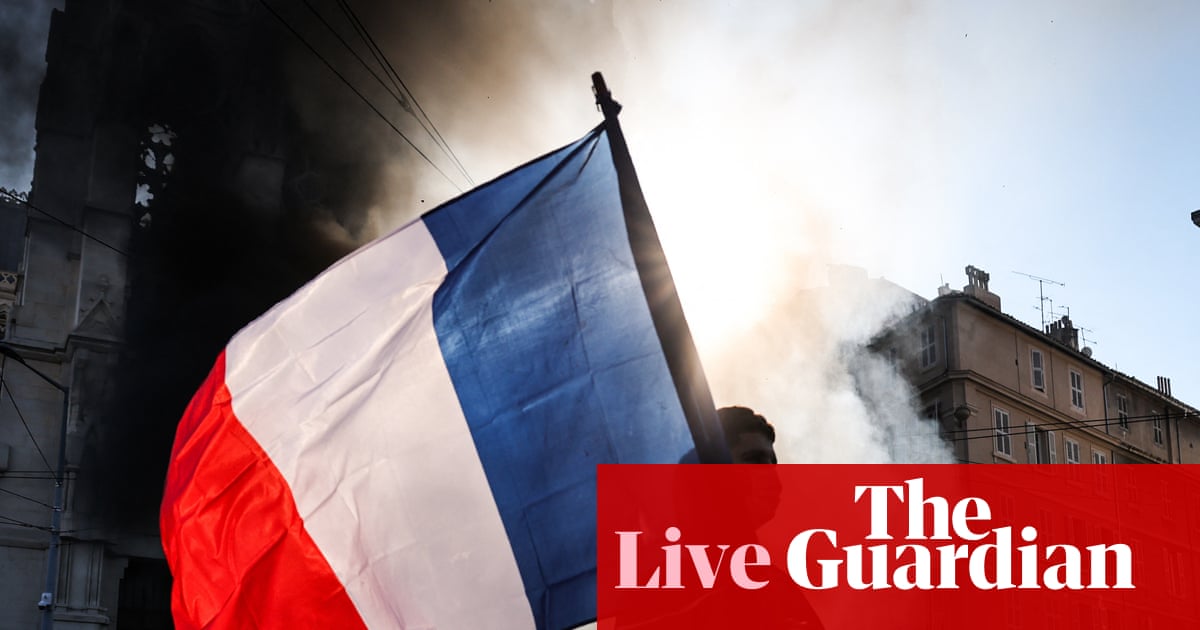
France is grappling with the aftermath of severe weekend riots, prompting President Macron to retain his interior minister despite acknowledged 'failures' and call for new security measures. Concurrently, Ukraine's President Zelenskyy has expressed frustration over a lack of intelligence from US partners regarding Russian missile attacks, and Sweden is navigating its government format…
Imagine there's a big playground fight in France, and the principal, Mr. Macron, decides to keep the teacher in charge of safety, Mr. Nuñez, even though things got a bit out of control. Mr. Macron wants Mr. Nuñez to find new ways to stop the troublemakers. Meanwhile, in another part of the world, the leader of Ukraine, Mr. Zelenskyy, is upset because his friends aren't giving him enough warning about attacks from a bully, and he feels they're not seeing how serious the situation really is.
Analysis
Laurent Nuñez
President Emmanuel Macron's decision to decline Interior Minister Laurent Nuñez's resignation offer comes amidst a backdrop of widespread civil unrest and acknowledged 'failures in anticipation and intelligence' regarding the recent riots. Macron emphasized the necessity of maintaining a stable chain of command within France's police and security forces during this volatile period. He has also tasked Nuñez with swiftly implementing new operational methods to effectively manage looters and restore order across the country.
Nuñez himself publicly admitted in a television interview that police forces 'lost control' in certain cities during the weekend's protests. This admission underscores the severity of the situation and the challenges faced by law enforcement in containing the 'unbridled violence' that gripped French urban centers. The president's decision to keep Nuñez suggests a preference for continuity and a focused effort on immediate security reforms rather than a leadership change during a crisis.
2,400 Arrests
The recent weekend witnessed some of the most violent unrest in France in years, leading to significant destruction and a large number of arrests. Public buildings were set ablaze, hundreds of shops were looted and destroyed, and at least 2,400 individuals were arrested across various cities. This scale of disruption prompted President Macron to deliver a televised address to the nation, where he condemned the 'unbridled violence' and questioned the motivations behind such destructive acts.
Macron's address reflected a national sentiment of disbelief and concern, as he posed the rhetorical question, 'how could French people do this to France?' The widespread nature of the protests, which included clashes with police and significant property damage, indicates deep-seated grievances within parts of the French populace. The authorities in Marseille, for instance, responded by issuing a ban on all public gatherings and demonstrations, highlighting the urgent need to prevent further escalation of violence.
Volodymyr Zelenskyy
Beyond France's domestic turmoil, the article also touches upon the ongoing conflict in Ukraine, with President Volodymyr Zelenskyy expressing growing frustration with international partners, particularly the United States. Following another night of heavy Russian attacks that resulted in casualties and damage to civilian infrastructure, Zelenskyy confirmed that Ukraine received no prior intelligence warnings from the US. He seemingly accused Washington of being in a 'state of denial' regarding the realities of the war.
Zelenskyy's remarks highlighted a perceived disconnect between Ukraine's urgent need for defensive aid, specifically missiles for air defense, and the actions of its partners. He criticized instances where such deliveries are reportedly blocked, or sanctions against Russia are delayed, while Russia continues its aggressive actions. The Ukrainian president reiterated that Ukraine has consistently sought a dignified end to the war and responded positively to ceasefire proposals, only to be met with continued ballistic missile attacks and killings from Russia, emphasizing Putin's unwillingness to de-escalate.
Key points
- French President Macron refused Interior Minister Laurent Nuñez's resignation after widespread riots.
- Macron tasked Nuñez with implementing new operational methods for security forces to handle looters.
- Nuñez admitted police 'lost control' in some cities during the protests, which led to 2,400 arrests.
- Marseille authorities banned public gatherings and demonstrations following the unrest.
- Ukrainian President Zelenskyy criticized US partners for not providing early warnings about Russian missile attacks and for being in 'denial of reality'.
- Russian attacks on Ukraine killed at least one person and injured eight, damaging energy facilities, a medical clinic, and residential buildings.
President Macron's decision to retain Interior Minister Nuñez and task him with developing 'new operational methods' could lead to more effective strategies for managing public order and preventing future widespread unrest in France. This focused approach might help stabilize the country and address the underlying issues contributing to the protests.
The continued unrest in France, coupled with the interior minister's admission of police losing control, suggests a potential for further escalation and prolonged instability. In Ukraine, President Zelenskyy's public criticism of US partners could strain diplomatic relations, potentially impacting the flow of crucial aid and prolonging the conflict.