Majority of EU countries call for talks over migrant influx into Ceuta enclave
A majority of EU countries called for emergency talks on the sudden inflow of tens of thousands of migrants into Spain's enclave of Ceuta in North Africa. An open letter from the leaders of 22 of the EU's 27 members demanded the bloc's interior ministers have a video meet…
Intelligence analysis by Llama
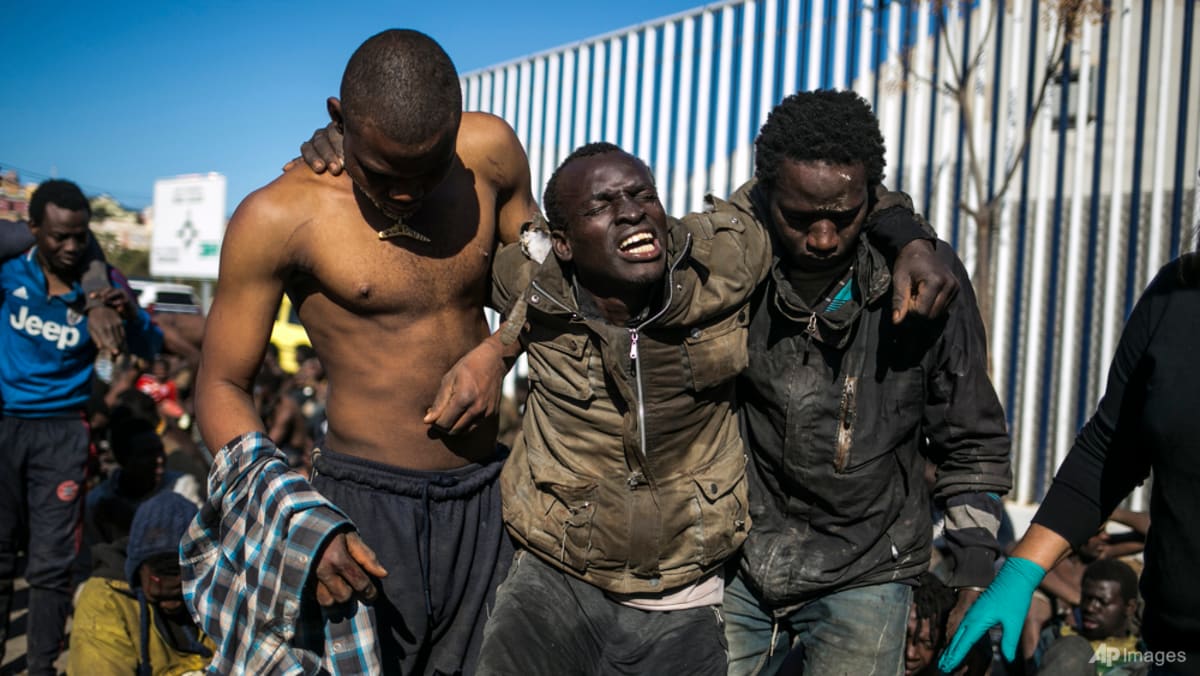
A majority of EU countries have called for emergency talks on the migrant influx into Ceuta enclave in North Africa. The EU leaders demand a speedy coordinated response to prevent further uncontrolled crossings.
Imagine a big wall that separates two countries. Suddenly, a huge number of people try to cross the wall at the same time. This is what happened in Ceuta, a small Spanish town in North Africa. The EU countries are worried about this and want to talk about how to stop it from happening again.
Analysis
A $60B Vote of Confidence
The sudden inflow of tens of thousands of migrants into Spain's enclave of Ceuta in North Africa has sparked a call for emergency talks among EU countries. An open letter from the leaders of 22 of the EU's 27 members demanded the bloc's interior ministers have a video meeting to agree a speedy coordinated response. The letter, initiated by Italian Prime Minister Giorgia Meloni and her Danish counterpart Mette Frederiksen, emphasized the need for a shared responsibility in defending the external borders of the Union. The signatories, including German Chancellor Friedrich Merz and the prime ministers of Hungary, Sweden, and Poland, but not the French and Portuguese leaders, whose countries directly border Spain, urged ministers to consider enhanced Frontex support and the effectiveness of EU cooperation with Morocco. The letter also highlighted the importance of preventing uncontrolled mass crossings, the instrumentalization of migration, or other hybrid threats that could create the perception that illegal entry into the European Union is possible. The situation in Ceuta is nearly back to normal, with nearly all of the 60,000 migrants who breached the border since Wednesday having left. However, the incident has raised concerns about the EU's ability to respond to such situations and the need for a coordinated approach to prevent further uncontrolled crossings. The EU foreign policy chief Ursula von der Leyen welcomed the move, saying the bloc needed a 'lessons learned process to improve our European resilience.' The EU's response to the migrant influx into Ceuta enclave will be closely watched, as it will set a precedent for future situations. The EU's ability to respond to such situations will be crucial in maintaining the trust of its citizens and preventing further uncontrolled crossings. The situation in Ceuta has also highlighted the need for a more effective EU cooperation with Morocco, which is essential in preventing uncontrolled mass crossings. The EU's response to the migrant influx into Ceuta enclave will be a test of its ability to respond to such situations and prevent further uncontrolled crossings. The EU's ability to respond to such situations will be crucial in maintaining the trust of its citizens and preventing further uncontrolled crossings.
Key points
- A majority of EU countries called for emergency talks on the migrant influx into Ceuta enclave in North Africa.
- The EU leaders demand a speedy coordinated response to prevent further uncontrolled crossings.
- The situation in Ceuta is nearly back to normal, with nearly all of the 60,000 migrants who breached the border since Wednesday having left.
- The EU's response to the migrant influx into Ceuta enclave will be closely watched, as it will set a precedent for future situations.
- The EU's ability to respond to such situations will be crucial in maintaining the trust of its citizens and preventing further uncontrolled crossings.
The EU's response to the migrant influx into Ceuta enclave could lead to a more effective and coordinated approach to preventing uncontrolled mass crossings. This could improve the EU's ability to respond to such situations and maintain the trust of its citizens.
The EU's response to the migrant influx into Ceuta enclave could be slow and ineffective, leading to further uncontrolled crossings and a loss of trust among its citizens. This could also lead to a breakdown in EU cooperation with Morocco, making it harder to prevent uncontrolled mass crossings.