Mecca pact does not give Pakistan a blank cheque
A new defense pact between Pakistan, Saudi Arabia, and Turkey is being analyzed by India. While it suggests mutual defense, it doesn't automatically grant Pakistan a blank check for security, especially concerning India.
Intelligence analysis by Gemini 2.5 Flash Lite
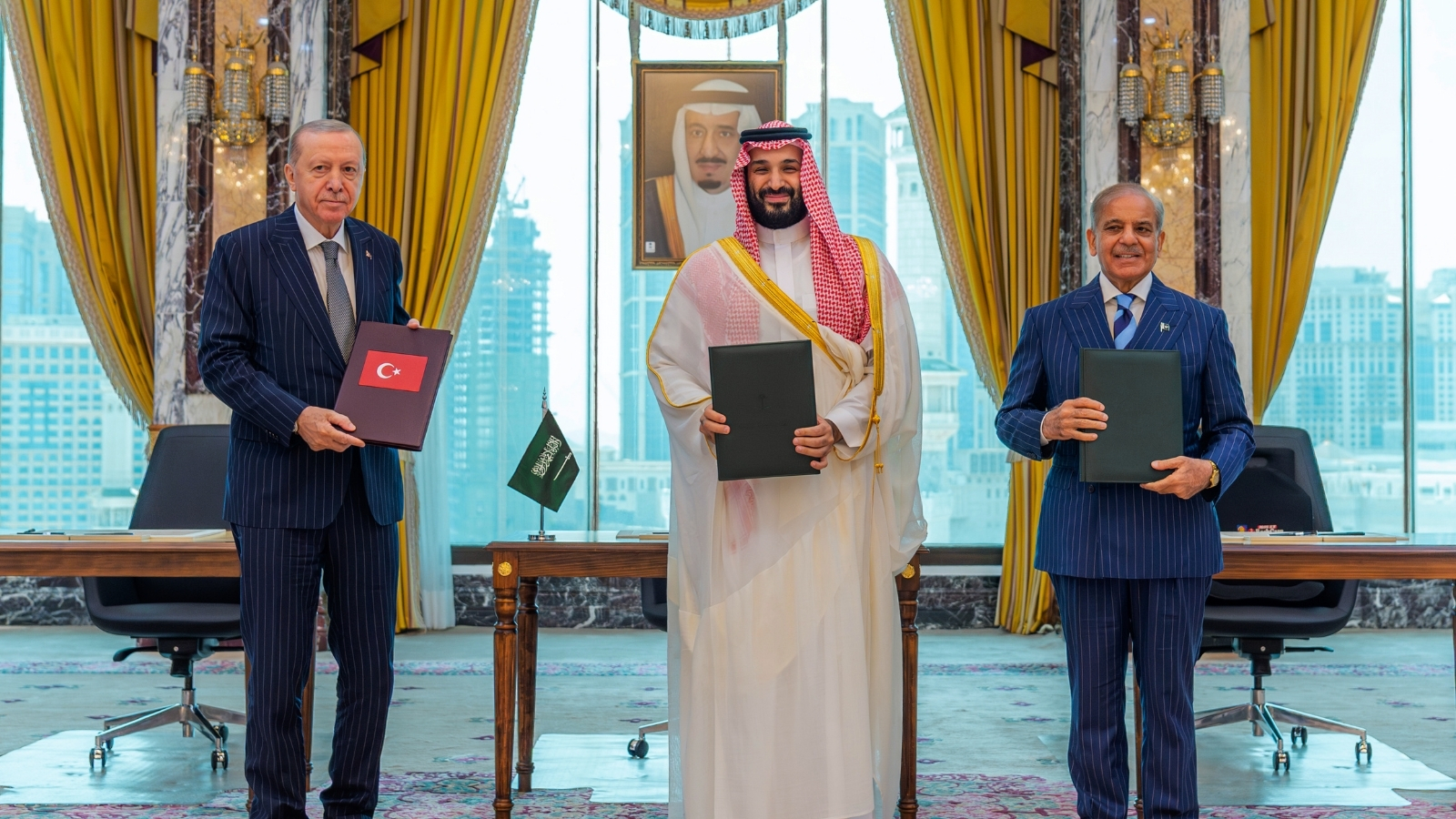
India is closely watching the Mecca Joint Defence Agreement, signed by Pakistan, Saudi Arabia, and Turkey. The pact's mutual defense clause is interpreted by some as extending Pakistan's security umbrella, but the article argues this is an incomplete reading, as it relies on established international law and the strategic interests of Saudi Arabia and Turkey.
Imagine three friends making a pact to protect each other if someone attacks them. This new agreement is like that, but for Pakistan, Saudi Arabia, and Turkey. India is watching because it doesn't want this pact to be used unfairly, like a shield for bad behavior, especially if it involves Pakistan causing trouble.
Analysis
Mecca Joint Defence Agreement
The Mecca Joint Defence Agreement, signed on August 7 by Pakistan, Saudi Arabia, and Turkey, has prompted careful consideration from India regarding its regional security implications and impact on bilateral ties. The core provision, stipulating that an armed attack on one signatory is an attack on all, has led to interpretations of an expanded security cover for Pakistan. However, the article posits that this view is incomplete. The agreement is framed defensively, aiming for collective deterrence against external aggression, especially in light of evolving security arrangements in West Asia. Official statements from Riyadh and Ankara emphasize its non-directional nature, openness to other participants, and non-supersession of existing commitments.
International Law and Thresholds
Legally, the agreement operates under Article 51 of the UN Charter, recognizing the right to self-defense. It creates an expectation of mutual assistance but does not extend this right beyond the established limits of necessity and proportionality. The threshold for an "armed attack" requires a significant scale and gravity of effects; mere support for non-state actors or consequences of proxy activity do not automatically meet this standard. Crucially, the pact addresses unprovoked armed attacks and does not shield actions resulting from state-sponsored terrorism. Any invocation against India would necessitate a political determination by Saudi Arabia and Turkey that an Indian response constituted an armed attack, implying an acknowledgement of Pakistan's role in initiating the action – a step neither capital has been inclined to take when costs are high.
Strategic Interests of Signatories
The practical impact of the agreement is significantly constrained by the strategic and economic interests of the stronger parties. Saudi Arabia's priorities remain focused on regime stability, economic transformation under Vision 2030, energy markets, and managing Iranian influence. Its substantial economic ties with India, including over $40 billion in annual trade, significant crude oil supply, and billions in investment, provide little incentive to jeopardize this relationship for Pakistan's tactical objectives. Turkey's position is more complex, balancing political support for Pakistan with meaningful commercial interests in India, including multi-billion-dollar trade volumes. While past tensions have led to trade and tourism contractions, pragmatic adjustments have occurred. For Pakistan, its economic fragility and dependence on external financing limit its capacity for uncontrolled escalation, narrowing the scope for independent adventurism when key partners have reasons to maintain stability.
Key points
- A new defense pact between Pakistan, Saudi Arabia, and Turkey has been signed, prompting India's careful review.
- The agreement's mutual defense clause is not an automatic security guarantee for Pakistan, especially against India.
- International law and the strategic interests of Saudi Arabia and Turkey are key constraints on the pact's application.
- Support for non-state actors or proxy activity does not automatically meet the threshold for an 'armed attack' under the pact.
- Economic ties and strategic priorities of Saudi Arabia and Turkey with India are significant factors limiting the pact's potential for escalation.
The agreement could foster greater regional stability if its defensive provisions are clearly understood and respected by all parties, preventing misinterpretations that could lead to escalation. Saudi Arabia and Turkey's commitment to their own economic and strategic interests with India may act as a stabilizing factor, ensuring the pact is not used to provoke conflict.
There is a risk that Pakistan could misinterpret the pact as a guarantee for aggressive actions, potentially testing the resolve of Saudi Arabia and Turkey. If a conflict were to arise, the involvement of these major powers could significantly destabilize the region, impacting global energy markets and economic ties.