Middle East crisis live: Hamas will hand over weapons to new Gaza administration, says official, but deal depends on Israeli withdrawal
Hamas has indicated it will disarm and transfer weapons to a new Gaza administration, but only if Israeli troops withdraw and an international force dismantles Israeli-backed militias, a proposal already rejected by an Israeli minister.
Intelligence analysis by Gemini 2.5 Flash
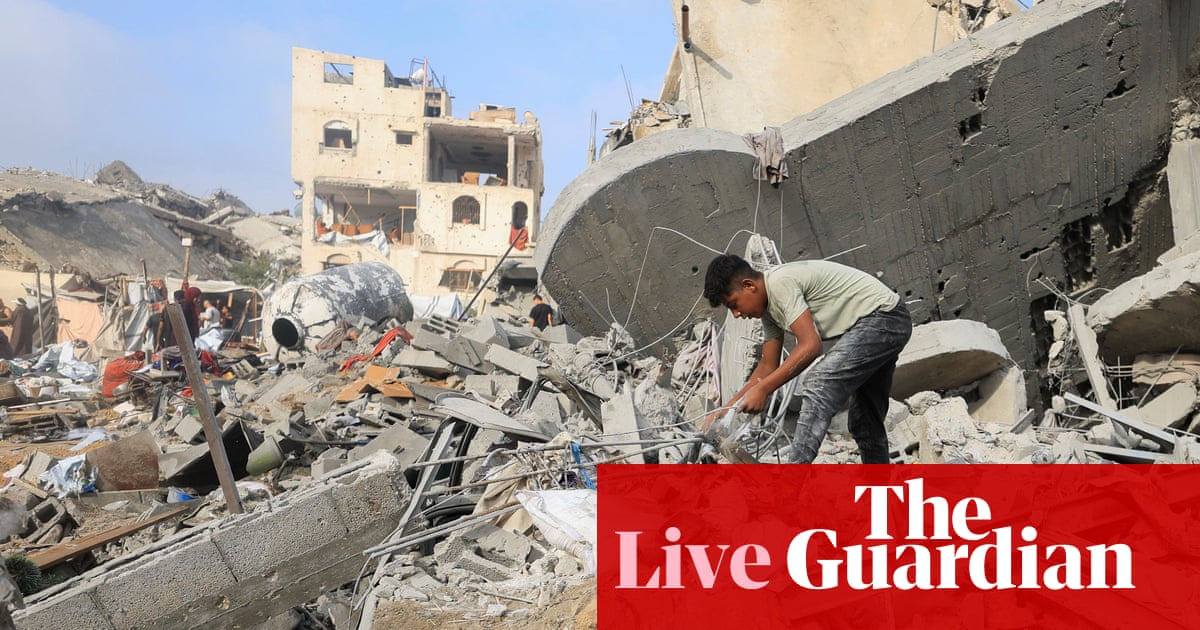
A potential deal for Hamas's disarmament in Gaza, announced by Donald Trump, faces significant hurdles as a Hamas official links it to an Israeli withdrawal and an Israeli minister vehemently rejects the plan, highlighting deep divisions amidst escalating regional conflicts involving Iran and rising energy prices.
Imagine two groups fighting over a playground. One group, Hamas, says they'll put away their toys if the other group, Israel, leaves the playground and a new grown-up supervisor comes in. But one of Israel's leaders says "no way!" and wants to keep fighting. Meanwhile, other big countries are also having arguments nearby, making everyone worried and even making the price of gas for cars go up.
Analysis
The Proposed Gaza Disarmament
A significant development in the ongoing Middle East crisis centers on a proposed agreement for the "complete disarmament" of Hamas in Gaza, as announced by Donald Trump. According to Hamas official Ghazi Hamad, the group is prepared to hand over its weapons to a newly established entity, the National Committee for the Administration of Gaza (NCAG), which was formed by Trump's Board of Peace to manage the territory's daily affairs. This move, if realized, would represent a fundamental shift in the power dynamics within Gaza and a potential pathway out of the protracted conflict.
However, the proposed disarmament is not unconditional. Hamad explicitly stated that the transfer of weapons is contingent upon the full withdrawal of Israeli troops from Gaza. Furthermore, he emphasized the necessity for the NCAG, supported by an international force, to enter Gaza and dismantle any Israeli-backed militias. These conditions introduce complex logistical and political challenges, requiring significant concessions and coordination from multiple parties, including Israel and international actors, to be met.
Israeli Rejection and Regional Tensions
Despite the announcement of a potential deal, its immediate future appears precarious due to strong opposition from within the Israeli government. Itamar Ben-Gvir, Israel’s Minister of National Security, swiftly rejected the draft agreement, labeling it "not acceptable" to Israel. His public comments underscore a deep ideological divide, as he argued that a commitment to cease targeted killings of Hamas members would allow the organization to regroup for future attacks. Ben-Gvir's stance insists on the continuation of military operations and the encouragement of emigration from Gaza, reflecting a hardline approach that directly contradicts the spirit of the proposed disarmament.
This internal Israeli dissent highlights the formidable political hurdles facing any peace initiative. The article also frames the Gaza situation within a broader context of escalating regional tensions, particularly involving Iran. The Islamic Revolutionary Guard Corps (IRGC) claimed to have struck two tankers in the Strait of Hormuz, asserting they were under US military escort and attempting to use an "undeclared route." This incident, following a period of renewed fighting between Iran and the US, has led to the near-complete closure of the vital waterway, significantly impacting global energy markets.
Broader Geopolitical Implications
The intertwining of the Gaza disarmament proposal with the wider US-Iran conflict underscores the complex and interconnected nature of Middle Eastern geopolitics. The Strait of Hormuz incident, which saw crude oil prices surge past $90 a barrel after US retaliatory strikes against Iran, demonstrates how regional flashpoints can have immediate and far-reaching global economic consequences. The ongoing US-Iran confrontation, described as a "stalling war" by Trump as he gathered his cabinet, adds another layer of instability to an already volatile region.
The proposed Gaza deal, even if it were to gain traction, would operate within this highly charged environment. The conditions set by Hamas, coupled with Israel's immediate rejection from a prominent minister, suggest that a comprehensive resolution remains distant. The involvement of Trump's Board of Peace and the mention of a US-backed administration ready to govern Gaza indicate significant international efforts to shape the region's future, yet these efforts are clearly met with substantial resistance and ongoing military actions from various parties. The overall situation points to a prolonged period of uncertainty and conflict, with significant implications for regional stability and global energy security.
Key points
- Hamas official Ghazi Hamad stated the group would hand over weapons to the new National Committee for the Administration of Gaza (NCAG).
- This disarmament is contingent on the withdrawal of Israeli troops and the dismantling of Israeli-backed militias by the NCAG and an international force.
- Donald Trump announced an agreement for "complete disarmament" of Hamas, with his Board of Peace publishing a roadmap.
- Israeli Minister of National Security Itamar Ben-Gvir publicly rejected the peace plan, calling it "not acceptable" and advocating for continued targeted killings.
- Separately, Iran's IRGC claimed to have struck two tankers in the Strait of Hormuz under US escort, contributing to soaring energy prices.
If the proposed deal were to somehow overcome current objections and be implemented, it could lead to a significant de-escalation of conflict in Gaza, potentially paving the way for a new, stable administration and reducing the immediate humanitarian crisis. A successful disarmament could also foster a more conducive environment for broader peace talks in the region.
The immediate rejection by a key Israeli minister and the ongoing regional hostilities, including Iran's actions in the Strait of Hormuz, suggest the deal is unlikely to progress. This could lead to continued violence in Gaza, further destabilization of the Middle East, and sustained high energy prices, exacerbating global economic and political tensions.
Market signals
- OIL The article reports that the Strait of Hormuz closure and US-Iran conflict have sent energy prices soaring, with crude oil pushing past $90 a barrel.
AI-generated analysis of potential market relevance. Not financial advice.