Middle East crisis live: US launches new round of airstrikes to ‘swiftly punish’ Iran after American troops killed
The US launched new airstrikes against Iran, targeting military and maritime facilities, in retaliation for an attack in Jordan that killed two American service members. This escalation follows the breakdown of a month-old ceasefire deal.
Intelligence analysis by Gemini 2.5 Flash
The Middle East crisis has intensified with the US conducting its eighth consecutive night of airstrikes against Iran, aiming to punish the Revolutionary Guard for a deadly attack on US troops in Jordan and degrade its ability to threaten shipping. Iran's supreme leader has warned of further costs for Washington, as attacks also hit Kuwaiti infrastructure, signaling a broader regional…
Imagine two big kids, the US and Iran, who were trying to be friends but then one of them, Iran, hurt some of the US's friends. Now, the US is really mad and is hitting Iran back with air attacks to punish them and stop them from causing more trouble, especially near a very important sea road where ships carry oil. This makes everyone worried that their big fight could get even bigger and hurt more people and places nearby.
Analysis
US Retaliation and Strategic Goals
The United States military has initiated a fresh wave of airstrikes against Iran, explicitly stating its intent to "swiftly punish" the country's Revolutionary Guard. These strikes, directed by President Donald Trump, come in direct response to an attack in Jordan that resulted in the deaths of two American service members, with one missing and four hospitalized. Beyond immediate retribution, the US Central Command (Centcom) indicated that the operations are designed to "further degrade" Iran's capacity to threaten commercial shipping, particularly in the strategically vital Strait of Hormuz.
Targets included Iranian military coastal surveillance and air defense facilities, maritime capabilities, and missile and drone storage sites. This marks the eighth consecutive night of US strikes against Iran, underscoring a sustained and aggressive posture. The US president described the deaths as a "shame" and linked Iran's actions to its pursuit of nuclear weapons, framing the conflict as a necessary measure to counter Iranian aggression.
Escalation Beyond Ceasefire
The recent surge in hostilities represents a significant breakdown in regional stability, particularly following the collapse of a framework ceasefire deal signed just a month prior. The article highlights that the two US troop deaths were the first from direct Iranian fire since the initial stages of the war, marking a critical turning point. Iran's supreme leader, Mojtaba Khamenei, had warned Washington would pay for "seeking to escalate the conflict" even before the latest US strikes, and later stated that US actions showed Trump's signature was "utterly worthless and devoid of credibility," promising "even heavier costs and further humiliation" for the US.
This exchange of attacks has rapidly intensified, with both sides suffering casualties. The American deaths bring the total number of US service members killed since the war began to 16, with over 430 injured. Iran's health ministry reported 50 people killed and more than 500 injured in US strikes over the past three weeks, indicating a severe human cost to the escalating conflict.
Regional Repercussions and Broader Conflict
The conflict's reach extends beyond direct US-Iran confrontations, impacting other nations in the Middle East. Kuwait, a US Gulf ally, reported significant damage from Iranian strikes, including hits on a water desalination plant and an oil facility. This marks the second attack on a desalination plant in two days in Kuwait, a nation heavily reliant on desalination for its drinking water, highlighting the vulnerability of critical infrastructure in the region. Iran's army claimed to have targeted two US bases in Kuwait with drones, hitting an ammunition depot and radar systems.
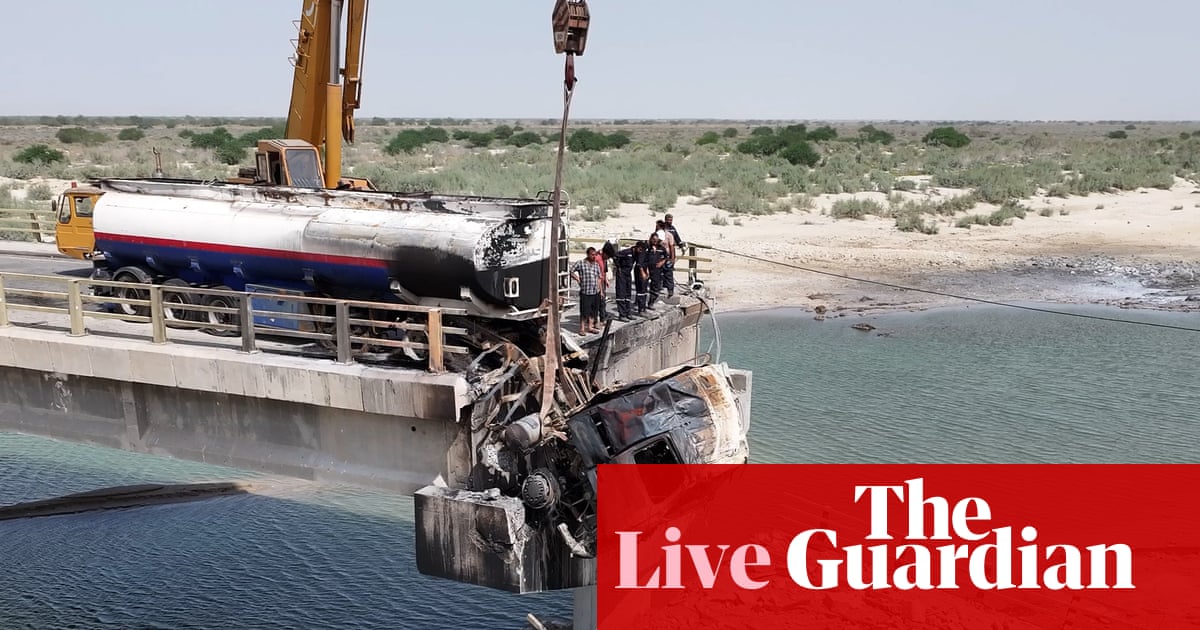
Furthermore, Iran appeared to target Saudi Arabia and other US Gulf allies, as well as Jordan, following US attacks on Iranian bridges, power facilities, and other infrastructure. In Iraq, a base of the Kurdistan Freedom party, an Iranian Kurdish dissident group, was struck by a drone, wounding eight members. These incidents underscore the widening scope of the conflict, raising concerns about broader regional destabilization and the potential for a return to an all-out war scenario, as explicitly noted in the article.
Key points
- The US launched new airstrikes against Iran, its eighth consecutive night of attacks, in retaliation for an Iranian strike that killed two US service members in Jordan.
- The US aims to "swiftly punish" Iran's Revolutionary Guard and "further degrade" its ability to threaten commercial shipping in the Strait of Hormuz.
- Iran's supreme leader warned of "even heavier costs" for the US, following the breakdown of a month-old ceasefire deal.
- Iranian attacks also targeted Kuwait, hitting a water desalination plant and an oil facility, and potentially Saudi Arabia and other US Gulf allies.
- The conflict has resulted in 16 US service member deaths and over 430 injuries, while Iran's health ministry reported 50 killed and over 500 injured in US strikes.
The current escalation, marked by direct US troop deaths and retaliatory strikes, significantly increases the risk of a full-scale war between the US and Iran. This could lead to further casualties, widespread regional instability, and severe disruptions to global energy supplies, as critical infrastructure in Gulf nations becomes targets.
Market signals
- OIL Escalation of conflict in the Middle East, particularly near the vital Strait of Hormuz and attacks on oil facilities in Kuwait, increases supply-route risk and could drive oil prices higher.
AI-generated analysis of potential market relevance. Not financial advice.