NASA To Send Another Telescope to Join Hubble and Webb in Deep Space Exploration
NASA is set to launch its next flagship space observatory, the Nancy Grace Roman Space Telescope, this Sunday from Kennedy Space Center in Florida. The telescope will investigate some of the universe's biggest mysteries, including dark energy and dark matter, while also h…
Intelligence analysis by Llama
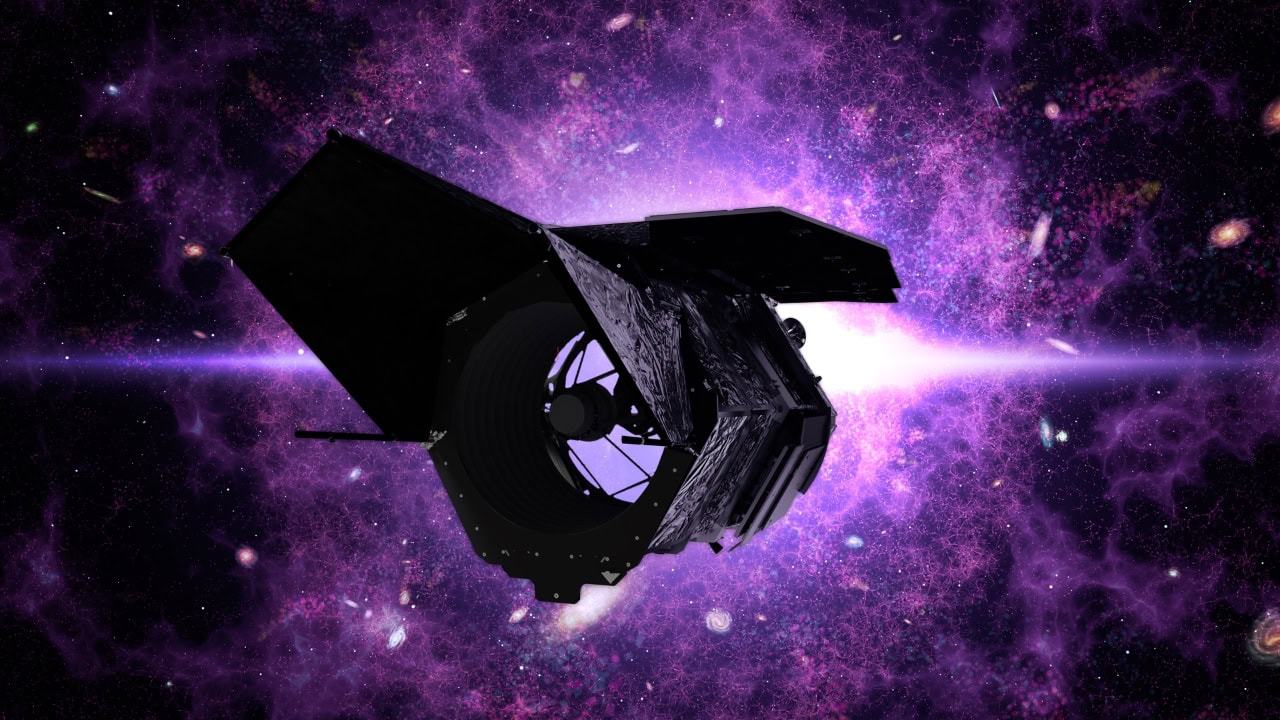
The Roman Space Telescope is the next step after the Hubble Space Telescope and the James Webb Space Telescope, and it brings new capabilities that will build on the incredible discoveries made by these groundbreaking observatories. The telescope will travel toward Lagrange Point 2, a location roughly a million miles from Earth and about four times the distance to the moon.
Imagine you have a super powerful pair of binoculars that can see really far away. The Roman Space Telescope is like that, but instead of looking at mountains and trees, it looks at stars and galaxies. It's going to help us learn more about the universe and how it works.
Analysis
The Roman Space Telescope: A New Era in Space Exploration
The Nancy Grace Roman Space Telescope is the next flagship space observatory from NASA, set to launch this Sunday from Kennedy Space Center in Florida. This mission marks a significant step forward in space exploration, building on the incredible discoveries made by the Hubble Space Telescope and the James Webb Space Telescope. The Roman Space Telescope will investigate some of the universe's biggest mysteries, including dark energy and dark matter, while also hunting for planets beyond our solar system.
A Reimagined Design
The Roman Space Telescope is a reimagination of the original Roman telescope, designed to be more efficient and effective in its mission. The telescope will travel toward Lagrange Point 2, a location roughly a million miles from Earth and about four times the distance to the moon. This location provides a stable and quiet environment for the telescope to operate, allowing it to make precise measurements of the universe.
A Comprehensive Exoplanet Search
The Roman Space Telescope will conduct one of the most comprehensive exoplanet searches ever attempted. Scientists expect it to discover thousands of new planets and provide the first statistical census of planetary systems resembling our own. This mission will help us understand the diversity of planetary systems and how they form and evolve over time.
Direct Imaging of Exoplanets
The Roman Space Telescope will also demonstrate new technology capable of directly imaging relatively nearby exoplanets. This technology will allow scientists to study the atmospheres of exoplanets and search for signs of life. The telescope will be able to directly image exoplanets that are as close as 100 light-years from Earth, providing a unique opportunity to study these distant worlds.
Unlocking the Fundamental Nature of Dark Matter and Dark Energy
The Roman Space Telescope will also help scientists understand dark matter and dark energy, which are still unknown. Dark matter is a type of matter that does not emit, absorb, or reflect any electromagnetic radiation, making it invisible to our telescopes. Dark energy, on the other hand, is a mysterious force that is driving the acceleration of the universe's expansion. The Roman Space Telescope will provide critical keys to understanding these phenomena, helping us unlock the fundamental nature of the universe.
Key points
- The Roman Space Telescope is the next flagship space observatory from NASA.
- The telescope will investigate some of the universe's biggest mysteries, including dark energy and dark matter.
- The Roman Space Telescope will conduct one of the most comprehensive exoplanet searches ever attempted.
- The telescope will demonstrate new technology capable of directly imaging relatively nearby exoplanets.
- The Roman Space Telescope will help scientists understand dark matter and dark energy.
If the Roman Space Telescope is successful, it could lead to a major breakthrough in our understanding of dark matter and dark energy. This could have significant implications for our understanding of the universe and its evolution.
However, there are also risks associated with the Roman Space Telescope mission. For example, the telescope's instruments may not perform as expected, or the data may be difficult to interpret. Additionally, the mission may be delayed or cancelled due to unforeseen circumstances.