New Flood Danger: Authorities in Nepal and Tibet Suspend Search
Authorities in Nepal and Tibet have suspended search and rescue operations for flash flood victims due to the imminent danger of a new flood wave. A lake formed by mud and debris is overflowing, exacerbated by continuous rainfall, prompting rescue teams to retreat.
Intelligence analysis by Gemini 2.5 Flash
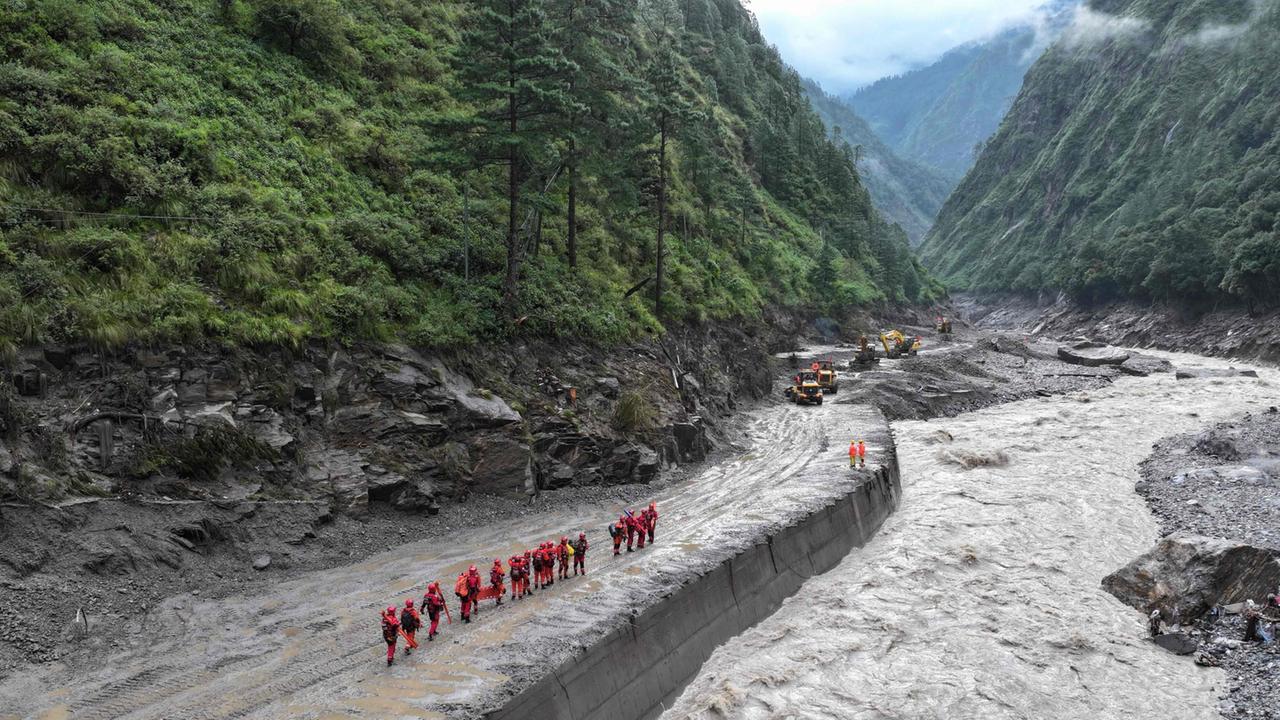
Following a devastating flash flood in the Nepal-Tibet border region, search efforts for hundreds of missing people and victims have been halted. The decision comes as a newly formed lake, created by landslide debris, threatens to unleash another wave of flooding, with heavy rains forecast to increase its volume and risk to rescue personnel.
Imagine a giant mudslide blocked a river, making a new lake. Now, it's raining a lot, and that lake is getting too full and might burst, causing another big flood. So, the grown-ups looking for people who got caught in the first flood have to stop and move away to stay safe, because it's too dangerous to keep searching right now.
Analysis
The ongoing humanitarian crisis in the Nepal-Tibet border region has escalated with the suspension of search and rescue operations, driven by the imminent threat of a secondary flash flood. This decision underscores the extreme volatility and danger faced by emergency responders in the wake of the initial devastating event. The article highlights the precarious situation where a natural dam, formed by extensive mud and debris, is now holding back a significant volume of water, with continuous rainfall threatening to breach it and unleash further destruction. The scale of the initial disaster, with hundreds dead and over a thousand missing, is already immense, and the potential for a new flood wave adds a critical layer of complexity and risk to an already overwhelmed region.
Three Million Cubic Meters
The immediate and most pressing concern is the stability of the newly formed lake, which, according to China's Ministry of Water Resources, could swell to approximately three million cubic meters. This immense volume of water, held back by unstable debris, poses a severe threat to downstream communities and rescue teams. The Chinese state television CCTV reported that the lake is already beginning to overflow, prompting a mandatory one-kilometer retreat for all personnel. This precautionary measure, mirrored in Nepal's Rasuwa district, illustrates the gravity of the situation and the authorities' recognition of the potential for a catastrophic secondary event. The weather forecast predicting three more days of precipitation further exacerbates these fears, making any immediate resumption of search efforts highly improbable.
The initial flash flood, which tore through 170 kilometers of the border region, caused widespread devastation, obliterating villages and severely damaging critical infrastructure like bridges and dams. The rising death toll, now at least 469 in Nepal alone, and the thousands still missing, including 260 foreigners reported by China, paint a grim picture of the human cost. The challenges extend beyond immediate rescue, with difficulties in identifying bodies and compiling a complete list of the missing, indicating a prolonged and arduous recovery process. The recovery of seven victims 70 kilometers into India further illustrates the far-reaching impact of the initial deluge.
Langtang National Park
The affected Himalayan region holds significant appeal for international tourists, particularly mountaineers and pilgrims drawn to sites like Nepal's Langtang National Park and sacred mountains in Tibet. This popularity explains the presence of a substantial number of foreign nationals among the missing, including eight German citizens, as confirmed by the German Foreign Office. The involvement of German agencies in gathering "reliable information on the whereabouts of German citizens" underscores the international dimension of this disaster and the consular challenges it presents. The region's allure, while a boon for local economies, also means that natural catastrophes here have a broader global impact, necessitating international coordination for rescue, recovery, and information dissemination.
The article also touches upon the broader context of the disaster, noting that while the exact trigger for the flash flood remains unclear, a glacier collapse on the Nepalese side is a leading theory. This points to the inherent geological instability of the Himalayas, a region highly susceptible to such events. The mention of the German GFZ Helmholtz Centre for Geosciences expert, Niels Hovius, further contextualizes the event within the framework of climate change.
Niels Hovius
Niels Hovius from the GFZ Helmholtz Centre for Geosciences highlights the potential, albeit unconfirmed, link between the flash flood and climate change. While acknowledging that such events have occurred historically, Hovius points to observable trends: "glaciers are melting, permafrost is thawing, the zero-degree isotherm is rising - and the Himalayas are severely affected." This expert opinion suggests that while a direct causal link to this specific event is still under investigation, the broader environmental changes in the Himalayas are creating conditions conducive to more frequent and intense natural disasters. The long-term implications of these changes for the region's stability and the safety of its inhabitants and visitors are profound.
The article from 2023, referenced within the text, further reinforces this concern, stating that up to 80 percent of Himalayan glaciers could disappear by 2100, with "significant consequences." This broader scientific consensus adds a layer of urgency to understanding and mitigating the impacts of such events. The current crisis, therefore, serves as a stark reminder of the vulnerability of high-altitude regions to environmental shifts and the complex interplay between natural processes and human activity. The ongoing efforts to understand the triggers and broader implications of this flash flood will be crucial for future disaster preparedness and climate adaptation strategies in the Himalayas.
Key points
- Search and rescue operations in Nepal and Tibet are suspended due to new flood danger.
- A lake formed by mud and debris is overflowing, with continuous rain expected to increase its volume to three million cubic meters.
- The death toll in Nepal has reached at least 469, with 977 people reported missing by Nepalese authorities and 558 by China.
- Eight German citizens are among the missing, prompting the German Foreign Office to gather information.
- The flash flood, which caused widespread devastation, may be linked to a glacier collapse and potentially climate change.
If the weather improves and the newly formed lake stabilizes without further overflow, rescue operations could resume swiftly, potentially leading to more survivors being found and a clearer picture of the missing. International cooperation, including efforts by the German Foreign Office, could also facilitate the safe return or location of foreign nationals.
The continued heavy rainfall and the potential collapse of the natural dam holding back the three million cubic meters of water could trigger a catastrophic secondary flood, endangering rescue teams and further devastating already affected areas. This would exacerbate the already high death toll and complicate the recovery and identification of victims, especially with many foreign nationals still missing.