NUS researchers find drug that turns off ‘master switch’ in aggressive breast cancer
Researchers from the National University of Singapore's Yong Loo Lin School of Medicine have discovered a drug that turns off a 'master switch' driving tumour growth in triple-negative breast cancer, which could lead to better, more personalised treatments for the aggress…
Intelligence analysis by Llama
NUS researchers found that the drug RX-5902 can turn off the master switch gene DP103, reducing tumour growth and cancer stem cell survival in aggressive triple-negative breast cancer. The drug showed a 40-60% reduction in cancer stem cell viability and around 90% tumour size reduction in lab models, extending survival and sparing healthy cells.
Imagine a master switch that makes cancer cells grow and spread. Researchers found a drug that can turn off this switch, slowing down cancer growth and making it easier to treat. This could lead to better treatments for people with aggressive breast cancer.
Analysis
DP103: The Master Switch Gene in Triple-Negative Breast Cancer
Triple-negative breast cancer is an aggressive subtype of breast cancer that disproportionately affects women under 40. It is so named as the cancer typically lacks three receptors – to which oestrogen, progesterone and the HER2 protein attach. As cancer drugs typically target these receptors, their absence makes the cancer particularly difficult to treat. The team from NUS Medicine noted that the cancer lacks effective targeted therapies and that a small population of cancer stem cells often resist treatment, fuelling the tumour regrowth that leads to rapid metastasis and recurrence.
Investigating the mechanisms that allow these cancer cells to spread and resist therapy, they narrowed in on regulators of a pathway known as Wnt signalling, which controls tasks such as cell growth and movement. The team identified a master regulator – referring to a gene that controls a major biological process – called DP103. DP103 creates a cycle where cancer cells keep growing and spreading, while resisting treatment and maintaining the cancer stem cells responsible for disease recurrence.
The team researched whether a targeted drug – known as Supinoxin, or RX-5902 – could turn off this master switch, blocking its effects in driving triple-negative breast cancer. Analysing 21 samples – comprising patient tumour tissue samples, laboratory-grown breast cancer cells and organoids derived from local cancer patients, among others – the team found that the drug reduced cancer stem cell viability by 40 to 60 per cent, while tumour growth in laboratory-grown tumour models fell by about 50 per cent. In laboratory models, the treatment reduced tumour size by around 90 per cent while largely sparing healthy cells. It also extended survival, with 50 per cent of these treated laboratory models reaching 70 days and beyond, compared with none in the untreated group.
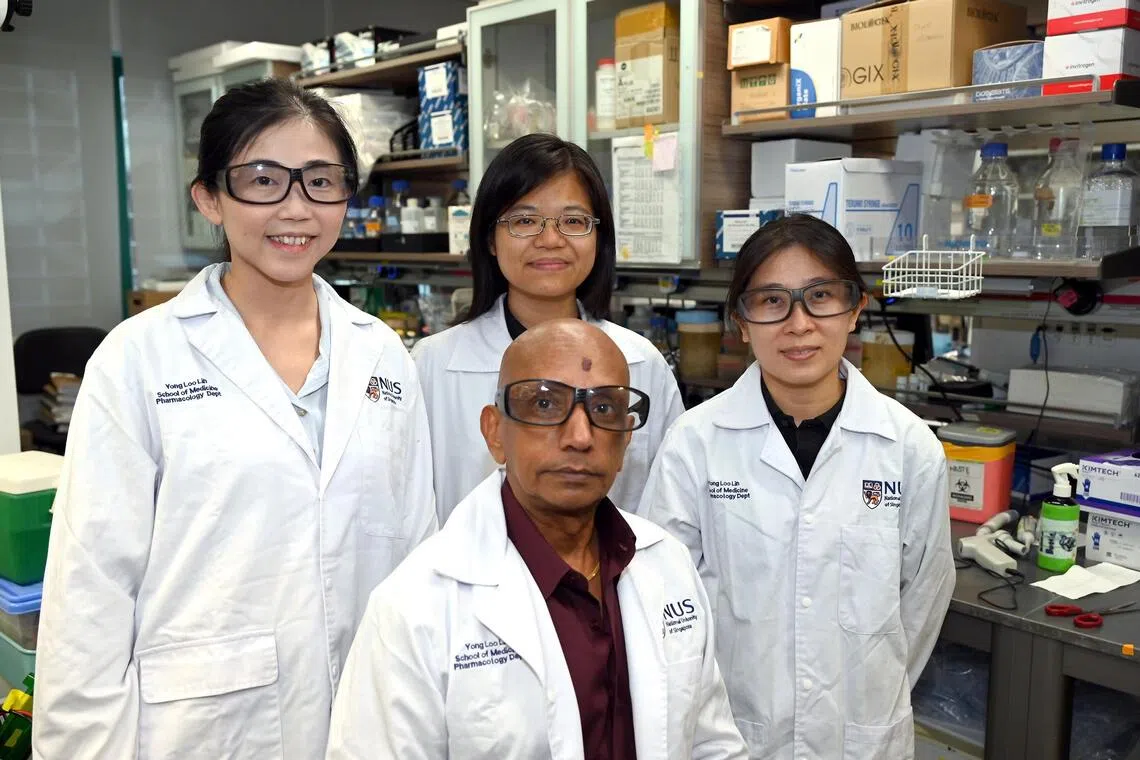
Their findings were published in the journal Cell Death And Disease. DP103 had previously been identified as a biomarker for triple-negative breast cancer by a team led by Alan Prem Kumar, an assistant professor with the NUS Centre for Cancer Research (N2CR), who is also principal investigator for the new study. While RX-5902 is already being studied in treating breast cancer, Kumar said this latest study hinted at how those more likely to benefit from the drug's use could be pinpointed.
"Our findings suggest that DP103 could potentially serve as a diagnostic biomarker to identify the patients most likely to benefit from RX-5902 treatment, paving the way for a more precise, personalised approach to treating triple-negative breast cancer," he said. "Instead of treating all patients the same, future clinical trials could focus on those whose tumours have high levels of DP103, where the therapy is expected to have the greatest impact," said Kumar, who is also an assistant professor at NUS Medicine's pharmacology department.
The study's first author, Cai Wanpei, noted that RX-5902 could prevent beta-catenin – a protein whose mutation is associated with various cancers – from entering the nucleus of human cells, switching off genes that drive the growth and spread of cancer. "This slows tumour progression and triggers apoptosis – the natural death of cancer cells," said Cai, who was a PhD student at the N2CR and NUS Medicine's pharmacology department during the research.
Why cancer in young adults is rising – and why their needs are different
‘It's still working’: More are living with cancer as era of targeted drugs takes hold
Key points
- NUS researchers found a drug that can turn off the master switch gene DP103, reducing tumour growth and cancer stem cell survival in aggressive triple-negative breast cancer.
- The drug showed a 40-60% reduction in cancer stem cell viability and around 90% tumour size reduction in lab models, extending survival and sparing healthy cells.
- DP103 may serve as a biomarker to identify patients who will benefit most from the drug's use, enabling personalised treatments and potential applications in other cancers driven by Wnt signalling.
This discovery could lead to better, more personalised treatments for triple-negative breast cancer, which could improve survival rates and quality of life for patients. The researchers also found that the drug could be used to treat other cancers driven by Wnt signalling, opening up new avenues for treatment.
The study's findings are promising, but more research is needed to confirm the results and to develop effective treatments. Additionally, the drug may not work for all patients, and further studies are needed to identify the best candidates for treatment.