Search for survivors continues as 45 rescued after cargo ship sinks in South China Sea
A Vietnamese cargo ship, the Khoi Nguyen 18, sank in the South China Sea near Fiery Cross Reef, leaving 17 of its 62 crew members missing. Chinese rescue forces are assisting in the ongoing search for survivors after 45 people were rescued.
Intelligence analysis by Gemini 2.5 Flash
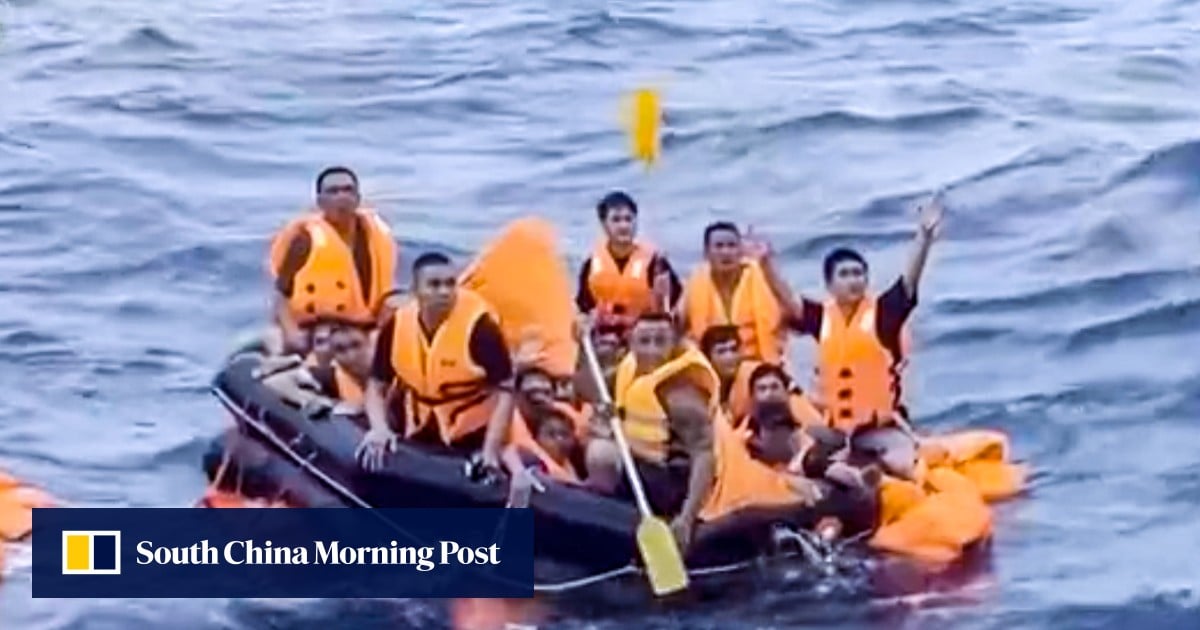
A Vietnamese cargo vessel carrying 62 crew members encountered severe weather and sank in the South China Sea's Spratly Islands. Chinese state media reported that 45 individuals have been rescued, but the search continues for 17 missing Vietnamese sailors, highlighting the dangers of maritime operations in the region during typhoon season.
Imagine a big boat carrying stuff got stuck in a really bad storm in a busy part of the ocean where many countries argue about who owns what. The boat sank, and many people were saved, but some are still missing. Big rescue boats and helicopters from China are helping to find them, showing that even when countries disagree, they can still help each other in an emergency.
Analysis
The sinking of the Vietnamese cargo ship Khoi Nguyen 18 in the South China Sea represents a tragic maritime incident, with 17 crew members still missing after 45 were rescued. The vessel, carrying 62 Vietnamese nationals, encountered severe difficulties and sank near Fiery Cross Reef in the Spratly Islands on a Saturday evening. This area is known for its challenging conditions, especially during the height of typhoon season, which the article explicitly states contributed to the accident. The incident highlights the perilous nature of shipping routes in this busy and often turbulent body of water.
Maritime Tragedy in Disputed Waters
The Khoi Nguyen 18's sinking near Fiery Cross Reef places the incident in a geopolitically sensitive area of the South China Sea. The Spratly Islands, a chain of disputed features, are claimed by multiple nations, including China and Vietnam. While the immediate focus is on the humanitarian crisis, the location of the accident inherently draws attention to the broader context of territorial claims and maritime activity in the region. The vessel's distress during "bad weather" underscores the constant environmental threats faced by seafarers, particularly when navigating through areas prone to typhoons and unpredictable sea conditions.
The timing of the accident, at the peak of typhoon season, significantly complicated rescue efforts. Changing weather and sea conditions, as reported by CCTV, made the search for survivors exceptionally difficult. This natural hazard is a recurring challenge for all maritime traffic in the South China Sea, irrespective of the political landscape. The sheer number of crew members on board, 62, also points to the scale of the potential loss of life and the urgency of the ongoing search.
China's Role in Rescue Operations
Crucially, Chinese rescue forces have played a significant role in the ongoing search and rescue operation. State media reported that the Chinese salvage vessel Nanhai Jiu 115 was the first to spot distress signals, initiating the rescue efforts. This vessel, along with other Chinese rescue ships and helicopters, has been actively involved in saving survivors. The article notes that 29 people were rescued from a life raft by the Chinese ship, with others picked up later by Chinese vessels and a helicopter.
Vietnam's foreign ministry acknowledged and appreciated this assistance, stating that the search was being carried out "with assistance from Chinese rescue forces." This cooperation, even in a region marked by territorial disputes between China and Vietnam, demonstrates a pragmatic approach to humanitarian crises. It suggests that despite underlying tensions, there is a capacity for collaboration on matters of immediate human safety. The deployment of significant assets like rescue ships and helicopters by China underscores the scale of their response and their capability in maritime rescue.
Navigational Hazards and Regional Cooperation
The incident serves as a stark reminder of the inherent dangers of maritime navigation in the South China Sea. The combination of heavy shipping traffic, unpredictable weather patterns, and the vastness of the sea makes it a challenging environment for vessels of all types. The loss of a cargo ship with such a large crew highlights the need for robust safety protocols and effective regional coordination for maritime emergencies.
While territorial disputes often dominate headlines concerning the South China Sea, this rescue operation illustrates a different facet of regional interaction: humanitarian aid. The willingness of Chinese forces to assist a Vietnamese vessel, and Vietnam's public acknowledgment of this help, could be seen as a small but significant instance of practical cooperation. Such events, though tragic, can sometimes pave the way for dialogue and collaboration on non-contentious issues like maritime safety and environmental protection, which benefit all nations operating in the region. The ongoing search for the remaining 17 crew members remains the immediate priority, emphasizing the human cost of maritime accidents.
Key points
- A Vietnamese cargo ship, Khoi Nguyen 18, sank in the South China Sea near Fiery Cross Reef.
- The vessel had 62 Vietnamese crew members; 45 have been rescued, and 17 are still missing.
- Chinese rescue forces, including ships and helicopters, are actively assisting in the search operation.
- Bad weather and typhoon season conditions significantly complicated the rescue efforts.
- Vietnam's foreign ministry acknowledged China's assistance in the humanitarian effort.
The ongoing cooperation between Chinese and Vietnamese rescue forces, despite geopolitical tensions in the South China Sea, offers a hopeful precedent for future humanitarian collaboration in the region. This joint effort could foster improved communication and trust, potentially leading to more coordinated responses to maritime emergencies and other non-political challenges.
The severe weather conditions during typhoon season, which contributed to the sinking, highlight the persistent and dangerous environmental risks for maritime operations in the South China Sea. The difficulty in locating the remaining 17 missing crew members underscores the inherent challenges of large-scale sea rescues, suggesting that future incidents could also result in significant loss of life despite rescue efforts.