South Korea's 'Best Summer': 1.2 Million Liquidations, Trillions in Losses
South Korea's stock market experienced a dramatic crash, with 1.2 million retail investors facing margin calls and 360,000 accounts forcibly liquidated, leading to 940 trillion Korean Won in losses for major semiconductor stocks.
Intelligence analysis by Gemini 2.5 Flash
After a period of unprecedented growth fueled by semiconductor giants like Samsung and SK Hynix, the South Korean stock market saw a sharp decline, wiping out fortunes for many retail investors, particularly young people who had heavily leveraged their investments. The article highlights a pattern of speculative frenzies in the country's financial markets, exacerbated by government po…
Imagine everyone in South Korea got super excited about buying shares in big computer chip companies, thinking they'd get rich really fast. The government even made it easier to buy these shares and borrow money to buy even more! But then, like a roller coaster that goes up super high and then suddenly drops, the prices of these shares crashed. Lots of people who borrowed money lost everything, and some even ended up owing money, making them very sad. It's like betting all your allowance on a game, winning a lot at first, but then losing it all and more when the game suddenly ends badly.
Analysis
The Allure and Collapse of a 'Golden Age'
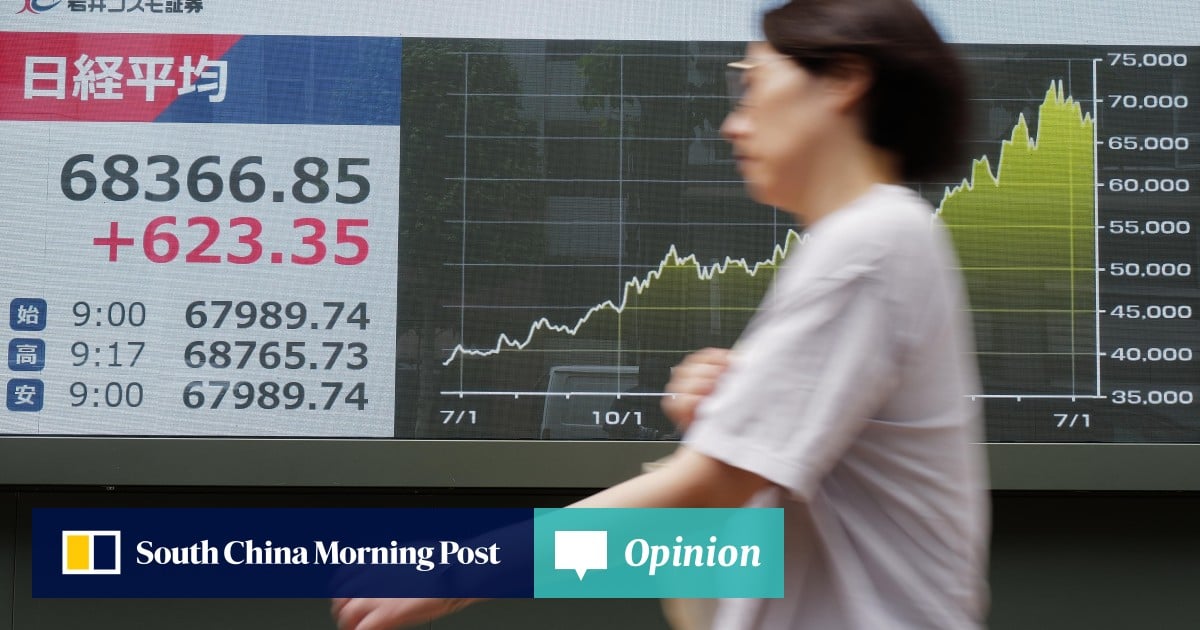
South Korea's stock market, particularly its semiconductor sector, experienced a meteoric rise in early 2026, leading many to believe in a new 'golden age' of wealth creation. The success of companies like SK Hynix, which reportedly offered employees annual bonuses equivalent to millions of RMB, fueled a nationwide investment frenzy. Retail investors, including young people and even infants (via parental accounts), poured their savings and borrowed money into the market, often using high-leverage ETFs linked to blue-chip stocks like Samsung and SK Hynix. This speculative fervor led to a surge in luxury goods purchases and real estate prices, creating a widespread perception of easy wealth.
However, this 'best summer' quickly turned into a nightmare. Within less than a month, the KOSPI index plummeted by approximately a quarter from its peak. The combined market value of SK Hynix and Samsung alone shrank by an estimated 940 trillion Korean Won (approximately 4.3 trillion RMB). The use of two-times leverage ETFs meant that even a 'technical adjustment' rapidly escalated into a cascade of forced liquidations. Reuters reported that over 1.2 million retail investor accounts received margin calls, and 360,000 accounts were forcibly closed, with over 60% of those affected being under 30 years old. This sudden reversal left many bankrupt, some even resorting to extreme measures, highlighting the devastating social consequences of unchecked speculation.
Government's Role in Fueling the Fire
The article suggests that the intensity and speed of this market boom and bust were not merely accidental but were significantly influenced by government policies. Both the Yoon Suk-yeol and Lee Jae-myung administrations, despite their political differences, shared a common goal: to redirect Korean capital from savings, real estate, and foreign markets back into the domestic stock market. This was achieved through several measures, including delaying financial investment income tax, lowering securities transaction tax, and raising the threshold for capital gains tax on stocks, effectively making stock market profits largely tax-free for most retail investors. A temporary ban on short-selling further signaled government support for individual investors.
Crucially, the government actively endorsed the bull market through initiatives like the 'Corporate Value-Up Program,' encouraging companies to increase dividends and stock buybacks, and launching related ETFs for pension funds and retail investors. Lee Jae-myung even campaigned on a promise of a 5000-point KOSPI. The most impactful policy was the allowance of two-times leverage ETFs tied to single blue-chip stocks in early 2026, primarily targeting SK Hynix and Samsung. This made it incredibly easy for ordinary Koreans to amplify their gains, but also their losses. Only after the market's collapse did regulators intervene, raising the minimum margin requirement, a move seen as too little, too late, after the government had effectively acted as a 'major dealer' in this speculative game.
A Recurring Cycle of Speculation
The recent crash is not an isolated incident but rather the latest chapter in a recurring pattern of speculative bubbles in South Korea. The article draws parallels to the 1999 tech bubble, the 2020 'Donghak Ants' movement (where retail investors collectively bought blue-chip stocks during the pandemic), and the 2022 Luna coin collapse. In each instance, a 'get rich quick' mentality, fueled by the perception of limited traditional avenues for social mobility, led millions of Koreans to 'go all in' on speculative assets. The stories of overnight millionaires, though rare, consistently overshadow the widespread losses, perpetuating the cycle.
This phenomenon is rooted in a societal belief, as noted by Seoul National University Professor Choi Jae-won, that traditional paths to social mobility are increasingly closed, leaving speculative assets as the only perceived route to upward mobility. Despite repeated financial devastation, investors often learn not to avoid risk, but to try and enter earlier and exit faster in the next bubble. The article highlights the tragic consequences, including increased debt among young people and a rise in debt restructuring applications. The allure of rapid wealth accumulation, often amplified by government encouragement and easy access to leverage, continues to draw new 'ants' to the gambling table, ensuring that the cycle of boom and bust persists.
Key points
- South Korea's stock market experienced a severe crash, with 1.2 million retail investors facing margin calls and 360,000 accounts forcibly liquidated.
- The crash resulted in a 940 trillion Korean Won (4.3 trillion RMB) reduction in the market value of semiconductor giants SK Hynix and Samsung.
- The investment frenzy was fueled by government policies aimed at boosting domestic capital markets, including tax incentives and the introduction of two-times leverage ETFs for single blue-chip stocks.
- The article highlights a recurring pattern of speculative bubbles in South Korea, drawing parallels to past events like the 1999 tech bubble and the 2022 Luna coin collapse.
- Many young investors, particularly those under 30, were heavily impacted, losing their entire principal and incurring debt due to high leverage.
The widespread financial losses and forced liquidations could lead to significant social unrest and a crisis of confidence in financial markets, particularly among younger generations. The article suggests a potential increase in personal debt and mental health issues, as many face bankruptcy and the collapse of their financial hopes.