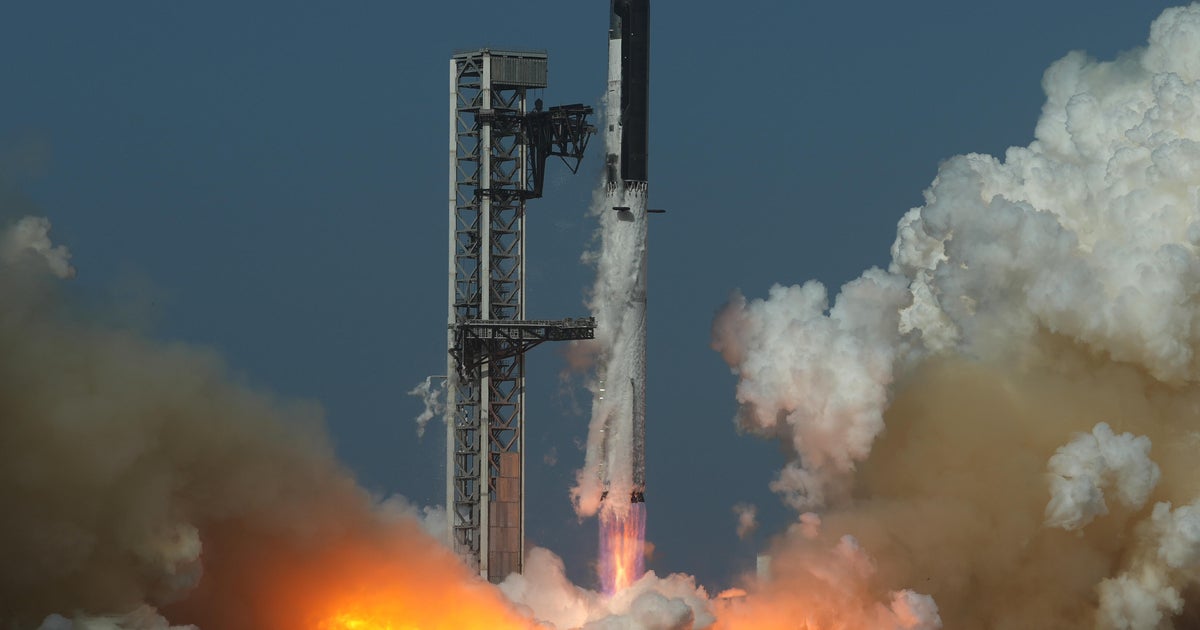
SpaceX's giant Super Heavy-Starship rocket blasts off on key test flight
SpaceX launched its 13th Super Heavy-Starship rocket, with the booster experiencing engine issues during splashdown, while the Starship upper stage successfully deployed satellites and performed an intact splashdown.
Intelligence analysis by Gemini 2.5 Flash
The latest test flight of SpaceX's massive Super Heavy-Starship rocket yielded mixed results, as the Super Heavy booster encountered engine problems during its return to the Gulf of Mexico. However, the Starship upper stage achieved several key milestones, including deploying Starlink satellites, restarting an engine in space, and completing a successful, intact splashdown in the Indi…
Imagine a giant two-part toy rocket that's trying to go to the Moon! On its latest test, the bottom part, which helps it blast off, had some engine hiccups when it tried to land back in the ocean. But the top part, called Starship, did really well! It launched mini-satellites, turned its engine on again in space, and even landed gently in the ocean far away, staying in one piece. This is super important because NASA wants to use a bigger version of this top part to take astronauts to the Moon.
Analysis
A Flight of Mixed Outcomes
SpaceX's 13th Super Heavy-Starship test flight, and the second for its third-generation 'V3' rocket, presented a blend of successes and challenges. While the 397-foot-tall rocket achieved a spectacular liftoff from Starbase, Texas, powered by 33 Raptor engines, the Super Heavy booster's return phase encountered significant issues. Despite performing well during ascent and a boostback burn, only 10 of 13 engines restarted for the crucial splashdown maneuver, with just five appearing to be operational upon impact, leading to a harder-than-expected landing in the Gulf of Mexico.
Conversely, the Starship upper stage demonstrated remarkable progress. All six of its Raptor engines operated smoothly, allowing it to deploy 20 third-generation Starlink internet satellites in a real-world test of its payload dispenser. Furthermore, the Starship successfully reignited an engine in space, a vital capability for future lunar missions, and completed a belly-first reentry before flipping upright for a dramatic, and crucially, intact rocket-powered splashdown northwest of Australia. This intact recovery marks a significant step forward, providing valuable data for engineers.
Starship's Pivotal Role in Artemis
The successful elements of the Starship's performance are particularly welcome news for NASA, which has selected a variant of the upper stage to serve as the Human Landing System (HLS) for its Artemis program. This lunar lander is designed to transport astronauts to the Moon's south pole, with the first such landing targeted for 2028. The Starship's ability to deploy satellites, restart engines in space, and survive reentry and splashdown are all critical demonstrations of technologies required for these ambitious missions.
However, the path to the Moon is complex. For lunar missions, SpaceX's architecture requires up to 15 Super Heavy-Starship tanker launches to refuel the lander in low-Earth orbit before it can proceed to the Moon. This intricate on-orbit propellant transfer system, along with the need for the lander variant to fly and be certified for human spaceflight, represents a significant engineering and logistical challenge. NASA veterans and the Government Accountability Office (GAO) have highlighted the complexity and the number of flights needed as top risks for the program.
Navigating the Path to Certification
The GAO's recent report underscored that SpaceX faces major hurdles in preparing the Super Heavy-Starship for operational use, specifically citing the development of cryogenic fuel management technologies as a primary risk. The necessity of multiple Starship vehicles transferring propellant in orbit before the HLS Starship can dock with the Orion spacecraft in lunar orbit adds layers of complexity and demands unprecedented reliability.
To meet the 2028 target for the first crewed lunar landing, SpaceX must rapidly accelerate its test schedule. This involves not only refining the booster's landing capabilities but also demonstrating the consistent reliability required to launch over a dozen tankers within days of the lander's launch. While the intact splashdown of the Starship upper stage is a positive indicator, the overall program still needs to prove its full operational capability and safety for human spaceflight, especially given that the specific moon lander variant has yet to fly and no Starship has reached Earth orbit.
Key points
- SpaceX's Super Heavy-Starship completed its 13th test flight, the second for its third-generation 'V3' rocket.
- The Super Heavy booster experienced engine issues during its descent, resulting in a 'hard' splashdown in the Gulf of Mexico.
- The Starship upper stage successfully deployed 20 Starlink satellites and demonstrated an in-space engine restart.
- The Starship achieved its first fully intact splashdown in the Indian Ocean, a critical step for future missions.
- NASA is relying on a Starship variant as the lunar lander for its Artemis program, targeting a 2028 Moon landing, but faces challenges with refueling and certification.
The Starship upper stage's successful deployment of satellites, in-space engine restart, and intact splashdown are significant milestones, demonstrating key capabilities essential for future lunar missions. These successes provide valuable data and build confidence in the vehicle's potential to serve as NASA's Artemis lunar lander.
The Super Heavy booster's engine issues during its return and the GAO's concerns about the complexity of on-orbit refueling highlight substantial technical and logistical challenges. These issues could delay the Starship's certification for human spaceflight and impact NASA's ambitious timeline for returning astronauts to the Moon.