Talk is growing of a Tesla-SpaceX merger. Will geopolitics throw a spanner in the works?
Discussions are increasing about a potential merger between Tesla and SpaceX, but geopolitical tensions between the US and China pose significant challenges. Elon Musk's reliance on China for Tesla's manufacturing while SpaceX serves as a US national security contractor c…
Intelligence analysis by Gemini 2.5 Flash
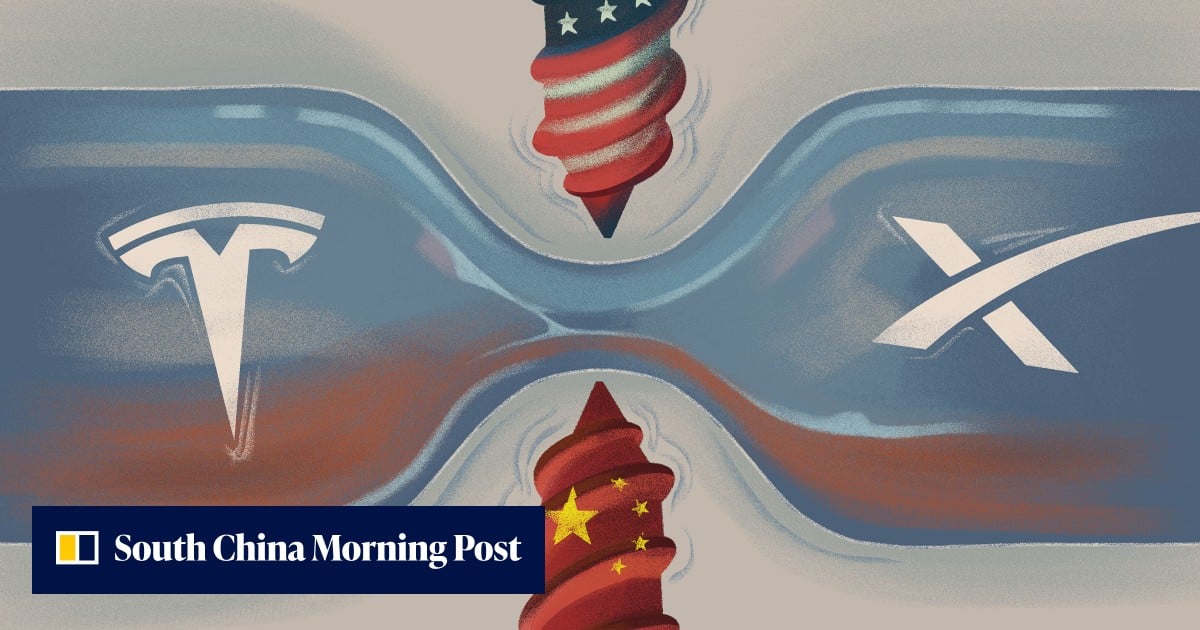
Elon Musk faces a critical balancing act as a potential merger between his two flagship companies, Tesla and SpaceX, gains traction. The challenge stems from Tesla's deep integration with China's supply chain for global EV production and SpaceX's role as a key US Pentagon contractor, creating a geopolitical 'bottleneck' for regulatory approval in both Washington and Beijing.
Imagine a super-smart inventor named Elon who has two big toy companies: one makes cool electric cars (Tesla) and the other builds rockets and sends satellites into space (SpaceX). Now, he's thinking about joining them together. But here's the tricky part: his car company makes lots of cars in China, which is like one big team, and his rocket company helps the US government, which is another big team. These two big teams sometimes don't get along. So, if Elon tries to merge his toy companies, it's like trying to make two friends who are arguing play nicely together, and it might make things very complicated for his big plan.
Analysis
The prospect of a merger between Elon Musk's automotive giant Tesla and his aerospace company SpaceX is increasingly discussed, yet it faces substantial geopolitical headwinds. The core dilemma arises from the divergent strategic importance of these companies to the world's two largest economies, the United States and China. Tesla's global manufacturing relies heavily on its Shanghai Gigafactory, a critical hub for EV production and exports, while SpaceX is deeply embedded in US national security as a Pentagon contractor. This dual allegiance creates a complex regulatory and political tightrope for Musk to walk.
Tesla's Shanghai Gigafactory
Tesla's Gigafactory in Lingang, Shanghai, stands as a testament to efficient manufacturing, capable of producing thousands of vehicles monthly, with over half exported overseas. This facility is a cornerstone of Tesla's global supply chain, enabling rapid production and distribution of electric vehicles worldwide. Its strategic location and high output underscore China's indispensable role in Tesla's operational success and global market reach. However, this deep reliance on Chinese manufacturing presents a significant vulnerability from Washington's perspective, especially given the escalating tech and trade tensions between the two superpowers.
This reliance necessitates a delicate balancing act for Elon Musk, who must ensure that Tesla's operations in China do not compromise US national security interests, particularly if the company were to merge with a defense contractor like SpaceX. Industry observers suggest that any such combination would require a 'complicated, ring-fenced strategy' for Tesla's China operations. This strategy would aim to satisfy the regulatory demands and security concerns of both the US and Chinese governments, potentially isolating sensitive aspects of the business.
SpaceX and the Pentagon
SpaceX has evolved into a core national security contractor for the Pentagon, providing critical launch services and satellite internet capabilities. Its Starlink constellation, for instance, has significant implications for military communications and intelligence. This deep integration with the US defense apparatus positions SpaceX as a strategic asset for Washington, making any potential merger with a company heavily reliant on a geopolitical rival like China a matter of intense scrutiny. The US government would likely be concerned about data security, technology transfer, and potential influence from Beijing over a combined entity.
Such a merger would force regulators to consider how to protect sensitive US defense technologies and information from potential exposure through Tesla's China-based operations. The dual nature of Musk's empire—one part deeply intertwined with a geopolitical competitor and the other a critical national security partner—creates an unprecedented challenge for regulatory bodies. The article highlights that this situation could create a 'bottleneck' for any merger attempts, as both Washington and Beijing would scrutinize the implications for their respective national interests.
Geopolitical Bottleneck
The growing talk of a Tesla-SpaceX merger is overshadowed by the potential for geopolitics to 'throw a spanner in the works.' The fundamental conflict lies in the competing interests of the US and China, each viewing parts of Musk's empire as strategically vital. Washington's security concerns regarding SpaceX's defense contracts clash with Beijing's economic interests in Tesla's manufacturing prowess and market presence. This creates a significant regulatory hurdle that could impede or even prevent a merger.
Elon Musk's challenge is to devise a strategy that can appease both sides, a task described as requiring a 'complicated, ring-fenced strategy' for his China operations. This would likely involve strict separation of data, technology, and operational control between the China-dependent EV business and the US defense-aligned space ventures. The success or failure of such a strategy will not only determine the fate of a potential Tesla-SpaceX merger but also set a precedent for how global tech giants navigate an increasingly fragmented and politicized international landscape.
Key points
- Talk is increasing about a potential merger between Tesla and SpaceX, both led by Elon Musk.
- Tesla's global EV production heavily relies on its efficient Gigafactory in Shanghai, China.
- SpaceX is a core national security contractor for the US Pentagon, creating a geopolitical conflict of interest.
- Elon Musk faces a dilemma balancing China's economic importance for Tesla with SpaceX's US defense role.
- Industry observers suggest a 'complicated, ring-fenced strategy' for China operations would be necessary to satisfy regulators in both countries.
If Elon Musk successfully implements a ring-fenced strategy for his China operations, it could allow both Tesla and SpaceX to continue their global expansion while satisfying regulators in Washington and Beijing. This delicate balance might enable the potential merger to proceed, fostering innovation across EVs, space technology, and AI without being derailed by geopolitical tensions.
The geopolitical tensions between the US and China could create an insurmountable 'bottleneck' for a Tesla-SpaceX merger, potentially forcing Musk to choose between his critical manufacturing base in China and his national security contracts with the Pentagon. This could lead to significant operational restructuring, divestitures, or even prevent the merger entirely, hindering the synergistic potential of his diverse ventures.