The AI-Generated Pattern Hides You From Surveillance Cameras—Including Flock
A new AI-generated pattern, developed by Bill Swearingen, can effectively hide individuals and vehicles from surveillance cameras, including those used by Flock, Axon, and Clearview AI.
Intelligence analysis by Gemini 2.5 Flash
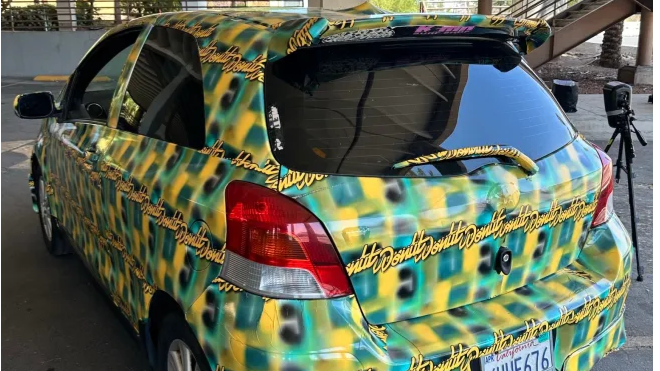
Researcher Bill Swearingen has created 'noRecognition,' an AI-generated pattern designed to confuse camera detection software. After 31 million tests, the pattern successfully prevents classification by 11 open-source algorithms, offering a novel way to evade widespread surveillance systems.
Imagine you have a special shirt with a weird pattern on it. When a robot camera looks at you, instead of seeing a person, it just sees a jumble of colors and gets confused, like it can't tell what you are! A smart person made these patterns so that cameras that watch cars and people can't figure out who or what they're looking at, helping people keep their privacy.
Analysis
Bill Swearingen's Experiment
Bill Swearingen, co-founder of the SecKC security meetup in Kansas City, dedicated a year to an intensive research project aimed at disrupting automated surveillance. His methodology involved running approximately 31 million tests from his home, systematically refining patterns designed to evade detection by camera software. This rigorous, iterative process allowed him to develop a robust solution capable of consistently fooling advanced AI vision systems.
Swearingen's work highlights the potential for individual researchers to create impactful tools that challenge established surveillance technologies. His commitment to open-source testing and public demonstration underscores a broader movement towards empowering individuals with privacy-enhancing technologies in an increasingly monitored world.
The noRecognition Project
The 'noRecognition' project is centered around AI-generated patterns that, when applied to objects or individuals, prevent camera software from accurately classifying them. The patterns are specifically engineered to exploit vulnerabilities in machine learning algorithms, causing them to fail in identifying what they cover, whether it's people, faces, or cars. This adversarial approach turns the very technology used for surveillance against itself.
The effectiveness of these patterns was rigorously tested against 11 different open-source detection algorithms. Crucially, the 'noRecognition' patterns successfully defeated all of them. This broad compatibility suggests a fundamental disruption to how these systems operate, rather than a solution tailored to a single platform. The project's success against a range of algorithms, including those underpinning prominent surveillance tools, marks a significant milestone in privacy technology.
Defeating Flock Cameras
One of the most notable achievements of the 'noRecognition' patterns is their ability to defeat the software behind Flock license plate readers. Flock cameras are a controversial surveillance system being rapidly deployed across various locations, raising significant privacy concerns due to their widespread data collection capabilities. The ability to render objects invisible to such systems offers a direct countermeasure to their pervasive monitoring.
Beyond Flock, the patterns also proved effective against software used in Axon body cameras and Clearview AI, further demonstrating their broad applicability in challenging different facets of modern surveillance. The first public demonstration of this capability took place at Def Con in Las Vegas, where a 2009 Toyota Yaris, adorned with the pattern, was driven past a live Flock camera, successfully evading its detection. This real-world test validates the practical utility of Swearingen's innovative privacy solution.
Key points
- Bill Swearingen developed AI-generated patterns to hide objects from surveillance cameras.
- The 'noRecognition' patterns defeated 11 open-source detection algorithms, including those used by Flock, Axon, and Clearview AI.
- The project involved 31 million tests over a year to refine the patterns' effectiveness.
- A public test at Def Con successfully demonstrated the pattern's ability to hide a car from a Flock camera.
- This technology offers a new tool for individuals to counter pervasive AI-powered surveillance systems.
This technology could empower individuals to reclaim a degree of privacy in public spaces, offering a practical defense against the proliferation of AI-powered surveillance. It may foster innovation in privacy-enhancing tools, leading to a more balanced relationship between public safety and individual liberties.
While beneficial for privacy, such patterns could also be misused by individuals seeking to evade legitimate law enforcement or engage in illicit activities without detection. This could lead to an 'arms race' between surveillance technology developers and privacy advocates, potentially escalating the sophistication of both sides.