The Pack Is the Painting: Evil Biscuit and the Schizocollage Movement Come to Hong Kong
Evil Biscuit, a pseudonymous artist, is leading a movement in internet art, creating dense, meme-filled images that blur the line between artwork and collectible. His latest project, Card NFT 2, features physical cards that can be redeemed for digital ones, and he is cont…
Intelligence analysis by Llama
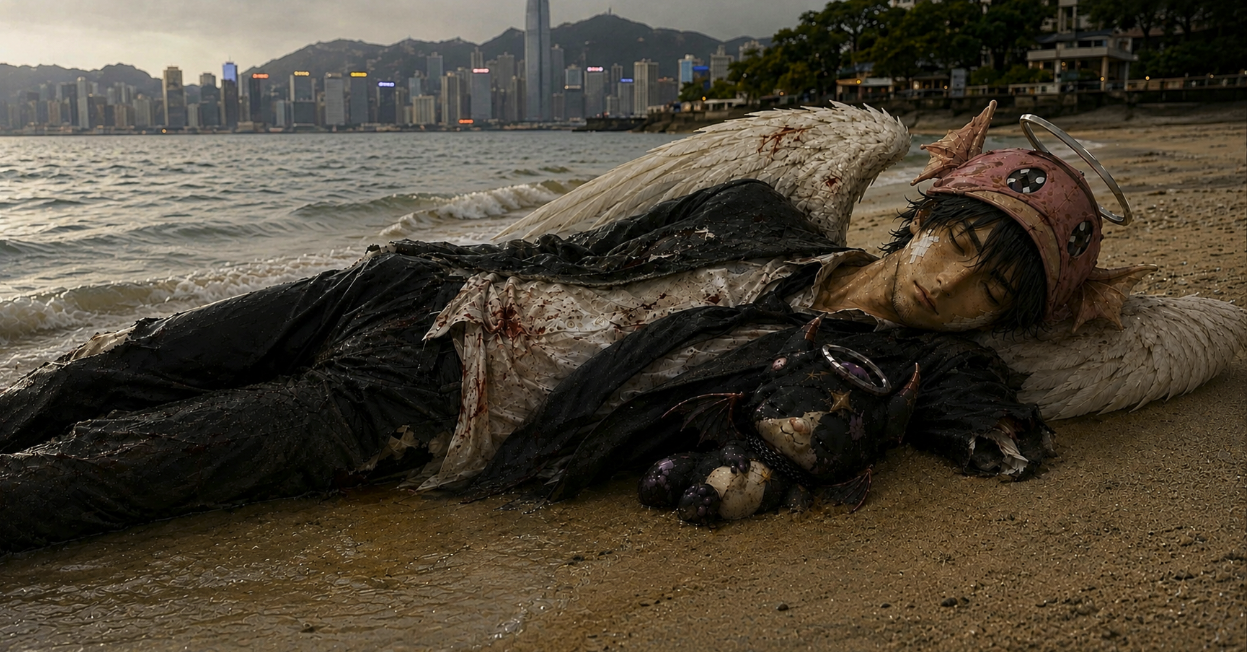
Evil Biscuit's schizocollage art movement is pushing the boundaries of internet art, with his latest project featuring physical cards that can be redeemed for digital ones. He is contributing to the Bitcoin Asia 2026 conference card pack, alongside other key artists in the movement.
Imagine taking a bunch of old trading cards and dissolving the ink off them with a special liquid. Then, you take the leftover metal and print new artwork onto it. This is what Evil Biscuit, a pseudonymous artist, is doing with his latest project. He's creating new art by destroying old cards, and it's really cool.
Analysis
The Birth of a Movement
The schizocollage movement, led by Evil Biscuit, has been quietly staging one of the most genuine artistic rebellions of the decade. This movement has been characterized by its use of dense, meme-filled images that blur the line between artwork and collectible. The style, which has been described as traitmaxxing, involves taking the trait system that generates ordinary avatar collections and pushing it past its breaking point, hundreds of layers deep, until the image verges on chaos.
Critics have started to take notice of this movement, with Dean Kissick placing it in the lineage of deliberately 'bad painting'. The movement's participants have also coined their own term for it: Avant/Gay. At the center of this scene sits Evil Biscuit, whose Drifella collections are widely cited as its defining works.
Destruction, Death, and Rebirth
One theme that runs through everything Biscuit makes is 'destruction, death and rebirth'. This is reflected in his latest project, Card NFT 2, which features physical cards that can be redeemed for digital ones. The cards are made by dissolving the ink off vintage holographic Pokémon cards with acetone, leaving only the bare silver foil, and then UV-printing entirely new artwork onto the wreckage.
Saburō Murakami, a Japanese artist from the 1950s, would understand this process. In 1956, Murakami ran through a row of paper screens, leaving a torn, human-shaped hole in each one. The audience heard the rip in the moment but likely didn't understand it. Murakami belonged to Gutai, the radical postwar avant-garde collective whose members painted with their feet and fought with mud, and his gesture made an argument the art world is still digesting.
The Trading Card as Art
The trading card has become a central element in the schizocollage movement. Biscuit's work has been escaping the screen, and the destruction has gotten literal. His cards are not just collectibles, but also artworks that can be redeemed for digital ones. This blurs the line between artwork and collectible, and highlights the importance of the trading card as a medium for art.
The Bitcoin Asia 2026 Conference
Biscuit's art is headed to Hong Kong, where he will be contributing to the Bitcoin Asia 2026 conference card pack. The pack is something like a satellite of the show, sealed in foil. It sits exactly on the fault line this scene has been working: the old hierarchy between artwork and collectible has collapsed, and the most interesting artists now make objects that are both at once.
Conclusion
The schizocollage movement, led by Evil Biscuit, is pushing the boundaries of internet art. His latest project, Card NFT 2, features physical cards that can be redeemed for digital ones, and he is contributing to the Bitcoin Asia 2026 conference card pack. This movement challenges the traditional hierarchy between artwork and collectible, and highlights the importance of internet art in the digital age.
Key points
- The schizocollage movement is a new art movement that challenges the traditional hierarchy between artwork and collectible.
- Evil Biscuit is a pseudonymous artist who is leading the movement with his dense, meme-filled images.
- The movement's style, known as traitmaxxing, involves taking the trait system that generates ordinary avatar collections and pushing it past its breaking point.
- Biscuit's latest project, Card NFT 2, features physical cards that can be redeemed for digital ones.
- The Bitcoin Asia 2026 conference card pack will feature Biscuit's art alongside other key artists in the movement.
The schizocollage movement has the potential to bring about a new era of creativity and innovation in the art world. By blurring the line between artwork and collectible, artists like Evil Biscuit are pushing the boundaries of what is possible and challenging traditional notions of art and value.
The schizocollage movement may also lead to a proliferation of low-quality, mass-produced art that devalues the concept of art itself. If not managed properly, the movement could result in a homogenization of artistic styles and a loss of originality and creativity.