The worst chart for bitcoin bulls right now
The S&P 500 and Nasdaq, when priced in bitcoin, have decisively broken above their 200-week moving averages for the first time since 2012, signaling a potential end to Bitcoin's era of outsized outperformance against equities.
Intelligence analysis by Gemini 2.5 Flash
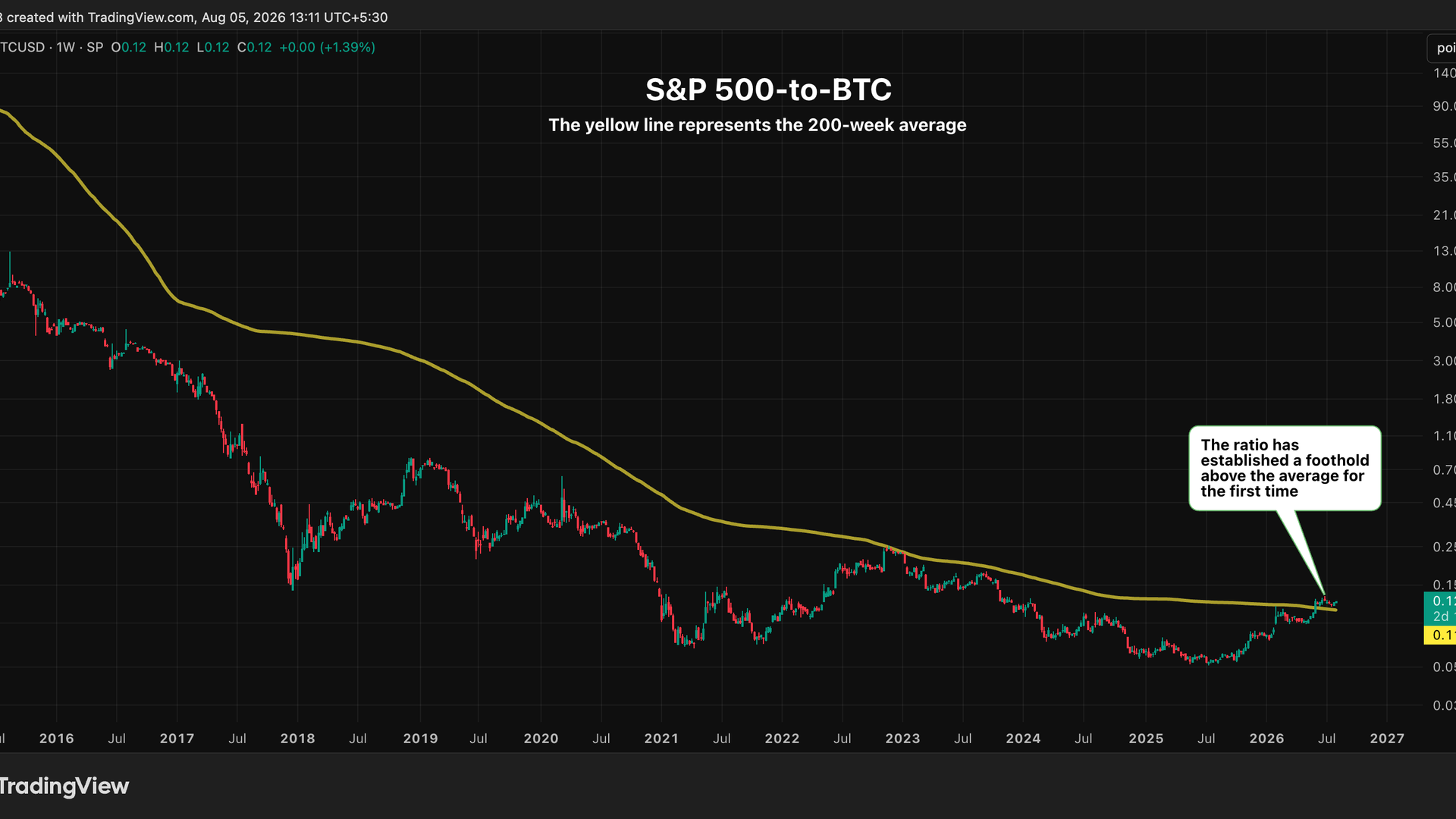
For over a decade, Bitcoin consistently outperformed traditional stock indices like the S&P 500 and Nasdaq, a key argument for its 'store of value' narrative. However, a critical technical indicator—the S&P 500-to-bitcoin ratio—has now crossed and held above its 200-week moving average, suggesting this long-standing trend of Bitcoin's dominance may be reversing, challenging aggressive…
Imagine Bitcoin was a super speedy race car that always zoomed past regular cars like the S&P 500 and Nasdaq. For a long time, it was the fastest, always winning. But now, a special chart shows that the regular cars are starting to keep up and even pull ahead of the Bitcoin car, something that hasn't happened in a very long time. This might mean Bitcoin won't always be the super-duper fastest car anymore, but maybe a strong, steady one instead.
Analysis
A Decisive Shift in Market Dynamics
For 14 years, Bitcoin's outperformance against major stock indices like the S&P 500 and Nasdaq was a consistent theme, often cited by its proponents as evidence of its superior store of value. This trend was clearly visible in the S&P 500-to-bitcoin ratio, which measures how much Bitcoin is needed to buy the index. Historically, this ratio has generally declined, with its 200-week simple moving average acting as a firm ceiling, indicating that any brief periods of stock outperformance against Bitcoin were quickly reversed.
However, the market has recently witnessed a significant and unprecedented change. In recent weeks, the S&P 500-to-bitcoin ratio has not only topped its 200-week average but has also established a firm foothold above it. This behavior is mirrored by the Nasdaq/BTC ratio, indicating a broad-based shift rather than an isolated incident. This sustained break above a critical long-term technical indicator suggests a fundamental change in the relative strength between Bitcoin and traditional equities.
Implications for Bitcoin's Narrative and Forecasts
The implications of this chart pattern are particularly painful for Bitcoin bulls. The fact that the break above the 200-week average has held, rather than quickly reversing, strongly suggests that Bitcoin's era of outsized rallies compared to equities may have concluded. This directly challenges the 'superior store of value' narrative that has underpinned much of Bitcoin's appeal and growth over the past decade.
For macro traders, a stocks-to-bitcoin ratio that no longer decisively favors Bitcoin diminishes the cryptocurrency's allure as a standalone portfolio enhancer. Furthermore, this development casts doubt on the more aggressive price forecasts for the next bull cycle, which often extrapolate from prior cycles where Bitcoin's smaller market capitalization allowed for exponential growth. These forecasts, predicting prices of $300,000 or higher, may need to be re-evaluated in light of Bitcoin's evolving market dynamics and its increasing integration into mainstream finance.
Bitcoin's Maturation and Future Trajectory
Despite the bearish implications for traditional Bitcoin bulls, there is a more constructive interpretation of this market shift: Bitcoin is growing up. Moonshot rallies, characterized by 10-fold increases in a year, are often a phenomenon of young assets with thin liquidity, where a relatively small number of buyers can significantly impact prices. This dynamic becomes increasingly difficult to replicate as an asset matures and its market capitalization grows to over a trillion dollars.
Bitcoin's current market structure, with the introduction of spot ETFs, options, futures, and structured products, has made it significantly easier to buy and integrate into traditional financial portfolios. However, this very 'plumbing' that enhances accessibility and liquidity also makes it harder for the asset to experience the violent, parabolic price movements seen in its earlier years. This maturation suggests a future where Bitcoin might offer more stable, albeit potentially less explosive, returns, aligning more with established asset classes rather than consistently outperforming them by orders of magnitude.
Key points
- The S&P 500-to-bitcoin and Nasdaq-to-bitcoin ratios have broken above their 200-week moving averages for the first time since 2012.
- This technical shift suggests Bitcoin's long-standing outperformance against equities may be ending.
- The 'superior store of value' narrative for Bitcoin could lose its edge if this trend persists.
- The development challenges aggressive Bitcoin price forecasts that extrapolate from prior bull cycles.
- A constructive view suggests this is a sign of Bitcoin's maturation, making extreme volatility less likely as it becomes a trillion-dollar asset with more financial plumbing.
The article suggests that this shift could be a sign of Bitcoin's maturation, indicating it's becoming a more established asset. As Bitcoin grows up and integrates into mainstream finance with products like ETFs, it may offer more stable, albeit less volatile, returns, appealing to a broader base of institutional investors.
The sustained outperformance of the S&P 500 and Nasdaq against Bitcoin could signal the end of Bitcoin's era of outsized rallies. This might undermine its 'superior store of value' narrative and challenge aggressive price forecasts, potentially reducing its appeal for macro traders seeking single-handedly portfolio-lifting assets.