Trump hints at Kim contacts after scaling back Seoul drills
President Donald Trump says North Korean leader Kim Jong Un has responded to his recent messages, calling the contacts "very positive," a day after he ordered a scale-back of joint US-South Korea military exercises.
Intelligence analysis by Llama
Trump combined a diplomatic overture toward Pyongyang with a public rebuke of Seoul, tying the surprise reduction in joint drills to South Korea's refusal to join the US-Israeli campaign against Iran. The 11-day Ulchi Freedom Shield exercises had already begun.
Imagine the US and South Korea practice a big game together every year in case a bully shows up. The US leader just said, 'Let's practice less,' while saying he's texting the bully and things are going well. South Korea is now worried because the practice was their safety net.
Analysis
The 39,000-soldier ultimatum
Trump's decision to scale back joint exercises was framed in transactional terms that put a price tag on the US military presence in South Korea. "We have 39,000 soldiers over there, guarding you from Kim Jong Un, your next-door neighbor, and you're not going to help us on a very easy military operation in Iran," he said, explicitly linking the alliance's value to cooperation on a separate Middle East conflict. The statement transforms decades of US forward deployment in Northeast Asia into conditional protection, a posture that Senator Jack Reed warned would be read in Beijing and Moscow as evidence of an ally the United States "abandons." For Singapore, which sits astride critical sea lanes and relies on US credibility to underwrite regional security, any precedent that alliances can be paused over unrelated disputes is a strategic signal worth tracking.
Ulchi Freedom Shield and the 'new level of deterrent' threat
The 11-day Ulchi Freedom Shield drills are designed to simulate war with North Korea, with US and South Korean forces this year rehearsing combat against troops hardened by deployment on Russia's side in Ukraine, according to Colonel Ryan Donald. Pyongyang's response has been to test-fire a ballistic missile over the Sea of Japan and warn of a "new level of deterrent." Trump's parallel claim of "very positive" contacts with Kim therefore sits uneasily alongside live-fire drills and active missile testing, raising the question of whether the overture is genuine de-escalation or leverage against Seoul. The asymmetry is notable: Washington is publicly negotiating while its troops are still rehearsing for the very contingency being discussed.
Three summits and a Sentosa precedent
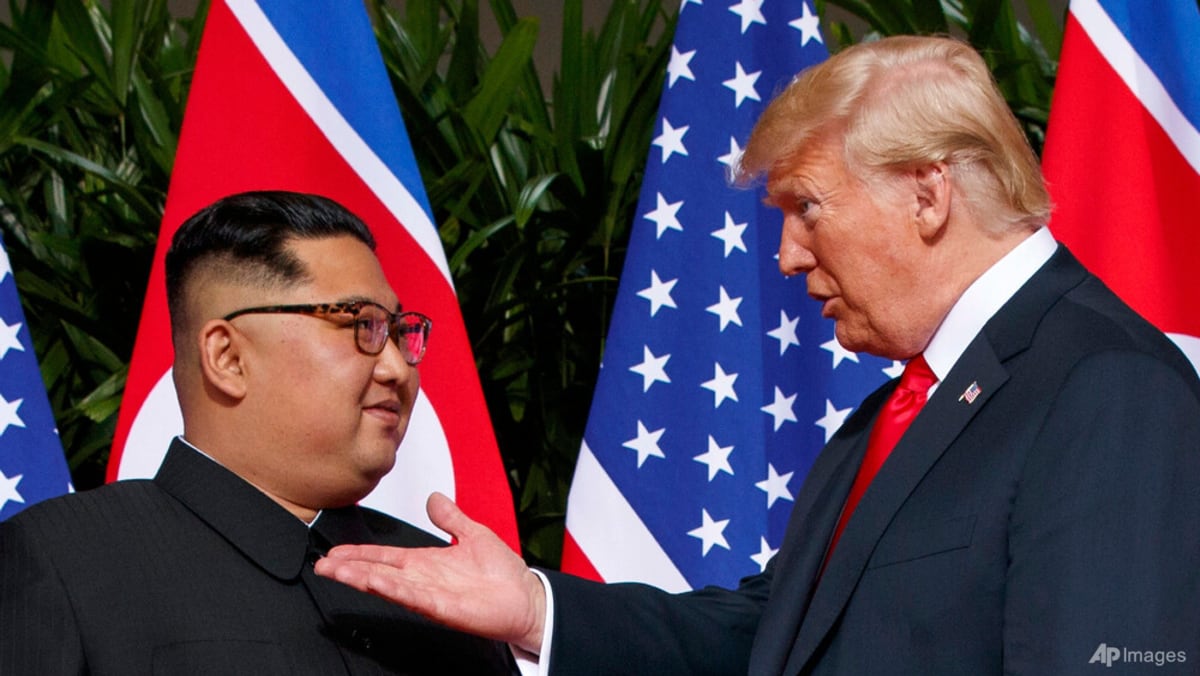
The image accompanying the report — the 2018 Trump-Kim handshake on Sentosa Island — is more than a historical curiosity. It anchors the current outreach in a personal record: three meetings during Trump's first term, no contact in the second until now, and a self-described mutual understanding in which "I understand him. He understands me." That personal framing is what makes the drill cut-off politically feasible at home, where a conventional alliance restructuring would face Congressional resistance, but it also concentrates diplomatic risk in a single relationship. If Kim's "very positive" response fails to produce a verifiable step — a freeze, a moratorium, an inspection regime — the political cost of having publicly downgraded exercises will fall on Seoul first and on regional partners second.
Key points
- Trump said Kim Jong Un has responded to his recent messages and described the contacts as 'very positive'
- He ordered the Pentagon to scale back joint US-South Korea drills, calling them 'inappropriate and hostile'
- He tied the cut to South Korea's refusal to help with the US-Israeli war against Iran
- The 11-day Ulchi Freedom Shield exercises had already begun, with South Korea reviewing Trump's comments
- North Korea recently test-fired a ballistic missile and warned of a 'new level of deterrent'
If Trump's claimed channel with Kim produces a verifiable step such as a missile test moratorium or a return to working-level talks, the scaled-back drills could be reframed as a confidence-building concession rather than an abandonment, easing tensions without a formal deal.
If the contacts produce no concrete deliverable, South Korea may accelerate independent nuclear and conventional capabilities, China and Russia may test US commitments elsewhere in the region, and Pyongyang may interpret the drill cut as license to advance its program further.