Turkey, Pakistan, Saudi Arabia will form political, military mechanisms to coordinate under defence pact, Ankara says
Turkey, Saudi Arabia, and Pakistan have signed a joint defense agreement, which includes the formation of political and military mechanisms to coordinate under a defense pact. The agreement also stipulates that an armed attack against any member would be regarded as an at…
Intelligence analysis by Llama
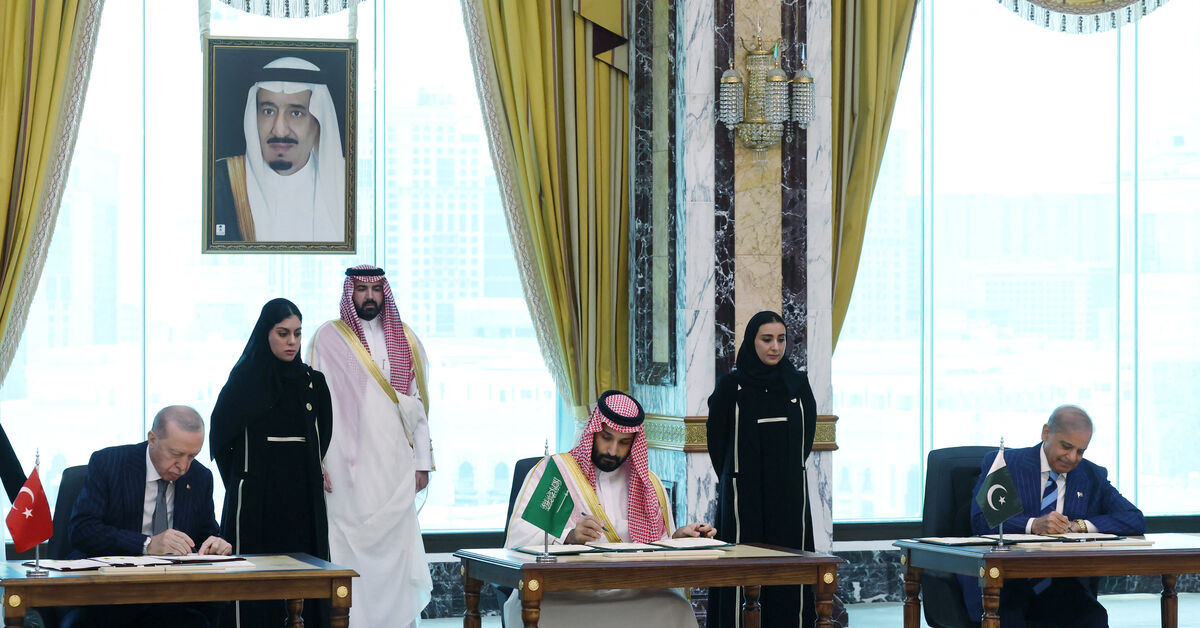
Turkey, Saudi Arabia, and Pakistan have signed a joint defense agreement, which includes the formation of political and military mechanisms to coordinate under a defense pact. The agreement also stipulates that an armed attack against any member would be regarded as an attack on all, similar to NATO's Article 5 collective defense clause.
Turkey, Saudi Arabia, and Pakistan have signed a joint defense agreement. This means that if one of these countries is attacked, the other two countries will help defend it. They are also planning to have joint military exercises and share technology to make their defense industry stronger.
Analysis
Mecca Joint Defence Agreement
The Mecca Joint Defence Agreement signed between Turkey, Saudi Arabia, and Pakistan on August 7, 2026, is a significant development in the region. The agreement aims to strengthen the collective defense of the three countries and deepen defense industry cooperation. The agreement stipulates that an armed attack against any member would be regarded as an attack on all, similar to NATO's Article 5 collective defense clause.
This development is crucial for the regional powers as it addresses their concerns about a regional conflagration and Iranian missile fire onto Gulf oil exporters. The agreement also includes the formation of political and military mechanisms to coordinate under the defense pact. The mechanisms will include the three countries' defense ministers, foreign ministers, and military chiefs.
The joint military exercises are also being planned under the pact, while cooperation could include joint production and technology sharing in the defense industry. This agreement is a significant step towards strengthening the collective defense of the three countries and deepening their defense industry cooperation.
Regional Implications
The Mecca Joint Defence Agreement has significant regional implications. The agreement aims to strengthen the collective defense of the three countries and address their concerns about a regional conflagration. The agreement also deepens defense industry cooperation between the three countries, which is crucial for their regional security.
The agreement is also significant as it addresses the concerns of the regional powers about Iranian missile fire onto Gulf oil exporters. The agreement stipulates that an armed attack against any member would be regarded as an attack on all, similar to NATO's Article 5 collective defense clause. This development is crucial for the regional powers as it strengthens their collective defense and deepens defense industry cooperation.
Future Developments
The Mecca Joint Defence Agreement has significant future developments. The agreement includes the formation of political and military mechanisms to coordinate under the defense pact. The mechanisms will include the three countries' defense ministers, foreign ministers, and military chiefs.
The joint military exercises are also being planned under the pact, while cooperation could include joint production and technology sharing in the defense industry. This agreement is a significant step towards strengthening the collective defense of the three countries and deepening their defense industry cooperation.
Key points
- Turkey, Saudi Arabia, and Pakistan have signed a joint defense agreement.
- The agreement includes the formation of political and military mechanisms to coordinate under the defense pact.
- The agreement stipulates that an armed attack against any member would be regarded as an attack on all, similar to NATO's Article 5 collective defense clause.
- The joint military exercises are being planned under the pact.
- Cooperation could include joint production and technology sharing in the defense industry.
The Mecca Joint Defence Agreement has the potential to strengthen the collective defense of Turkey, Saudi Arabia, and Pakistan, and deepen their defense industry cooperation. This development could lead to increased regional stability and security, as the three countries work together to address their common security concerns.
The Mecca Joint Defence Agreement may not be enough to address the regional security concerns of Turkey, Saudi Arabia, and Pakistan. The agreement may not be able to prevent a regional conflagration, and the three countries may still face challenges in their defense industry cooperation.