Ukraine offers Russia truce in Black Sea as food supply fears mount, source says
Ukraine has proposed, via a third party, a mutual halt to attacks on civilian targets in the Black Sea as strikes on vessels and ports threaten grain exports and global food supplies, though Russia says it has received no formal proposal.
Intelligence analysis by Llama
Kyiv has floated a Black Sea truce on civilian-target attacks through an intermediary, while both sides warn of threats to global food supplies. Russia says it has not received a formal proposal, and Ukraine's grain exports have collapsed 76 per cent year-on-year in August.
Ukraine and Russia are fighting, and both have been attacking ships that carry food across the Black Sea. Ukraine asked, through a friend, if both sides could stop attacking those food ships. Russia says it hasn't gotten any real offer. Meanwhile, the world's food supply is worried because lots of grain usually travels through that sea.
Analysis
Novorossiysk
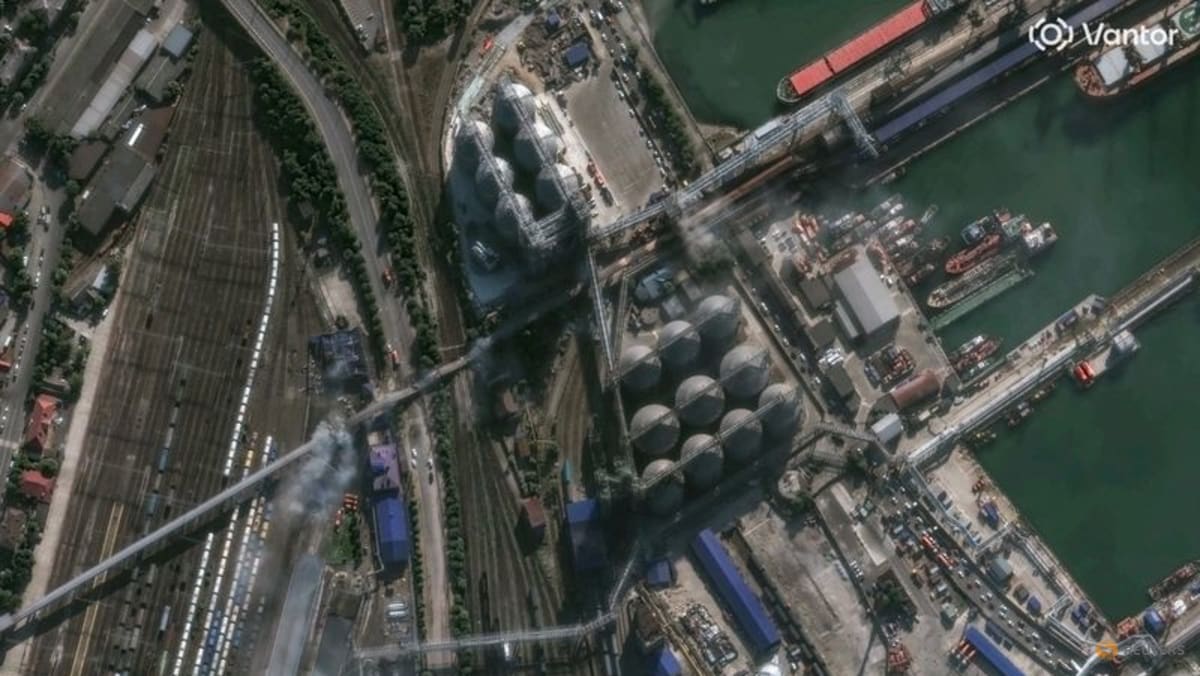
A satellite image dated August 12, 2026 shows damage to a grain conveyor in Novorossiysk, in Russia's Krasnodar region, after a Ukrainian drone and missile attack. The strike illustrates how the Black Sea confrontation has migrated from Ukrainian ports in the Odesa region to Russian infrastructure along the same shipping corridor, deepening the sense that neither side is observing restraint on civilian-economic targets. With both countries now hitting each other's grain facilities, the practical effect is a slow-motion blockade of one of the world's most important wheat export routes, regardless of any official declaration.
76 per cent
The article reports that Ukraine's grain exports have tumbled 76 per cent year-on-year so far in August, an extraordinary collapse that Kyiv's agricultural sector warns could have vast economic consequences if it persists. Many shipowners have already stopped calling at Odesa ports, wary of Russian strikes on dozens of foreign-flagged vessels and port infrastructure, forcing Kyiv onto longer and more expensive alternative routes. The 76 per cent figure is the clearest single data point in the story and is what gives the food-supply warnings their weight, lifting them above routine diplomatic posturing into measurable economic territory.
Hakan Fidan
Turkish Foreign Minister Hakan Fidan said on Saturday that a proposal had been conveyed to both Russia and Ukraine for a moratorium on attacks in the Black Sea, identifying Ankara as the most likely third-party intermediary behind Kyiv's offer. Within hours, however, Russia's Deputy Foreign Minister Alexander Grushko told state news agency TASS that Moscow had received no formal Black Sea ceasefire proposal and characterised recent moratorium talk as informal noise circulating through various channels. The mismatch suggests either that the diplomatic track is still being shaped behind the scenes, or that Moscow wants to publicly discount the proposal while leaving room to engage privately, a pattern familiar from the 2022-23 Black Sea grain corridor negotiations that Turkey and the UN helped broker.
Key points
- Ukraine sent Russia an offer via a third party to halt attacks on civilian targets in the Black Sea, a source familiar with the matter told Reuters.
- Russia's Deputy Foreign Minister Alexander Grushko said Moscow has received no formal Black Sea ceasefire proposal, according to TASS.
- Turkish Foreign Minister Hakan Fidan confirmed a proposal was conveyed to both countries for a moratorium on Black Sea attacks.
- Ukraine's grain exports have fallen 76 per cent year-on-year in August so far, with many shipowners avoiding Odesa ports.
- Euronext September wheat futures turned lower after the Reuters report, giving up sharp earlier gains on hopes of a truce.
If both sides accept a moratorium on attacks against civilian shipping and port infrastructure in the Black Sea, shipowners are likely to return to Odesa, easing the 76 per cent export collapse and stabilising global wheat prices. Turkish mediation, which previously helped broker the 2022-23 grain corridor, offers a credible channel for formalising any agreement.
Moscow's claim that no formal proposal exists, paired with continued strikes on grain infrastructure on both sides of the sea, suggests the diplomatic opening may not translate into a real ceasefire. If attacks persist, Ukraine's alternative export routes cannot fully offset lost Black Sea capacity, and wheat-importing economies including Singapore would face sustained price pressure and tighter supply.
Market signals
- BL2U6 The Reuters report of Ukraine's truce offer triggered a reversal in Euronext September wheat, which gave up sharp earlier gains on hopes of restored Black Sea flows.
AI-generated analysis of potential market relevance. Not financial advice.