US trapped in self-inflicted quagmire
Iranian newspapers analyze the ongoing conflict, asserting that the US and Israel have failed to achieve strategic objectives against Iran, leading to a self-inflicted geopolitical quagmire.
Intelligence analysis by Gemini 2.5 Flash
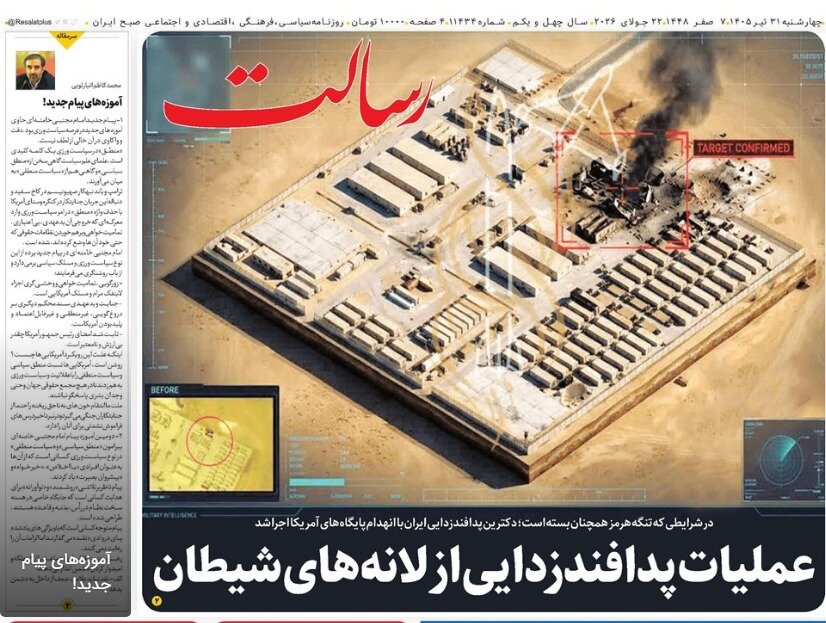
Tehran's media outlets contend that despite military and economic pressures, the US has not weakened Iran's capabilities or regional influence. They highlight the potential for continued crisis, diplomatic efforts like a ceasefire proposal, and the critical implications of the Strait of Hormuz for global energy security.
Imagine two big kids, the US and Iran, are having a really long argument. The US has tried to make Iran change its mind by pushing it around and taking away its toys, but Iran hasn't budged. Now, some grown-ups are trying to get them to agree to a short break from fighting, but it's tricky because they don't fully trust each other. Everyone knows if the fight gets too big, it could stop important things like oil from moving around the world, which would be a huge problem for everyone.
Analysis
Iran's Perceived Resilience and US Failures
Iranian newspapers, including Resalat and Siasat-e-Rooz, present a unified narrative asserting the failure of US and Israeli strategic objectives against Iran. Resalat claims that the "hegemonic war machine has not achieved any of its strategic objectives," specifically noting that Iran's missile and nuclear capabilities remain intact, its regional strategic depth is unsevered, and its political structure has not collapsed. This perspective frames the ongoing military and economic pressures as counterproductive for Washington and Tel Aviv, leading instead to a "severe geopolitical nightmare." The article emphasizes that the US has become "trapped by its own hand in a swamp of unforeseen consequences," with the potential closure of the Strait of Hormuz highlighted as a critical vulnerability for the Western economy.
Siasat-e-Rooz reinforces this view, stating that "no change will occur in Iran’s position" despite US attempts to intensify attacks and economic pressure. It cites a Washington Post report, quoting intelligence officials, suggesting that new attacks are unlikely to alter Tehran's stance. This analysis underscores a belief within Iranian media that the US's efforts to change the system in Iran through economic sanctions, particularly blocking oil exports, are futile. The paper characterizes the conflict with Iran as the "biggest international crisis facing the US government," with potential for even greater crises in the future, further solidifying the narrative of US strategic miscalculation.
Diplomatic Overtures and Enduring Obstacles
Amidst the ongoing tensions, Donya-e-Eqtesad discusses the prospects for reviving diplomatic understandings, specifically focusing on a 10-day ceasefire proposal and the "Islamabad understanding." The paper suggests that while a new agreement isn't imminent, there's a reactivation of overt and covert diplomacy in the region, evidenced by Qatar's initiative, an Iranian interior minister's trip to Pakistan, and renewed emphasis on diplomacy by figures like Marco Rubio. This indicates a recognition within Iranian analysis of the need for de-escalation mechanisms, even if temporary. The "Islamabad understanding" is presented as a framework for managing disputes through diplomacy and preventing escalation, offering a glimmer of hope for a less confrontational path.
However, the article also injects a note of caution, warning against the "scenario of deception" based on historical patterns of conflict. This highlights a deep-seated mistrust and skepticism towards such proposals, suggesting that any diplomatic overture is viewed through the lens of past betrayals or tactical maneuvers rather than genuine peace efforts. Ettelaat further elaborates on the future of the crisis, outlining three scenarios: gradual escalation, a new ceasefire, or a continuation of the current state of "neither full-scale war nor lasting peace." This third scenario, characterized by limited attacks, political pressure, and regional competition, is deemed highly likely, implying that even if ceasefires emerge, they may not lead to lasting stability.
Future Trajectories of Iran-US Relations
Ettelaat's analysis of future scenarios provides a comprehensive outlook on the protracted nature of the Iran-US confrontation. The paper dismisses the likelihood of a full-scale ground invasion due to its high costs, as assessed by military analysts. Instead, it anticipates a continuation of "air and naval battles and proxy warfare," interspersed with "occasional efforts to establish ceasefires." This suggests a future characterized by a low-intensity conflict, punctuated by periods of heightened tension and attempts at de-escalation, rather than a decisive resolution or a complete breakdown into all-out war.
The overarching conclusion drawn by the Iranian papers is that Iran-US relations will remain in a state of oscillation between escalation and crisis management. Achieving a lasting agreement is seen as facing "many obstacles," reflecting a pessimistic view on the immediate prospects for a comprehensive diplomatic breakthrough. This perspective underscores the deep-seated animosity and strategic deadlock that define the relationship, where both sides are perceived to be entrenched in their positions, making any significant shift towards peace a formidable challenge. The emphasis on the US being in a "self-inflicted quagmire" serves to bolster Iran's narrative of resilience and strategic patience in the face of external pressure.
Key points
- Iranian newspapers assert that US and Israeli strategic objectives against Iran have failed, leaving the US in a "self-inflicted quagmire."
- Iran's missile and nuclear capabilities, regional influence, and political structure are deemed resilient despite US pressures.
- The potential closure of the Strait of Hormuz is highlighted as a critical threat to global energy security and the Western economy.
- Diplomatic initiatives, including a 10-day ceasefire proposal and the "Islamabad understanding," are being discussed but are viewed with skepticism regarding potential deception.
- The future of Iran-US relations is expected to oscillate between escalation and crisis management, with lasting peace facing many obstacles.
If the proposed 10-day ceasefire moves forward, it could serve as a crucial first step towards reviving diplomatic efforts and managing disputes, potentially preventing further escalation. The reactivation of overt and covert diplomacy, as noted by Donya-e-Eqtesad, offers a pathway for dialogue and a more stable regional environment.
The scenario of gradual escalation, as outlined by Ettelaat, remains a significant risk, with limited attacks and political pressure continuing to push the region to the brink of larger crises. Furthermore, the possibility of "deception" during ceasefire attempts, based on historical patterns, suggests that diplomatic efforts could be undermined, leading to renewed conflict.
Market signals
- OIL The article's mention of the Strait of Hormuz closure paralyzing global energy security suggests increased supply-route risk, which typically drives oil prices higher.
AI-generated analysis of potential market relevance. Not financial advice.