What will the US foreign robot ban mean for China’s world-leading start-ups?
The US Federal Communications Commission has banned imports of new foreign-made advanced robotic devices, citing supply chain and cybersecurity concerns. This move primarily targets Chinese robotics firms, which dominate the global humanoid robot market, and has been cond…
Intelligence analysis by Gemini 2.5 Flash
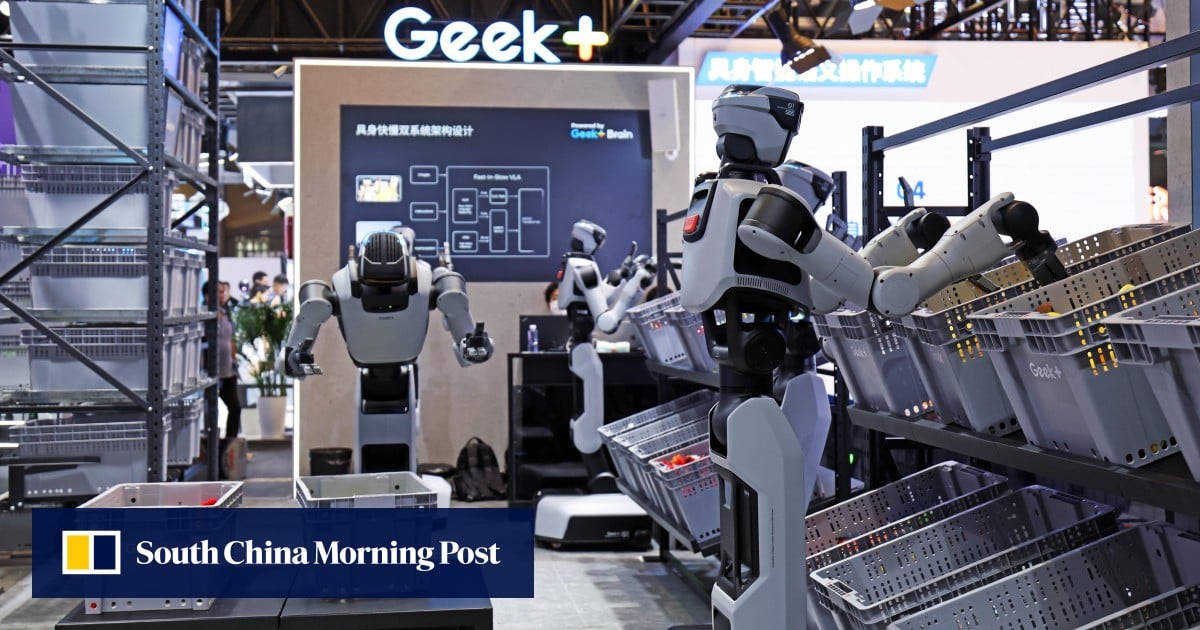
The US has implemented a ban on new foreign-made advanced robotic devices, including humanoids and quadrupeds, from entering its market. This regulatory action, driven by concerns over supply chain vulnerabilities and cybersecurity, is expected to significantly impact China's leading robotics companies and their global expansion ambitions.
Imagine a toy factory in another country that makes really cool, smart robots, like walking humanoids or robot dogs. The US government has now said that new versions of these foreign-made robots can't be sold in America anymore. They're worried about where the parts come from and if the robots could be hacked. This mostly affects factories in China because they make a lot of these robots, and now they have to figure out how to sell them elsewhere.
Analysis
Escalating Tech Tensions in Robotics
The recent decision by the US Federal Communications Commission (FCC) to ban imports of new foreign-made advanced robotic devices marks a significant escalation in the ongoing technological rivalry between the United States and China. This move, which specifically targets new humanoids, quadrupeds, and a broad range of connected mobile machines, is framed by the FCC as a measure to address supply chain vulnerabilities and mitigate cybersecurity threats. While the ban is broadly stated as applying to "foreign-produced" devices, its primary impact is clearly directed at Chinese robotics firms, given their dominant position in the global market. This policy reflects a broader trend of decoupling in critical technology sectors, where national security concerns are increasingly invoked to justify trade restrictions. The US government's actions suggest a strategic intent to limit China's influence in emerging technologies, even as Chinese companies have achieved considerable success in areas like humanoid robotics. The ban on new models, while leaving previously authorized devices unaffected for now, creates a substantial barrier for future market entry and expansion for Chinese innovators.
China's Robotics Dominance Under Threat
Chinese robotics companies have established a world-leading position, particularly in the humanoid robot sector. According to a report by Counterpoint Research, these firms accounted for over 80 percent of humanoid robots installed globally last year, underscoring their significant market penetration and technological advancements. This dominance is now directly challenged by the US ban, which could severely curtail their access to one of the world's largest and most lucrative markets. The ban forces these companies to recalibrate their ambitious overseas expansion plans, potentially shifting their focus to other international markets or intensifying domestic competition. Beijing has swiftly condemned the US action, characterizing it as protectionism and an overreach of national security concepts to suppress Chinese enterprises. Foreign ministry spokesperson Mao Ning asserted that such measures would ultimately harm American companies and consumers by limiting choice and fostering an uncompetitive environment. China's pledge to take "necessary measures to protect the legitimate rights and interests of Chinese enterprises" signals a potential for retaliatory actions or increased support for its domestic robotics industry to counter the US restrictions.
Implications for Global Robotics and Innovation
The US ban carries significant implications not only for the affected Chinese companies but also for the broader global robotics landscape and the pace of innovation. For Chinese start-ups, the immediate challenge is adapting their business models and market strategies to navigate this new regulatory hurdle. This could lead to increased investment in domestic R&D to reduce reliance on foreign components or markets, or a pivot towards non-US markets where regulatory environments are more favorable. The long-term effect might be a bifurcation of the global robotics market, with distinct ecosystems developing in response to geopolitical tensions. For the US, while the ban aims to enhance national security, it could also limit access to cutting-edge robotic technologies developed by Chinese firms, potentially slowing innovation or increasing costs for American consumers and businesses. The move also raises questions about the definition of "advanced robotic devices" and the criteria for assessing supply chain vulnerabilities and cybersecurity threats, which could set precedents for future technology restrictions. The global robotics industry, already grappling with rapid technological change, now faces added complexity from geopolitical considerations.
Key points
- The US FCC has banned imports of new foreign-made "advanced robotic devices" into the US.
- The ban covers new humanoids, quadrupeds, and connected mobile machines, citing supply chain vulnerabilities and cybersecurity threats.
- This policy primarily impacts Chinese robotics firms, which accounted for over 80% of global humanoid robot installations last year.
- China has condemned the ban as protectionism and vowed to protect its enterprises' legitimate rights.
- Previously authorized foreign robot models remain unaffected by the new regulation.
Chinese robotics firms might accelerate their domestic innovation and diversify into other global markets, fostering new partnerships and technological advancements outside the US. This could lead to a more robust and self-reliant Chinese robotics industry, potentially driving global competition and innovation in the long run.
The ban could severely hinder the global expansion of leading Chinese robotics start-ups, limiting their market access and revenue streams. This protectionist measure risks fragmenting the global robotics market, potentially slowing overall innovation and increasing costs for consumers worldwide due to reduced competition.