Where is Kuh-e Kolang and why has Trump threatened to target it?
Former US President Donald Trump has threatened to target 'Kuh-e Kolang,' an underground Iranian nuclear facility near Natanz, raising concerns about its unknown purpose and potential for military escalation.
Intelligence analysis by Gemini 2.5 Flash
Trump's recent threats against Iran highlighted Kuh-e Kolang, an underground complex Iran claims is for advanced centrifuge assembly, built after a 2020 sabotage. However, its depth, size, and lack of IAEA access fuel Western suspicions of broader nuclear activities, prompting US officials to consider it a potential military target.
Imagine Iran is building a secret underground workshop inside a mountain called Kuh-e Kolang. They say it's for fixing special spinning machines that make nuclear fuel, especially after their old workshop got broken. But some grown-ups, like the US president, think it might be for something even more secret and powerful, and he's warned that he might hit it. This makes everyone worried about a big fight.
Analysis
The Enigmatic Underground Complex
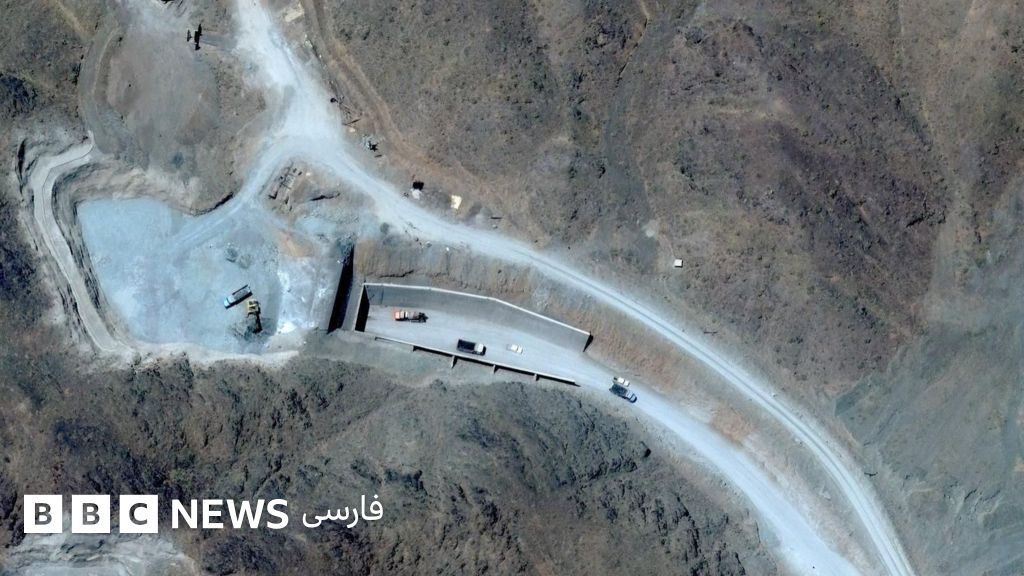
Kuh-e Kolang, or "Pickaxe Mountain," is an underground facility located approximately two kilometers south of Iran's Natanz nuclear complex in Isfahan province. Its construction began after a July 2020 explosion damaged the advanced centrifuge assembly building at Natanz, an incident Iranian officials attributed to "sabotage," widely believed to be carried out by Israel. Iran's then-head of the Atomic Energy Organization, Ali Akbar Salehi, announced plans for a "more modern, larger, and more comprehensive" replacement center deep within the mountain, ostensibly for the production and assembly of advanced centrifuges. Satellite imagery from late 2020 confirmed initial ground preparation, road construction, and support areas, with extensive excavation becoming visible by 2021, revealing multiple tunnel entrances.
Western Suspicions and Strategic Significance
Despite Iran's official narrative, the characteristics of Kuh-e Kolang have fueled significant Western suspicion regarding its true purpose. The sheer depth of the tunnels, the potential vastness of the complex—estimated by the Institute for Science and International Security (ISIS) to potentially exceed 5,000 square meters, larger than the destroyed Natanz facility—and the lack of access for International Atomic Energy Agency (IAEA) inspectors raise questions. Experts suggest the site could have applications beyond centrifuge assembly, including the establishment of a small enrichment unit or the storage of Iran's sensitive high-enriched uranium reserves, whose exact location has been uncertain since previous attacks on other Iranian nuclear sites. This combination of secrecy, depth, and potential capacity makes Kuh-e Kolang a critical and concerning element of Iran's nuclear infrastructure.
Escalating Tensions and Military Implications
The strategic importance of Kuh-e Kolang has been underscored by recent threats from former US President Donald Trump, who stated the US is monitoring the facility and warned of a potential "major attack." US officials have reportedly told the Wall Street Journal that targeting this complex is among the options being considered for expanding military operations against Iran. Iran has responded by significantly enhancing security measures around the site, including constructing a security wall and partially backfilling some tunnel entrances to restrict access, particularly after a 12-day conflict in June 2025. While ISIS's latest assessment indicates the complex is not yet fully operational and construction continues, the explicit threats and the facility's clandestine nature highlight the escalating tensions and the potential for military confrontation over Iran's nuclear program.
Key points
- Donald Trump threatened to target 'Kuh-e Kolang,' an underground Iranian nuclear facility.
- The complex is located near the Natanz nuclear site and was built after a 2020 sabotage incident.
- Iran claims Kuh-e Kolang is for advanced centrifuge assembly, replacing a damaged facility.
- Western experts suspect the site's depth, size, and lack of IAEA access suggest broader nuclear activities, possibly including uranium enrichment or storage.
- US officials are reportedly considering an attack on Kuh-e Kolang as an option for military operations against Iran.
The explicit threats against Kuh-e Kolang could lead to a direct military confrontation between the US and Iran, potentially escalating regional conflicts and further destabilizing the Middle East. Such an attack could also prompt Iran to accelerate its nuclear program in defiance, making future diplomatic solutions even more challenging.
Market signals
- OIL Threats of military action against Iranian nuclear facilities in the Middle East typically increase geopolitical risk, leading to concerns about oil supply disruptions and higher prices.
- XAU Escalating geopolitical tensions and the prospect of military conflict drive investors towards safe-haven assets like gold.
AI-generated analysis of potential market relevance. Not financial advice.