Why China’s C909 jet is rapidly being deployed in Xinjiang
Xinjiang has become the fastest-growing market for China’s C909 regional jet, with 30 aircraft now flying more than 120 routes. Its smaller size fits thinly used routes in a vast region where air travel is often the easiest option.
Intelligence analysis by GPT-5.4 Mini
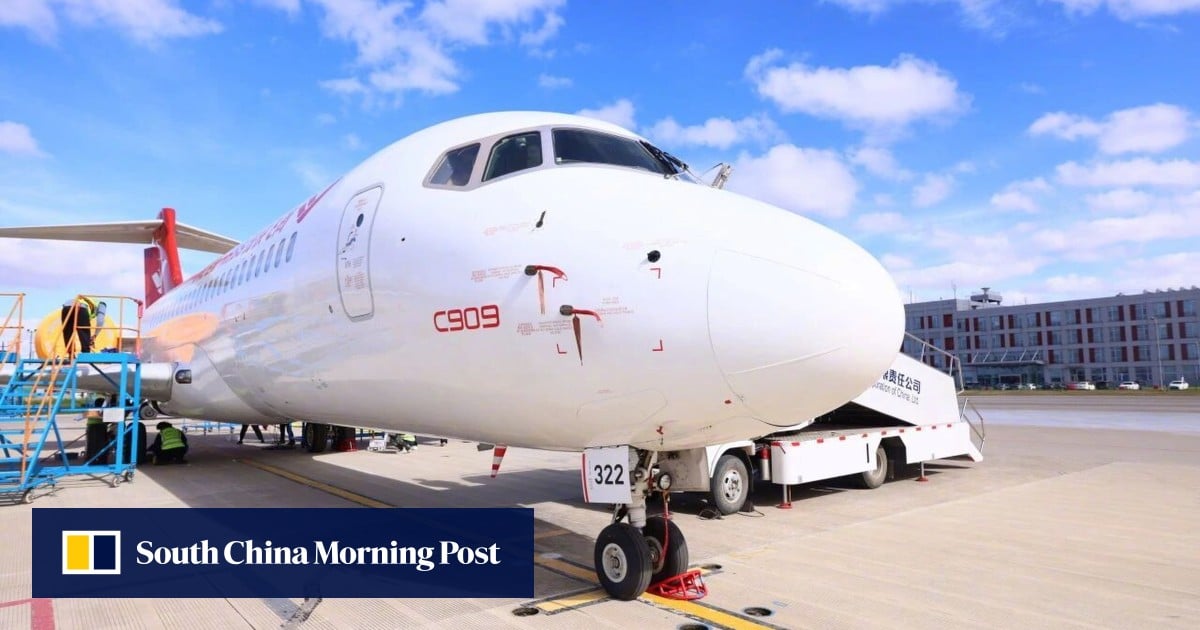
China’s C909 has struggled against Airbus and Boeing overall, but Xinjiang is becoming a strong use case. Airlines there are adding the 78- to 97-seat jet quickly because it is cheaper to operate on lightly filled routes across a large, sparsely populated region.
The C909 is like a smaller bus that works better on quiet roads than a giant coach. In Xinjiang, many trips do not need a big plane, so the smaller one can be cheaper and easier to fill.
Analysis
Xinjiang as a practical market
China’s C909, formerly known as the ARJ21, has had a difficult commercial path since launching about a decade ago. But in Xinjiang, the jet is expanding quickly because the region’s conditions match the aircraft’s strengths: many routes are new, demand is often thin, and flying is frequently the most convenient way to move between cities.
The article says the first C909 arrived in Xinjiang in June 2023. Since then, airlines have deployed 30 of the jets on more than 120 routes in the region, according to CCTV. That is a rapid build-out for an aircraft that has otherwise struggled to compete with Airbus and Boeing.
Why the aircraft fits
The C909 seats 78 to 97 passengers, far fewer than a Boeing 737 or Airbus A320, which usually carry about 150 to 180. That smaller size is an advantage on low-traffic routes, especially where airlines are opening new services and aircraft may not be full for much of the year.
A report by researchers from Comac, the state-owned manufacturer of the C909 and C919, argues that the jet is more cost-effective than larger narrowbody aircraft on such routes. The report, led by senior economist Guo Caisen, says the C909’s contribution margin is 6,000 yuan to 10,000 yuan higher per operating hour than the Boeing 737.
The broader takeaway is not that the C909 has solved China’s commercial aviation challenge. It is that the jet appears to have found a niche where its size and economics make sense, and Xinjiang is that niche.
Key points
- Xinjiang now has 30 C909 jets operating on more than 120 routes, according to CCTV.
- The first C909 arrived in the region in June 2023.
- The jet seats 78 to 97 passengers, making it smaller than a Boeing 737 or Airbus A320.
- Comac researchers say the C909 can be more cost-effective on low-traffic routes.
- The aircraft’s momentum in Xinjiang contrasts with its broader struggle against Airbus and Boeing.
If the deployment continues to work, the C909 could become a reliable tool for opening and sustaining new routes in Xinjiang. That would give China’s domestic jet a clear commercial niche and more real-world flying experience.
The growth may stay limited to places like Xinjiang where demand is thin and route economics favor smaller planes. Outside those conditions, the C909 still faces the same competition from larger and better-established Airbus and Boeing aircraft.