Why US sanctions threats against China aren’t credible
The US threat of sanctions against China over its relationship with Iran lacks credibility due to America's own economic vulnerabilities, including an AI bubble and a fragile bond market.
Intelligence analysis by Gemini 2.5 Flash
An opinion piece argues that the US is ill-equipped to impose effective sanctions on China, particularly by weaponizing global payments like SWIFT. The author contends that China's resilient economy and alternative payment systems, coupled with the US's massive public debt and inflated stock market, make Washington more susceptible to financial shocks, suggesting it would 'blink first…
Imagine two kids playing a game where one threatens to take away the other's favorite toy. But the kid making the threat has a wobbly tower of blocks that could fall over any minute, and the other kid has a different, equally fun toy to play with. This story says the US is like the kid with the wobbly tower (lots of debt and a bubbly stock market), and China is the kid with the backup toy (a strong economy and its own money system). So, the US's threats to take away China's 'toy' (access to global money systems) might not work because it could hurt itself more, and China has other options.
Analysis
The article posits that the United States' current economic landscape significantly undermines the credibility of its threats to impose sanctions on China, especially concerning Beijing's ties with Iran. The author, Andy Xie, highlights a critical shift in economic resilience between the two powers since the initial trade and tech war under former US President Donald Trump.
US$40 trillion
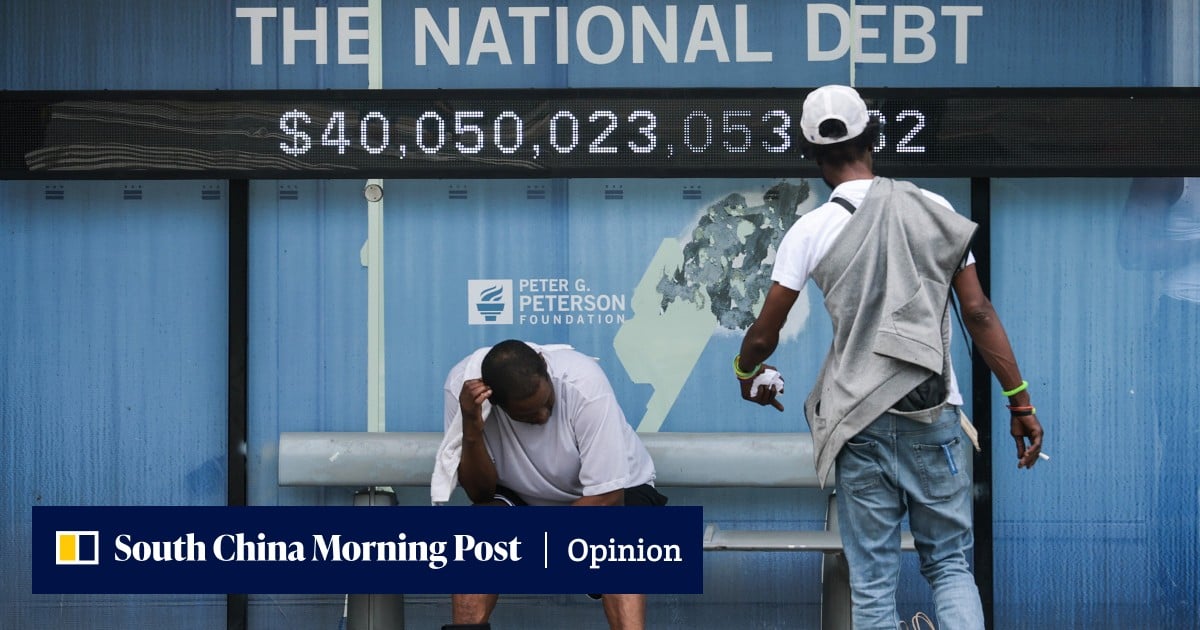
America's financial system is depicted as precariously balanced, primarily due to a ballooning fiscal deficit and surging public debt. The article notes that total US public debt has surpassed US$40 trillion, a substantial increase from US$9 trillion in 2007. This immense debt burden necessitates refinancing US$9 trillion in bonds and issuing an additional US$2.1 trillion to cover the deficit, leading to bond yields surging to levels last seen in 2007. Such a fragile fiscal position makes the US highly vulnerable to any major financial shock, which a financial war with China could easily trigger.
Furthermore, the US economy is characterized by a significant "artificial intelligence bubble" that has inflated stock market capitalization to 240 percent of gross domestic product. This level is higher than during previous market peaks in 1987, 2000, and 2007, indicating an overvalued market susceptible to correction. The combination of an overheated stock market and a precarious bond market creates a scenario where the US is more vulnerable to economic disruption than China, making aggressive financial actions a high-risk strategy for Washington.
SWIFT
The core of the US's financial leverage lies in its control over global payment systems, particularly SWIFT, which facilitates dollar-based cross-border transactions. The threat to remove major Chinese institutions from SWIFT is intended to cripple their ability to conduct international trade and finance. However, the article argues that such a move would merely accelerate the global shift away from the dollar and towards alternative payment mechanisms.
China has already established its Cross-border Interbank Payment System (CIPS), which is described as a "perfectly functional yuan payment system." The author suggests that China's trading partners could easily transition to CIPS, thereby mitigating the impact of SWIFT exclusion and bolstering the international standing of the yuan. This potential for an alternative system reduces the effectiveness of US sanctions and could inadvertently strengthen China's financial autonomy and global influence, diminishing the dollar's dominance.
Donald Trump
The current geopolitical and economic standoff is contextualized by the trade and tech war initiated by US President Donald Trump. During that period, China faced its own significant economic challenges, including a massive property bubble and an overextended shadow banking system. However, the Chinese government successfully managed to deflate these bubbles without precipitating a major economic downturn, demonstrating a capacity for resilience and crisis management.
In contrast to China's demonstrated resilience, the US economy is now portrayed as the more fragile entity. The article concludes that in a "game of chicken" involving financial warfare, the US is more likely to back down first. The potential for massive self-harm to its own financial system, stemming from its debt and market bubbles, makes Washington's threats less credible and its willingness to escalate an economic conflict questionable. China, having absorbed previous blows from US sanctions in trade and technology without recession, is seen as having little incentive to yield to additional pressure.
Key points
- US threats of sanctions against China, particularly involving SWIFT, are deemed not credible due to US economic fragility.
- The US economy is burdened by over US$40 trillion in public debt and an 'artificial intelligence bubble' in its stock market.
- China's economy is described as resilient, having successfully managed past domestic economic challenges.
- China's Cross-border Interbank Payment System (CIPS) offers an alternative to SWIFT, potentially accelerating the yuan's rise.
- The article suggests the US would 'blink first' in a financial confrontation due to the risk of massive self-harm.
If the US recognizes its economic vulnerabilities, it might pursue more cooperative and less confrontational approaches with China, potentially leading to de-escalation of trade and financial tensions. China's CIPS could gain further international traction, offering a more diversified global financial system less reliant on a single currency.
Should the US proceed with aggressive financial sanctions, it risks triggering a major financial collapse at home due to its fragile debt and stock markets. This could lead to a severe global economic shock, further fragmenting the international financial system and accelerating a potentially destabilizing shift away from the dollar.