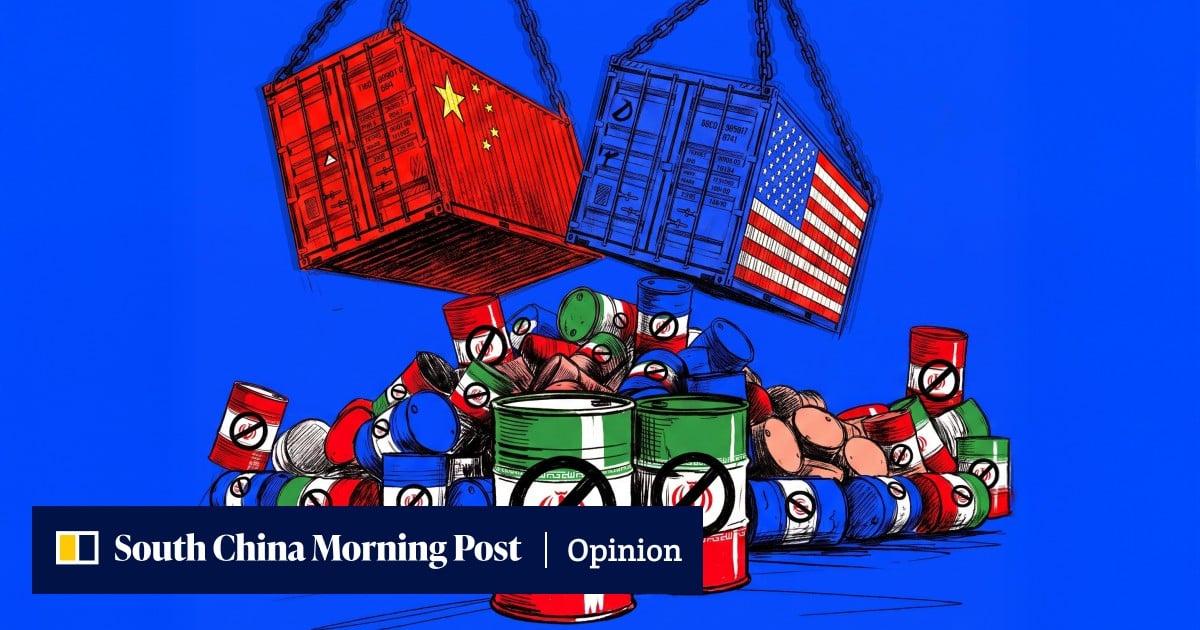
Will US threats over Iran be the last straw for Beijing?
US threats of sanctions over Iranian oil purchases, implicitly targeting China, are escalating tensions just months after a perceived stabilization in US-China trade relations.
Intelligence analysis by Gemini 2.5 Flash
The US is intensifying pressure on China across multiple fronts, including new sanctions related to Iranian oil, designations of Chinese companies as military-linked, and tariffs on various goods. This aggressive stance is testing Beijing's measured response and risks a significant deterioration in the already strained bilateral relationship.
Imagine two big kids, America and China, who usually play together but sometimes argue. America is telling other kids not to buy juice from Iran, and China buys a lot of juice from Iran. America is also making it harder for China's toy companies to sell their toys or get money. China is trying to stay calm and not fight back too hard, but America keeps pushing, and it feels like their friendship might break apart completely.
Analysis
The relationship between the United States and China, already fraught with trade disputes and strategic competition, is facing renewed strain over Washington's aggressive stance on Iran. The US Treasury Secretary's implicit threat of sanctions against nations continuing to purchase Iranian crude oil directly targets China, the Islamic Republic's largest oil customer. This move follows a series of escalating measures by the US since the Xi-Trump summit in May, which had briefly offered a semblance of calm.
Scott Bessent
US Treasury Secretary Scott Bessent's warning about sanctions on Iranian crude oil purchasers, while not explicitly naming China, clearly places Beijing in Washington's crosshairs. This threat is not an isolated incident but part of a broader strategy by the US to exert pressure on China. The US has already implemented new sanctions targeting 60 entities, including companies and vessels in mainland China and Hong Kong, linked to Iranian trade. This demonstrates a willingness to directly impact Chinese economic interests to achieve its foreign policy objectives regarding Iran.
This aggressive approach by the US signals a hardening stance, indicating that Washington is prepared to use economic leverage to enforce its will, even at the risk of further alienating a major global power. The implications extend beyond oil, as it sets a precedent for how the US might address other areas of disagreement with China, potentially leading to a more confrontational global economic environment. Beijing's response, so far, has been described as deliberate and calibrated, avoiding blanket retaliation in favor of targeted actions when core interests are directly threatened.
May summit
The fragile calm established after the May summit between President Xi Jinping and President Donald Trump is now being severely tested. Just three months after the leaders met, the US has unleashed a barrage of measures designed to tighten the screws on China. These actions include the Pentagon adding major Chinese tech companies like Alibaba, Baidu, and BYD to a list of "Chinese military companies," which can restrict their access to US capital and markets. This designation is a significant blow to these firms, impacting their international operations and investor confidence.
Furthermore, the US announced new tariffs on goods from 60 economies, including China, following a Section 301 investigation into forced labor. This was quickly followed by bans on imports of Chinese robots and power inverters, and an additional tariff on polysilicon. These cumulative actions underscore a systematic effort by Washington to decouple certain sectors of its economy from China and to challenge Beijing's economic practices. The rapid succession of these measures suggests a strategic intent to maintain constant pressure, making it difficult for China to find stable ground in the bilateral relationship.
Polysilicon
The imposition of a 15 percent tariff on polysilicon in August is another example of the US's targeted economic pressure on China. Polysilicon is a critical component in solar panels, and this tariff directly impacts China's robust solar energy industry. This move, alongside the ban on Chinese robots and power inverters, illustrates a broader US strategy to curb China's technological advancements and manufacturing dominance in key sectors. These actions are not merely about trade imbalances but are deeply intertwined with national security and technological supremacy concerns.
Beijing's response to this multifaceted onslaught has been characterized by a strategic shift from broad tariff retaliation to more precise counter-measures. China appears to be carefully weighing the costs and benefits of escalation, choosing its battles rather than engaging in an all-out trade war. This measured approach aims to protect its core interests while avoiding a complete rupture, but the continuous US pressure, with Iran as the latest flashpoint, pushes the relationship closer to a critical tipping point. The long-term implications for global supply chains and technological development are substantial, as both nations vie for economic and geopolitical influence.
Key points
- US Treasury Secretary Scott Bessent threatened sanctions against nations purchasing Iranian crude oil, implicitly targeting China.
- China is Iran's largest oil customer, placing it squarely in Washington's crosshairs.
- The US has already sanctioned 60 entities linked to Iranian trade, including some in mainland China and Hong Kong.
- Since May, the US has added major Chinese companies (Alibaba, Baidu, BYD) to a 'military companies' list, imposed new tariffs, and banned certain Chinese imports.
- Beijing has adopted a deliberate and calibrated response, avoiding blanket retaliation and striking back precisely when core interests are threatened.
China's deliberate and calibrated response, choosing to hold its fire where escalation costs outweigh benefits, suggests a potential for managing the current tensions without a full-blown rupture. This strategic patience could allow for future diplomatic avenues to de-escalate the situation, preventing a complete breakdown of bilateral relations.
The continuous and multifaceted pressure from the US, particularly the threats over Iran, risks pushing the US-China relationship to a major rupture. This could lead to further economic decoupling, increased geopolitical instability, and a more confrontational global environment, with significant negative impacts on international trade and cooperation.
Market signals
- BABA Alibaba was added to the US 'Chinese military companies' list, which can restrict its access to US capital and markets.
- BIDU Baidu was added to the US 'Chinese military companies' list, which can restrict its access to US capital and markets.
- BYDDY BYD was added to the US 'Chinese military companies' list, which can restrict its access to US capital and markets.
- OIL US threats of sanctions on Iranian crude oil purchases could reduce global supply, potentially driving up oil prices.
AI-generated analysis of potential market relevance. Not financial advice.