Zcash plummets 30% as Shielded Labs reveals a major bug that went undetected for four years
Zcash fell about 30% to $400 after Shielded Labs disclosed a critical Orchard bug that could have enabled undetectable counterfeit ZEC.
Intelligence analysis by GPT-5.4 Mini
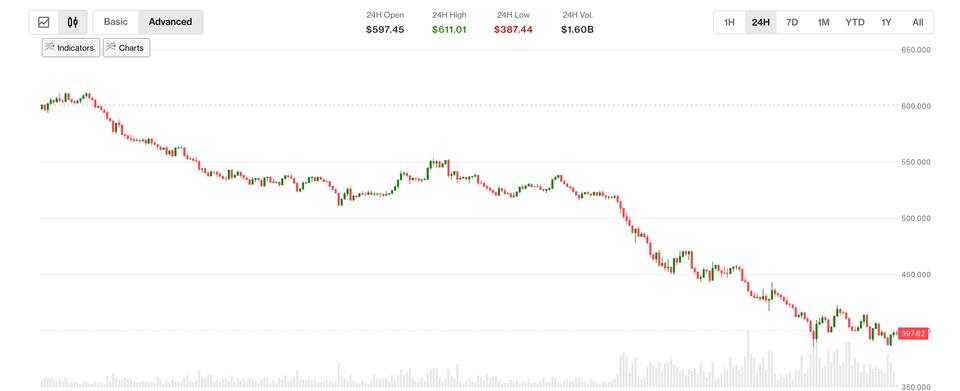
Shielded Labs said a flaw in Zcash's Orchard privacy pool could have let an attacker create unlimited counterfeit tokens without detection. The bug existed since May 2022, was fixed on June 1, and now has markets worried about possible hidden inflation.
A hidden hole was found in Zcash's privacy system that could have let someone make fake coins without anyone noticing. Even though it was fixed quickly, people worried the coin box might not be as safe as they thought, so the price dropped.
Analysis
What happened
Shielded Labs, a nonprofit Zcash developer, disclosed a critical vulnerability in the Orchard privacy pool that could have allowed an attacker to mint unlimited fake ZEC without being detected. The flaw was found on May 29 by security engineer Taylor Hornby during a targeted review, and it was patched in an emergency fix on June 1.
Why the market reacted
The problem is not just the bug itself, but the uncertainty around whether it was ever used before the fix. Shielded Labs said there is no cryptographic way to prove whether exploitation happened, because Orchard's privacy design and the nature of the flaw leave no definitive on-chain proof either way. That uncertainty is enough to pressure price, especially for a token whose value depends on confidence in fixed supply.
What Shielded Labs is proposing
The firm said it is working on a network upgrade that would add new accounting controls and let anyone verify ZEC supply integrity independently. It also said it is accelerating security work, including continued collaboration with Hornby, a formal verification effort for the Orchard circuit, and new hires for security and cryptography roles.
Bottom line
The story is less about a confirmed exploit and more about a damaged trust envelope. Zcash now has to convince holders that the bug was not used, or at least that future accounting and verification changes can make hidden inflation much harder to fear.
Key points
- Zcash fell roughly 30% to about $400 after Shielded Labs disclosed the issue.
- The bug was in the Orchard privacy pool and could have enabled unlimited undetectable counterfeit ZEC.
- Shielded Labs said the flaw existed since Orchard launched in May 2022 and was fixed on June 1, 2026.
- The team said it cannot cryptographically confirm whether the bug was exploited before the patch.
- A network upgrade, new accounting measures, and more security work are being proposed to restore trust.
If the planned upgrade adds stronger accounting and independent verification, it could help rebuild confidence in ZEC's supply. The faster fix and new security work may also convince users that the project can catch serious bugs quickly enough to limit damage.
The biggest risk is that no one can prove whether the flaw was used before the fix, so distrust may linger even after the patch. If holders keep worrying about hidden inflation, ZEC could face continued selling pressure and a longer-term credibility hit.