Zelenskyy discusses ‘urgent need to scale up’ air defences with key allies in London
Zelenskyy met Starmer, Macron and Merz in London to discuss boosting Ukraine’s air defences after fresh Russian attacks.
Intelligence analysis by GPT-5.4 Mini
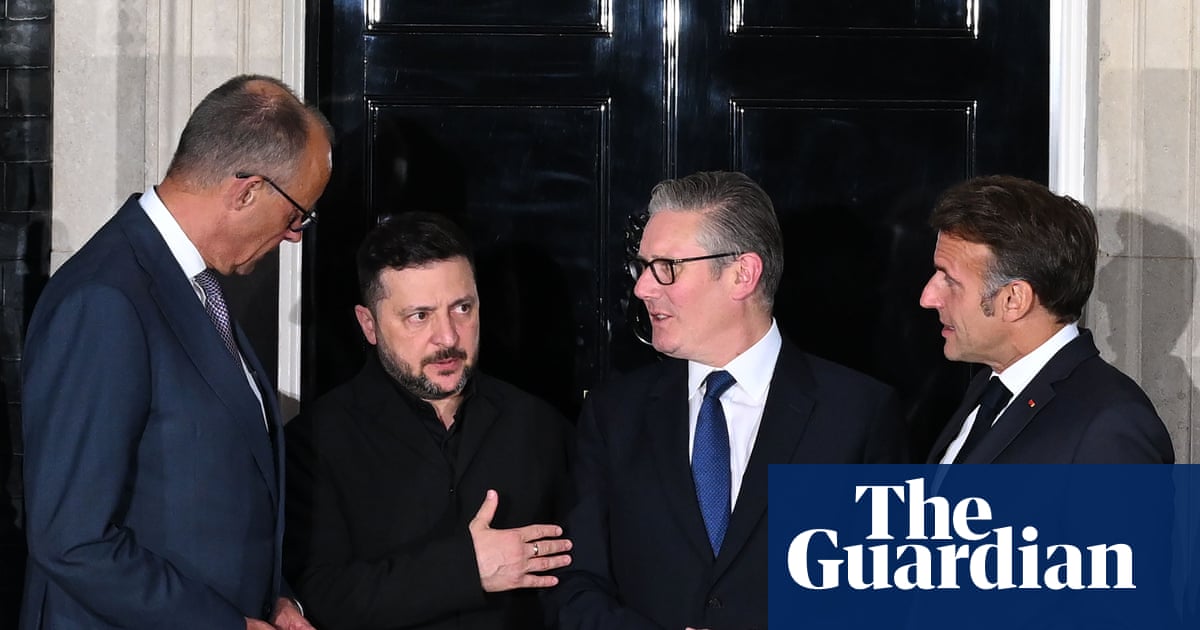
Ukraine’s president met Britain, France and Germany’s leaders in London after a new wave of Russian strikes, including damage near Chornobyl. The talks focused on faster production of interceptors, better air defence, and deeper strike capabilities, while allies pushed for a ceasefire and more sanctions on Russia.
Ukraine’s leader met three powerful allies in London to ask for stronger shields in the sky and better weapons to hit back. It is like a team asking neighbors to help fix a broken fence while a bully keeps throwing rocks over it.
Analysis
What happened
Volodymyr Zelenskyy met Keir Starmer, Emmanuel Macron and Friedrich Merz in London to discuss support for Ukraine after Russia fired hypersonic weapons and launched large-scale drone and missile attacks. According to Downing Street, the leaders focused on the “urgent need to scale up” Ukraine’s air defences and its deep-strike capabilities.
The meeting came shortly after a Russian drone strike damaged a storage centre for spent nuclear fuel near the Chornobyl nuclear power plant. Zelenskyy described that attack as “extremely vile,” while saying it did not cause a rise in radiation.
What the leaders said they want
The UK government said the leaders discussed producing more interceptors and co-developing anti-ballistic missile and deep-strike systems. They also condemned Russia’s attacks and called for an immediate and complete ceasefire, with the current line of contact as the starting point for talks.
The article says the leaders now want to use upcoming meetings, including the G7 summit at Evian and the NATO summit in July, to seek more support, more sanctions on Russia, and a larger military commitment for Ukraine.
Wider context
The meeting followed a week of heightened hostilities. Zelenskyy had publicly challenged Vladimir Putin to face-to-face talks, but Putin rejected the idea and said his war goals had not changed. Zelenskyy called that response weak and said Ukrainian deep strikes inside Russia would continue.
The article also describes a more optimistic mood in Kyiv, where Ukraine believes Russia’s advance has stalled and that its drone attacks are exposing weaknesses in Russian air defences and supply lines. The overall picture is of a war moving into a phase where air power, long-range strikes and allied weapons production are central.
Key points
- Zelenskyy met Starmer, Macron and Merz in London after new Russian strikes on Ukraine.
- Downing Street said the leaders discussed scaling up air defences and deep-strike capabilities.
- The talks followed a drone strike that damaged storage for spent nuclear fuel near Chornobyl.
- The leaders called for an immediate and complete ceasefire and more pressure on Russia.
- Upcoming G7 and NATO meetings are expected to be used to seek more aid and sanctions.
If the allies follow through, Ukraine could get more interceptors and better air defenses faster, making Russian missile and drone attacks less effective. The London talks could also help build momentum for more sanctions and more military aid at the G7 and NATO meetings.
If the allies do not move quickly, Russia’s attacks could keep damaging Ukrainian infrastructure and raising the pressure on civilians. The article also shows no sign of a ceasefire breakthrough, since Putin rejected direct talks and both sides appear ready to keep striking deeper into enemy territory.