A Helpful Guide to Fair Elections From the Supreme Court Majority
A satirical Atlantic piece mocks the Supreme Court majority’s approach to voting rights and redistricting in Louisiana v. Callais.
Intelligence analysis by GPT-5.4 Mini
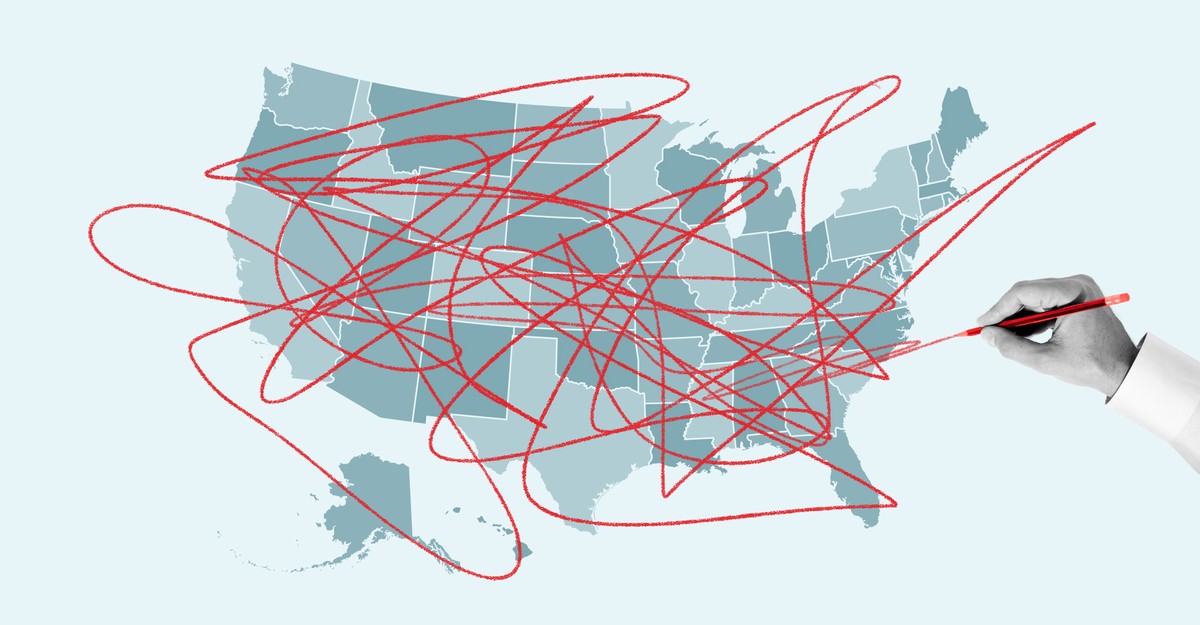
The article parodies how the Court majority might explain its views on fair elections, redistricting, and the Voting Rights Act. It treats partisan maps as the goal and uses exaggerated humor to criticize the logic behind weakening voting-rights protections.
The article is a joke version of a court explanation. It says election maps should be made to help one party, which is like saying a race is fair only if one runner gets a head start.
Analysis
What the piece is doing
This Atlantic newsletter is a satire about the Supreme Court majority’s thinking in Louisiana v. Callais, using a mock Q&A to lampoon how the justices might justify partisan redistricting and a weaker Voting Rights Act.
The core joke
The fake “guide” says a congressional map is healthy when it is red, with only tiny blue holdouts at most. It also defines a fair election as one that leaves voters with the best chance to elect a Republican, and it jokes that legal protections for minority voters are treated as a problem rather than a safeguard.
What it says about the Court
The piece also mocks the idea that last-minute map changes should be avoided under the Purcell principle only when they would not help Republicans. In the same vein, it jokes that the only kind of unconstitutional discrimination that matters is discrimination against white people. The humor is pointed: it frames the Court majority’s reasoning as partisan dressed up as neutral law.
Bottom line
This is not a straight news report. It is a political satire meant to criticize the Court’s direction on voting rights, election administration, and redistricting by pushing its logic to an absurd extreme.
Key points
- The article is a satirical take on the Supreme Court majority’s approach to Louisiana v. Callais.
- It mocks partisan redistricting by pretending that a fair map should be overwhelmingly red.
- It ridicules arguments for narrowing the Voting Rights Act and minimizing protections for minority voters.
- It also jokes that election rules should only be respected when they do not help Republicans.
- The piece uses humor to criticize what it sees as partisan legal reasoning presented as neutrality.
If the satire reaches a wide audience, it may help more readers understand the stakes of redistricting and voting-rights cases. That could increase public attention on how court decisions affect who gets represented.
If the Court keeps moving in the direction the satire mocks, voting-rights protections could weaken further and partisan map-drawing could become even easier to defend. That would make fair competition and minority representation harder to protect.